Why multilingual matters
India alone has 22 scheduled languages and hundreds of dialects. South Asia as a whole is one of the most linguistically diverse regions on earth. Yet the vast majority of development education content (courses, toolkits, guidelines, research papers) is available only in English. This creates a profound access barrier. The programme officer in rural Tamil Nadu who speaks Tamil at home, Hindi in official settings, and reads English haltingly is expected to learn evaluation methodology from materials written in academic English. The gap between her competence and the language of instruction is a structural barrier to professional development. UNESCO estimates that about 40% of the world's population does not have access to education in a language they speak or understand, and the share is far higher in many low- and middle-income countries. The World Bank reaches a similar conclusion in its 2021 policy paper Loud and Clear: Effective Language of Instruction Policies for Learning, finding that an estimated 37% of students in low- and middle-income countries are required to learn in a language different from the one they speak, a significant disadvantage, the Bank says, throughout their school life. The disadvantage compounds across their later careers.
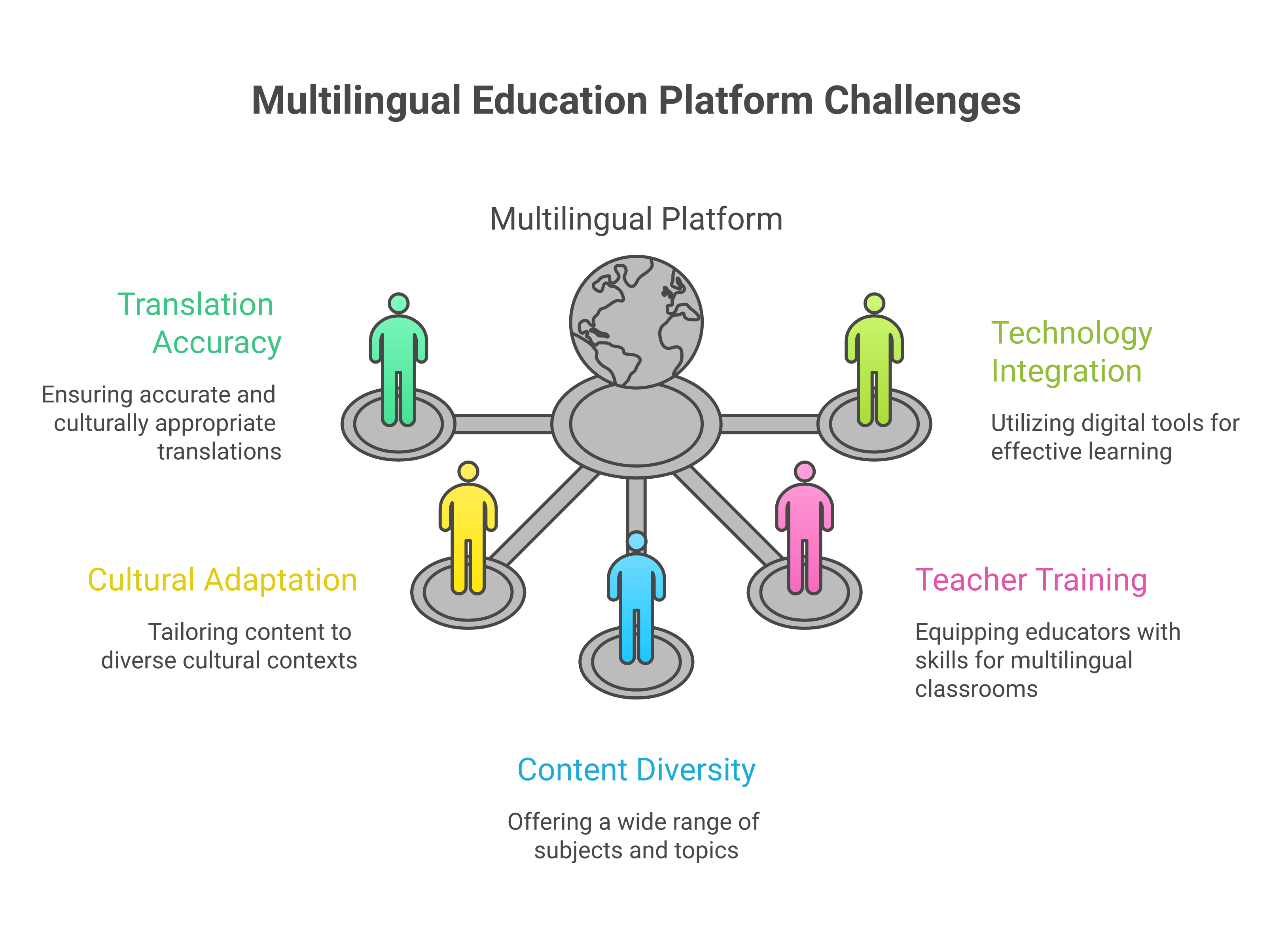
India's own National Education Policy 2020 reflects this evidence. It says that, wherever possible, the home language, mother tongue or local language will be the medium of instruction until at least Grade 5, and preferably until Grade 8 and beyond. UNESCO devoted its 2025 flagship India report, Bhasha Matters: State of the Education Report for India 2025, entirely to mother-tongue and multilingual education, arguing that in a country home to 1,369 languages, learning in a language children understand is "the foundation for educational inclusion, linguistic diversity preservation and enhanced learning outcomes." If the national framework for school education now rests on first-language learning, it is hard to justify a development sector that trains its own practitioners only in English. When ImpactMojo committed to making content available in Hindi, Tamil, Bengali, Telugu, and Marathi, we knew translation alone would not do. Each language carries its own intellectual traditions, pedagogical conventions, and cultural references, so adapting a concept means changing its examples and teaching approach as well as its words. What we learned in the process has fundamentally shaped our understanding of accessible education.
The translation trap
The usual approach to multilingual content is straightforward translation: take the English original, hire translators or run a machine pass, produce versions in the target languages. It is fast and cheap, and it often produces content that feels alien to native speakers. Technical terms are either left in English, which leaves sentences hard to follow for those who need the translation most, or turned into formal literary equivalents that few practitioners use.
Take the term "theory of change." In Hindi, the literal translation, parivartan ka siddhant, is grammatically correct but carries philosophical connotations that distract from the practical tool being described. Working with Hindi-speaking development professionals, we found that most use a hybrid: "theory of change" in English embedded in Hindi sentences, or the descriptive phrase badlav ki soch (thinking about change). Our Hindi content uses the term practitioners actually use, where a translation algorithm produces the literal one. Machine translation makes this kind of error at scale. In the bulk pass over this site's Hindi, Tamil, Bengali and Marathi course pages it rendered "development practitioner" as "doctor/physician" and "Evidence-Based Practice" as "medical treatment", and correcting such errors took several review rounds. A protected-terms glossary now keeps brand names, acronyms, author names and numbers intact.
Tamil presents different challenges. The language has a strong purist tradition that resists English borrowings, and Tamil-speaking evaluators use their own technical vocabulary (mathippeedu, மதிப்பீடு, for evaluation and kankaanippu, கண்காணிப்பு, for monitoring) that is well-established within the professional community. Ignoring this vocabulary in favour of transliterated English terms alienates precisely the audience we aim to serve.
"Translation is not finding equivalent words. It is finding equivalent understanding. The best multilingual content sounds like it was originally written in each language." Our lead content localisation specialist
Cultural adaptation beyond language
Language is the most visible dimension of localisation, and cultural adaptation runs deeper. Examples and case studies that resonate in one context may fall flat in another. A monitoring example using a watershed programme in Maharashtra connects immediately with Marathi-speaking learners but may mean little to someone in coastal Bengal. A gender analysis framework illustrated through dowry practices is relevant across North India but requires different framing in matrilineal communities of Kerala or Northeast India.
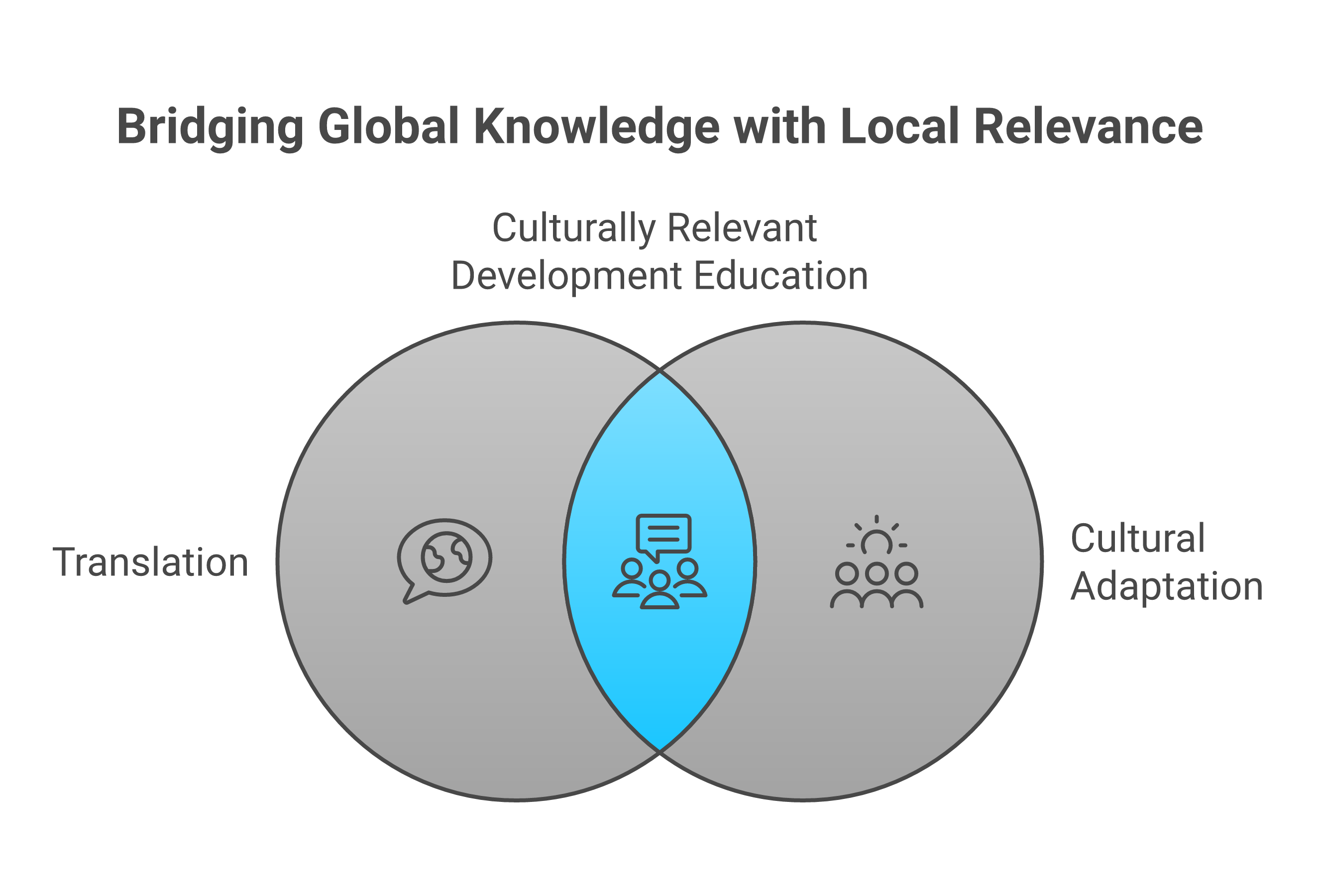
We learned to build content in layers. The core conceptual framework stays the same across languages: the principles of sampling, the logic of theory of change, the steps of a monitoring framework. The illustrative layer (examples, case studies, practice exercises) is the part that needs adapting for each linguistic and cultural context. Bengali content draws on examples from aquaculture, garment sector livelihoods, and cyclone preparedness. Telugu content references watershed programmes, rice cultivation, and Telangana's distinctive administrative structures. This approach requires more effort than simple translation, and the difference in learner engagement is dramatic.
Technical challenges of multilingual platforms
Building a multilingual web platform introduces technical challenges that monolingual developers rarely encounter. Text rendering across Indian scripts requires careful font selection, because not all web fonts support the conjunct characters and ligatures that Devanagari, Tamil, Bengali, and Telugu scripts require. When a reader switches language, the site loads a Noto Sans face for that script. We tested extensively to ensure that technical content renders correctly across browsers and devices, particularly on lower-end Android phones that our users commonly use.
Text expansion is another practical challenge. Hindi and Tamil translations of English text are typically 20-30% longer. Interface elements, buttons, and navigation labels designed for English may overflow or break when translated. Our CSS uses flexible layouts and rem-based sizing to accommodate text expansion without manual adjustment for each language.
Right-to-left (RTL) support is not needed for our five languages, but adding Urdu, widely used in Pakistan and parts of India, would require significant layout adaptation.
Navigation needs attention too. Navigation labels and other interface strings are translated, so a reader who switches to Tamil meets Tamil navigation.
What the numbers tell us
Since launching multilingual content, our analytics reveal patterns that validate the investment. Hindi content accounts for 35% of total page views, which is unsurprising given Hindi's speaker base, but notable because our Hindi learners spend 40% more time per session than English-language learners, suggesting deeper engagement over casual browsing. Tamil and Bengali content shows similar engagement depth. Telugu and Marathi, launched more recently, are growing steadily as word spreads through professional networks in those states.
Most tellingly, completion rates for courses are significantly higher when learners use their first language. The evaluation methods course, which has a 45% completion rate in English, achieves 62% in Hindi and 58% in Tamil. The content is no easier in these languages, and the conceptual rigour is identical. The likely reason is that the cognitive load of simultaneously learning new concepts and processing a second language is burdensome. Our own numbers are modest and platform-specific, but they echo a much larger evidence base.
The wider evidence points the same way. The UNESCO–ADEA policy brief Why and How Africa Should Invest in African Languages and Multilingual Education argues that mother-tongue-based education has "a real intrinsic value and worth" beyond emotional attachment to identity and culture. For India, the main evidence on early reading comes from Pratham's annual ASER surveys of children's foundational reading and arithmetic. They test children in their state's language and show where reading falls behind. Kerala and Tamil Nadu are among the states that have consistently posted strong reading outcomes, and both have invested in instruction through the regional mother tongue (Malayalam, Tamil) rather than defaulting to English. ASER does not by itself show which medium of instruction works better, so this is an association. One widely cited explanation of why a first language helps comes from Jim Cummins, whose linguistic interdependence hypothesis argues that the deeper, cognitively demanding skills of literacy and abstract reasoning sit in a "common underlying proficiency" shared across a learner's languages, so concepts grasped in a first language transfer to the second, rather than having to be rebuilt from scratch. Remove the language barrier, and that shared foundation does more of the work. This also bears on what makes open educational resources usable in practice.
Lessons for others
For other platforms considering multilingual content in South Asian languages, our core advice is to plan it as a content creation project that draws on a shared conceptual framework. Invest in native-speaking subject matter experts as well as translators. Budget for cultural adaptation as well as linguistic conversion. Test with real users in each language. And be prepared for the work to take two to three times longer than you expect, but to produce results that justify every hour invested. The development sector cannot claim to serve South Asia while speaking only in English. The World Bank's 2021 review of language-of-instruction policies, which concerns children, states the principle plainly: children learn more and are more likely to stay in school if they are first taught in a language that they speak and understand. Effective learning by doing demands that practitioners can engage with materials in the language they think in. You can see how we put this into practice across the ImpactMojo course catalog, free in every language we publish.