The Access Problem
Development education in South Asia faces a fundamental access problem. The courses, certifications, and training programmes that build professional capacity in monitoring, evaluation, research, and programme management are overwhelmingly concentrated in expensive institutions — international universities, private training companies, and exclusive fellowship programmes. A mid-career programme officer at an NGO in Patna earning Rs 25,000 per month cannot afford a $2,000 online evaluation course from a Western university. Yet this is precisely the person who most needs practical skills in programme design and evidence-based decision-making.
The result is a two-tier development sector. Well-funded international NGOs and consulting firms have staff trained in the latest methodologies. Grassroots organisations — the ones closest to communities and often most effective at delivery — operate with minimal technical capacity. This capacity gap perpetuates dependency: grassroots organisations rely on external consultants for evaluation, data analysis, and research design, transferring both resources and agency away from those best positioned to use them. Across the South Asian development landscape, this pattern repeats in country after country.
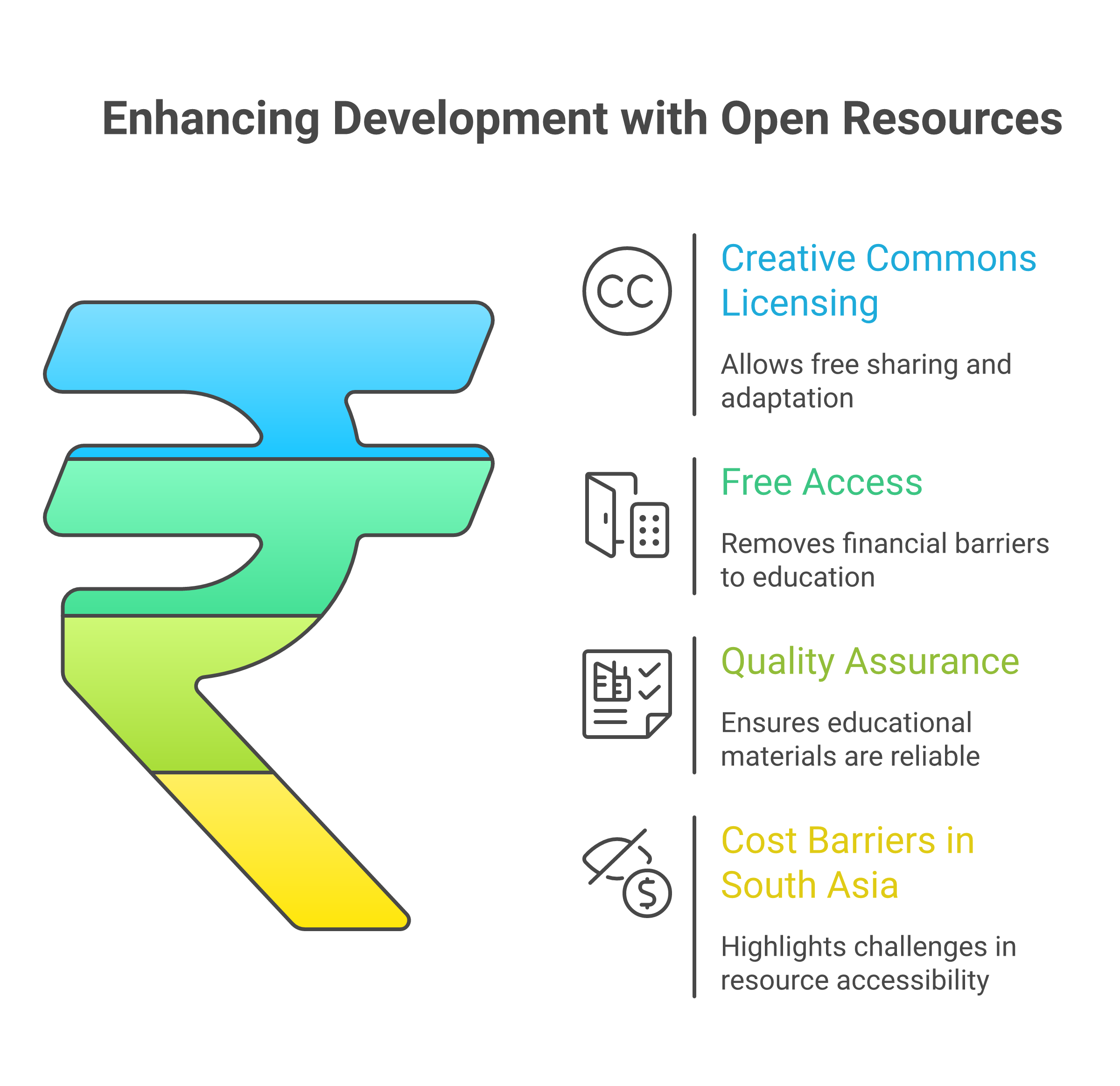
Open Educational Resources (OER) offer a powerful response to this access problem. As the Hewlett Foundation — which coined the term in 2002 — defines them, OER are teaching, learning, and research materials that reside in the public domain or have been released under an open licence permitting no-cost access, use, adaptation, and redistribution. By making high-quality learning materials freely available under Creative Commons licences, the OER movement removes the financial barriers that exclude the majority of development professionals from continuous learning. But openness alone is not enough — the resources must also be relevant, contextual, and pedagogically effective.
The OER Movement: A Brief History
The open education movement traces its roots to MIT's OpenCourseWare initiative, announced in 2001, piloted with 64 courses in 2002, and formally launched in 2003 — it now publishes materials from over 2,500 MIT courses freely online. Since then, the movement has grown dramatically. The UNESCO Recommendation on OER, adopted by member states in 2019, became the first international standard-setting instrument on OER, urging governments to build supportive policies for the creation, access, and redistribution of openly licensed educational resources. Advocacy coalitions such as SPARC have pushed the same agenda across open access, open data, and open education. OER is the teaching-and-learning sibling of the open access movement in research publishing — a movement whose canonical primer, Peter Suber's Open Access (MIT Press, 2012), is itself freely readable online, practising what it preaches.
In South Asia, the OER movement has gained significant momentum. India's National Programme on Technology Enhanced Learning (NPTEL) — a joint initiative of the IITs and IISc launched in 2003 — offers more than 3,000 free engineering and science courses for self-study, with certification optional. The National Repository of Open Educational Resources (NROER), run by CIET-NCERT and launched in 2013, hosts CC BY-SA-licensed materials aligned with Indian school curricula in multiple languages. Bangladesh's Aspire to Innovate (a2i) programme has built open learning platforms in Bangla. And platforms like ImpactMojo are extending the OER model specifically to development sector professional education.
Creative Commons licences are the legal infrastructure that makes OER work. A CC BY licence allows anyone to copy, redistribute, remix, and build upon the material, provided they give credit to the original creator. A CC BY-SA licence adds the requirement that derivative works use the same licence, ensuring the material remains open. Open education theorist David Wiley captures what these licences grant in his widely cited "5 Rs" of open content — the rights to retain, reuse, revise, remix, and redistribute a resource. It is precisely the revise and remix permissions that enable the localisation, translation, and contextualisation that make educational resources genuinely useful across diverse South Asian contexts — a principle explored further in our piece on multilingual learning.
The animating idea is simple: education is not a commodity to be traded but a public good to be shared — and open educational resources put that principle into practice. The Cape Town Open Education Declaration (2007), one of the movement's founding statements, argues that "publicly funded educational resources should be open educational resources" and calls on educators and institutions to share their work openly. The 2019 UNESCO Recommendation later codified that ethic, framing OER as a tool for achieving Sustainable Development Goal 4: inclusive, equitable, quality education for all.
Quality and Contextualisation
The most common criticism of OER is that free means low quality. This criticism has some basis — the internet is full of poorly designed, inaccurate, and pedagogically ineffective educational materials. But the equation of free with low quality reflects a misunderstanding of the OER model. The best OER is developed with the same rigour as commercial educational content, reviewed by subject matter experts, tested with learners, and iteratively improved based on feedback. The empirical record bears this out: John Hilton III's 2016 review of efficacy research, published in Educational Technology Research and Development, found that students using OER "generally achieve the same learning outcomes" as those using commercial textbooks "and simultaneously save significant amounts of money." When free material is built well, learners do not pay a quality penalty for paying nothing.
The more fundamental quality challenge for South Asian OER is contextualisation. A monitoring and evaluation course developed for American graduate students, even if openly licensed, is not immediately useful for a programme officer in Chhattisgarh. The examples are from different contexts. The regulatory frameworks are different. The resource constraints are different. The cultural dynamics of data collection are different. Effective OER for South Asian development professionals must be developed with and for the South Asian context — not simply translated or copied from materials designed elsewhere.
This is why platforms that create original, contextualised content for the South Asian development sector fill a critical gap. When a course on sample size determination uses examples from Indian government surveys rather than American clinical trials, it is immediately more relevant and accessible. When a game about theory of change uses scenarios from rural Maharashtra rather than suburban London, learners engage more deeply. Context is not decoration — it is pedagogy.
Beyond Content: Open Pedagogy
The most exciting frontier of open education is not just open content but open pedagogy — approaches to teaching and learning that leverage openness as a fundamental principle. In open pedagogy, learners are not just consumers of pre-built content but contributors to the knowledge commons. This is the essence of learning by doing. They create, remix, critique, and improve educational resources as part of their learning process.
For development education, open pedagogy has profound implications. A monitoring and evaluation course could ask learners to build their own frameworks using tools like the MEL Lab, or develop case studies from their own organisations, which then become part of the course's resource library for future cohorts. A data analysis course could have learners clean and analyse real datasets from development programmes, contributing to both their learning and the evidence base. A research methods course could ask learners to critique and improve existing course materials, developing critical analytical skills while strengthening the resource.
The Road Ahead
The OER movement in South Asian development education is still young, but the trajectory is promising. As internet access expands — India's active internet user base has now crossed 900 million, with much of the recent growth coming from rural users and Indian-language content — the potential audience for quality open educational content grows enormously. The challenge is no longer access to technology but access to relevant, high-quality content that speaks to the realities development professionals face every day. Building that content base, maintaining it, and continuously improving it through learner feedback and peer review is the work that platforms like ImpactMojo are committed to. Because when a programme officer in Patna can access the same quality learning as a consultant in London, the entire development sector becomes stronger.
Every course in the ImpactMojo catalog is part of that commons: free, openly licensed, and built to be reused.