The courage to follow the evidence
In development work, pivoting is hard. Organisations invest years building programmes, training staff, developing materials, and cultivating donor relationships around a particular theory of change. When monitoring data suggests the theory is wrong, or that a different approach would be more effective, the institutional pressure to ignore the evidence can be overwhelming. Yet the organisations that have the courage to follow the data, even when it is uncomfortable, often achieve the strongest outcomes.
These three stories from Indian development illustrate what happens when M&E systems work as they should: they track outputs for donor reports and also generate actionable insights that reshape programme strategy. The gap between producing data and actually using it is well documented: MEASURE Evaluation's data demand and use framework, written for health information systems, makes the point bluntly: building systems that capture quality data is only half the task, and decision-makers also have to want to use the data and be equipped to act on it. Each story below relies on strong data quality as the foundation. Each is drawn from published research and documented organisational trajectories. Each involves a moment of reckoning, when leaders confronted evidence that challenged their assumptions and chose to act on it rather than explain it away.
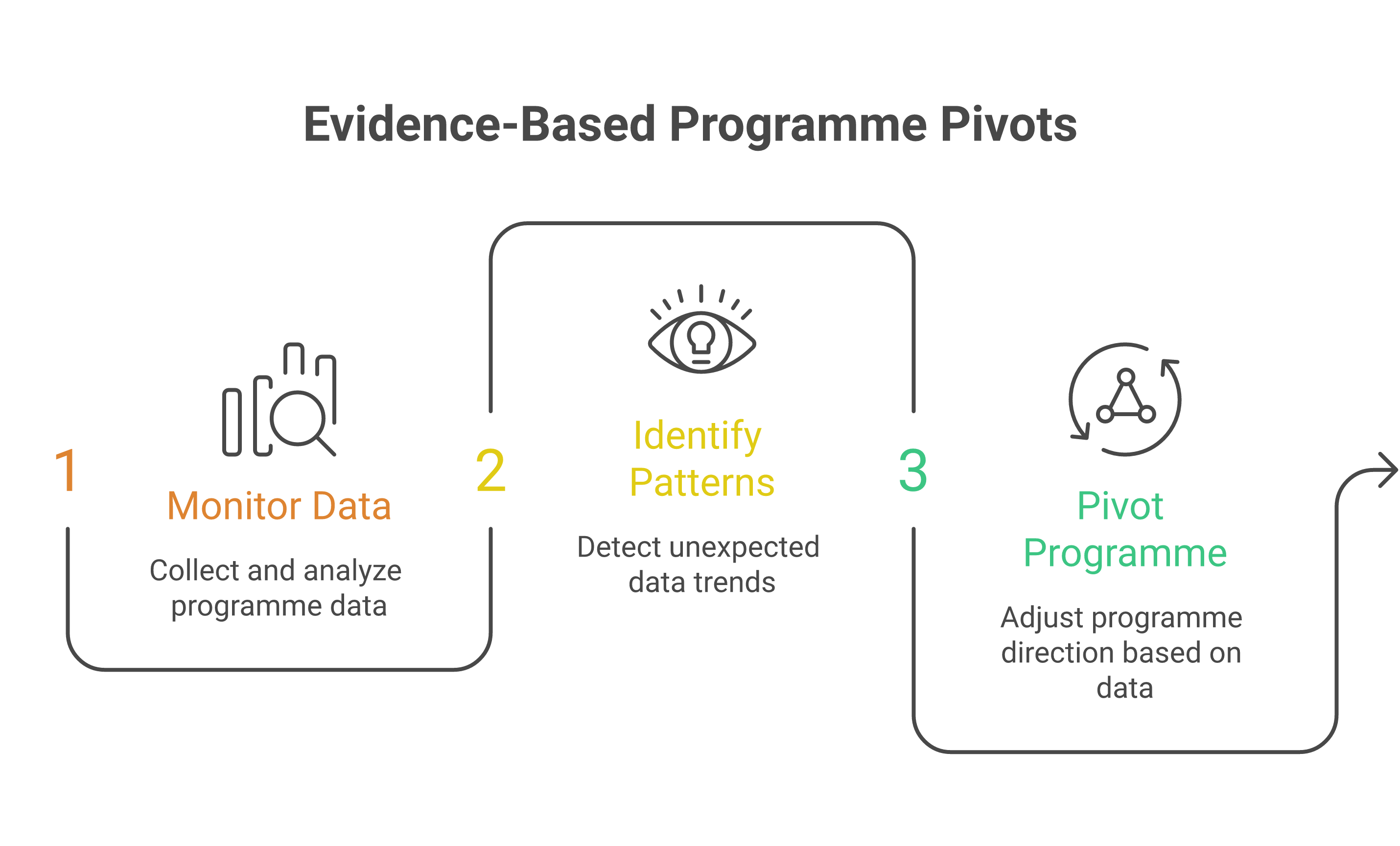
Story one: India's ICDS, the nutrition system that fed households instead of children
India's Integrated Child Development Services (ICDS) is the world's largest early childhood programme. On 28 February 2025, 10.12 crore (about 101 million) beneficiaries were registered on its Poshan Tracker app, served through roughly 14 lakh Anganwadi centres. When the World Bank studied the programme in 2005, the Supplementary Nutrition Programme (SNP) accounted for about two-thirds of its total cost, and food did reach children: an average of about 20 to 80 children per centre ate there, depending on location, and in most states 20 to 25 per centre also took food home. Output numbers were staggering: millions of meals served, millions of take-home ration packets distributed, hundreds of thousands of health workers deployed. By every activity metric, ICDS was succeeding at enormous scale. This is exactly the trap that anthropologist Marilyn Strathern distilled, in a 1997 paper, into the popular phrasing of Goodhart's law: "when a measure becomes a target, it ceases to be a good measure." Meals served and packets distributed had become the targets, and the system optimised for them, so the nutritional outcome they were meant to proxy got less attention. The Bank's authors saw a "food bias" in ICDS: staff and beneficiaries alike treated food distribution as if it were the whole nutrition effort.
Then came the outcome data. A landmark World Bank assessment by Gragnolati, Shekar, Das Gupta, Bredenkamp & Lee (2005), India's Undernourished Children: A Call for Reform and Action, documented what field workers had long suspected but the system had not confronted. About 60 million children in India were underweight, and undernutrition had fallen only modestly during the 1990s, lagging countries with similar economic growth. In a multivariate model of data from Kerala, Rajasthan and Uttar Pradesh collected between 2000 and 2002, children in villages with an Anganwadi centre were not significantly less likely to be underweight or ill than other children. Anaemia among pregnant women remained stubbornly high. The programme was distributing food, but children were not becoming noticeably less malnourished.
The deeper analysis was revealing. Take-home rations were being shared across entire households: a rational response by families where everyone was hungry, but one that diluted the nutritional impact on the target child or pregnant mother. In Madhya Pradesh only about a third of children consumed all of it themselves, a third consumed less than a quarter, and 6% consumed none. Anganwadi workers could spend up to 40% of their time on supplementary nutrition and a further 39% on preschool education, which left little for growth promotion, nutrition education and home visits. Most children under three, the group that suffers most from malnutrition, were not reached with counselling on feeding and child care. Where counselling was delivered, it was in group settings where women felt unable to ask about sensitive topics, and overburdened workers spent just minutes per household on it. In the authors' words, ICDS had given "more attention to increasing coverage than to improving the quality of service delivery."
The evidence catalysed a generation of reforms. Alive & Thrive, funded by the Gates Foundation and managed by FHI 360, gives technical support to the Uttar Pradesh State Nutrition Mission on maternal and infant and young child nutrition. POSHAN Abhiyaan, launched on 8 March 2018, gave Anganwadi workers a mobile application for service delivery and monitoring, added nutrition counselling training, and tied a monthly incentive to home visits and growth monitoring. And IDinsight's 2021 report on Take Home Ration in Rajasthan and Jharkhand cites its own surveys finding that about a third of eligible beneficiaries in Rajasthan reported receiving the ration in January 2020, against about two-thirds in Jharkhand. The data had been painful, but it pointed the way to a nutrition system that could actually work.
Sources: Gragnolati et al. (2005), India's Undernourished Children: A Call for Reform and Action, World Bank; Alive & Thrive page, Uttar Pradesh National Health Mission; Press Information Bureau release on the Poshan Tracker (March 2025); IDinsight (2021), Improving the Implementation of the Take Home Ration Programme Under ICDS; World Bank, Overview of POSHAN Abhiyaan.
"However, more attention has been given to increasing coverage than to improving the quality of service delivery and to distributing food rather than changing family-based feeding and caring behavior. This has resulted in limited impact.": Gragnolati et al., World Bank (2005)
Story two: JEEViKA in Bihar, where the evaluation measured more than income
JEEViKA (the Bihar Rural Livelihoods Project, one of India's largest NRLM implementations) worked through a clear chain: mobilise poor women into Self-Help Groups (SHGs), link them to bank credit, build their financial capabilities, and household income will rise. Its stated objective in the World Bank's 2006 appraisal was "to enhance social and economic empowerment of the rural poor in Bihar", with three key indicators: self-managed community institutions for most participant households, higher income, and less high-cost informal debt. From 2008 to 2011 the project mobilised more than 1.8 million women into 154,626 SHGs. The programme tracked the expected indicators: savings accumulated, loans disbursed, enterprises started, monthly income from SHG-linked activities.
The income data was modest. A rigorous evaluation by Datta (2015), using a retrospective baseline survey, an endline survey in late 2011 and propensity score matching, published in World Development, found a small shift towards cheaper loans and borrowing for productive needs, and more savings. The World Bank's note on the study reports no effect on land ownership or housing quality and consumption patterns similar in treatment and control villages, and puts the mixed results down partly to a short evaluation horizon. Datta's abstract adds some significant results on assets, food security and sanitation. The programme seemed to be helping households manage debt and money better rather than generating new income, and some observers began questioning whether the massive investment was justified.
The same evaluation measured something an income-only reading would have missed. Datta's own highlights report "significant and robust results on the empowerment levels of beneficiary women", measured by mobility, decision making and collective action, including gram sabha attendance. The World Bank's note on the study says JEEViKA "has greatly improved women's mobility, participation in decision making and propensity to engage in community based collective action." It reports that 5% more women in project areas go to health centres and attend regular gram sabha meetings, and that 18 to 20% more have a say in the political preferences of their households. The programme's real impact lay in the social and political sphere more than the economic one. The SHG meetings had become spaces where women developed collective agency, voice, and public presence.
Empowerment was in the programme's objective from the start, so the evaluation's value lay in measuring it beside income and debt. Read on income alone, the results would have looked like a modest return on a large investment; read against the full objective, they show where the programme was working. A cost study puts JEEViKA at more than 11 million women by 2018-19, with average annual spending per member falling from almost $60 in 2007 to $6 in 2018. JEEViKA is one of the most studied livelihoods programmes in the global South.
Sources: Datta, U. (2015), "Socio-Economic Impacts of JEEViKA: A Large-Scale Self-Help Group Project in Bihar, India," World Development, Vol. 68, pp. 1–18; Hoffmann, V., Rao, V., Surendra, V. & Datta, U. (2021), "Relief from Usury: Impact of a Self-Help Group Lending Program in Rural India," Journal of Development Economics; World Bank (2020), Measuring Empowerment: JEEViKA's Success in Empowering the Women of Rural Bihar, Impact Note; Siwach, G., Paul, S. and de Hoop, T. (2021), Implications of Scale for Program Costs and Cost-Effectiveness: Evidence from JEEViKA, Evidence Consortium on Women's Groups.
Story three: Pratham, the education organisation that chose depth over breadth
Pratham is India's largest education NGO, and one of the few that has publicly, rigorously, and repeatedly documented its own scaling failures. Its sequence of trials with J-PAL researchers is among the best documented in the sector. Its flagship Read India programme, rolled out in 2007, reached over 33 million children within two years. The organisation's dashboard showed impressive and growing reach, and donors were enthusiastic.
Then Pratham did something unusual: it evaluated itself candidly. Using data from ASER (the Annual Status of Education Report, which Pratham itself created) and a series of randomised evaluations of Read India conducted with J-PAL researchers, documented in Banerjee, Banerji, Berry, Duflo et al. (2017), "From Proof of Concept to Scalable Policies," published in the Journal of Economic Perspectives. The pattern was mixed. Volunteer-led classes outside school hours produced large gains in Jaunpur, Uttar Pradesh. In Bihar and Uttarakhand, where the programme moved into regular classes with government teachers, the materials-only and materials-plus-training versions had no effect on language scores. In Bihar over 80 percent of teachers were trained and used the materials more than half the time, so the programme kept its form but lost its central feature, since only 0 to 4 percent of regular classes were grouped by learning level. Scale had come at the cost of the implementation quality that made the programme work. A one-month summer camp run by the same government teachers did raise scores, which the authors read as a sign that teachers can deliver the method when it is the point of the exercise. Lant Pritchett, Michael Woolcock and Matt Andrews use the term isomorphic mimicry for institutions that adopt the outward form of a functioning organisation while the function is missing. Their examples come from government capability, and applying the idea to Read India is an interpretation.
Pratham's leadership faced the hardest question in development: do you keep the big numbers, or do you keep the impact? They chose impact. Rather than continuing to scale a diluted version of Read India, Pratham tested new designs of what it calls Teaching at the Right Level (TaRL). In Haryana in 2012-13, during a state-mandated extra hour in the school day, children in grades 3 to 5 were regrouped by level and taught by their own teachers, supervised by government coordinators, and Hindi scores rose by 0.2 levels. In Uttar Pradesh in 2013-14, Pratham tested in-school learning camps of 10 or 20 days, run by Pratham staff and trained local volunteers while regular teaching was suspended, for 50 days a year. Test scores rose by 0.7 to 1.0 levels, and the share of children who could read a paragraph or story rose from 24% in the control group to 49%. The model concentrated instruction into short, intensive learning camps, grouped children by their actual learning level whatever their grade, and used a simpler design that could survive the move from NGO volunteers to government teachers. It was smaller per round but dramatically more effective per child.
The results vindicated the approach: the randomised evaluations found large gains on basic literacy and numeracy, large by any education-research standard. Bihar's government announced Mission Gunvatta in April 2013, regrouping children in standards 3 to 5 by learning level for two hours a day, building on earlier pilots with Pratham in Jehanabad and East Champaran. Reach grew as well: Pratham's state partnerships covered 6.7 million children in 15 states in 2017-18 and 15.6 million in 2018-19, according to a 2023 Harvard Kennedy School working paper that studies Pratham as a case of adaptive design and evaluation. Pratham's willingness to document its own scaling problems publicly and rebuild around a more defensible model is studied there as a case in how development organisations learn while scaling.
Sources: Banerjee, A., Banerji, R., Berry, J., Duflo, E. et al. (2017), "From Proof of Concept to Scalable Policies: Challenges and Solutions, with an Application," Journal of Economic Perspectives, Vol. 31(4), pp. 73–102; Banerjee, A. et al. (2007), "Remedying Education: Evidence from Two Randomized Experiments in India," Quarterly Journal of Economics; Fahsbender, J., Gokhale, S. and Walton, M. (2023), "How Pratham Learns While Scaling: A Case Study of Adaptive Design and Evaluation," Harvard Kennedy School CID Faculty Working Paper No. 438; Banerji, R., Ideas for India, "Education reform and frontline administrators: a case study from Bihar II".
What these stories teach us
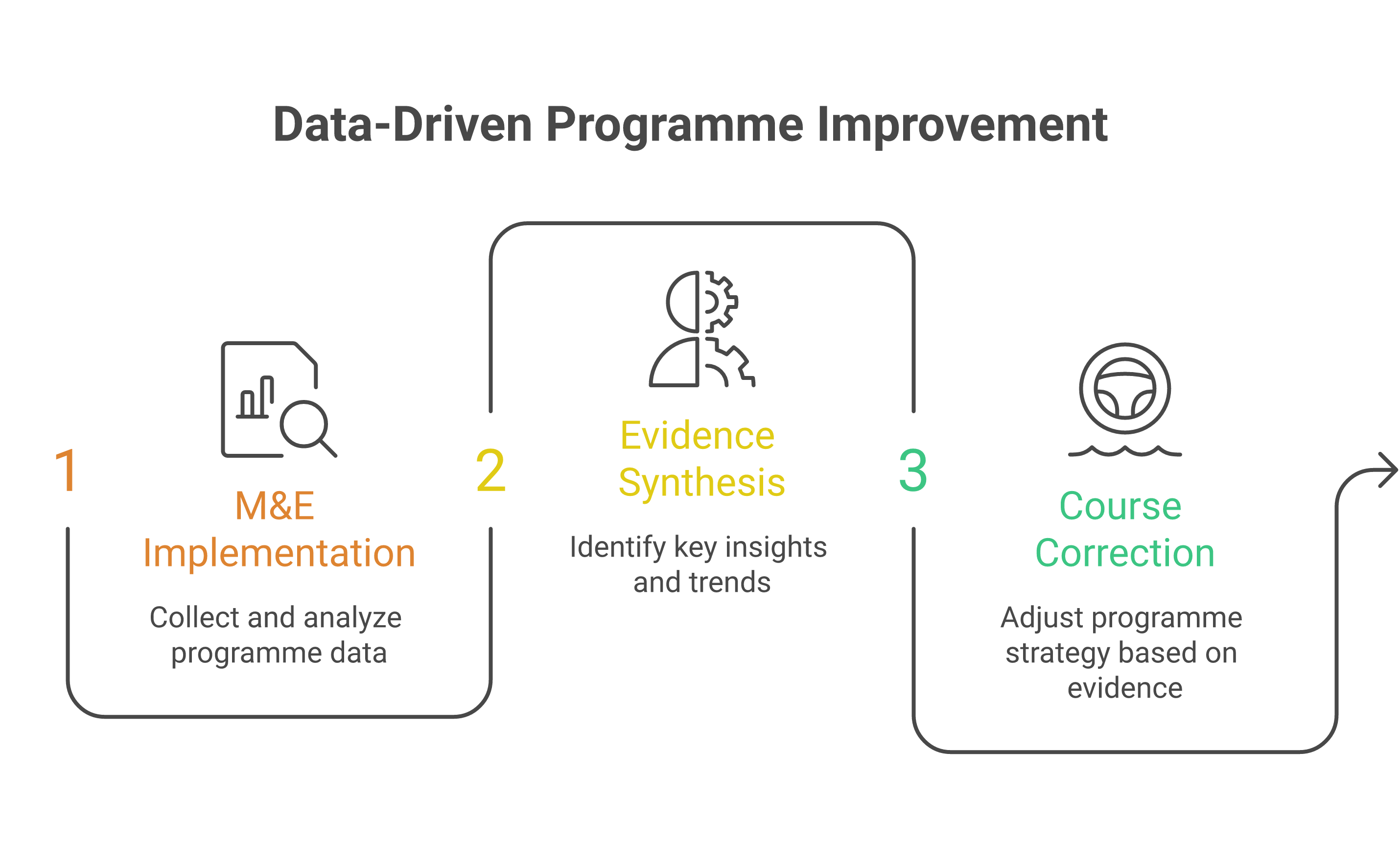
These three pivots share common features. Each required an M&E system capable of generating uncomfortable truths, underpinned by strong indicators that actually matter. As the World Bank's chief statistician Haishan Fu puts it, "you can't course-correct what you can't see", and seeing clearly meant building data systems that surfaced outcomes as well as outputs. Each required leaders willing to act on evidence even when it contradicted institutional narratives, drawing on the kind of learning culture that makes honest inquiry possible. And each ultimately strengthened the organisation, and the pivot was part of the reason.
All three are in the public record because the organisations and researchers involved chose to publish the findings, including the failures. ICDS's delivery problems are documented in a World Bank discussion paper. JEEViKA's mixed economic results are in a peer-reviewed journal and a World Bank note. Pratham's scaling problems are in the Journal of Economic Perspectives. The development sector needs more of this: honest accounts of what the data showed and what was done about it, alongside the success stories. Each is open to anyone who wants to check the figures against the source.
If you want to build the evaluation skills behind stories like these, our free MEL course, The Evidence Question, works through evidence-based decision-making end-to-end.