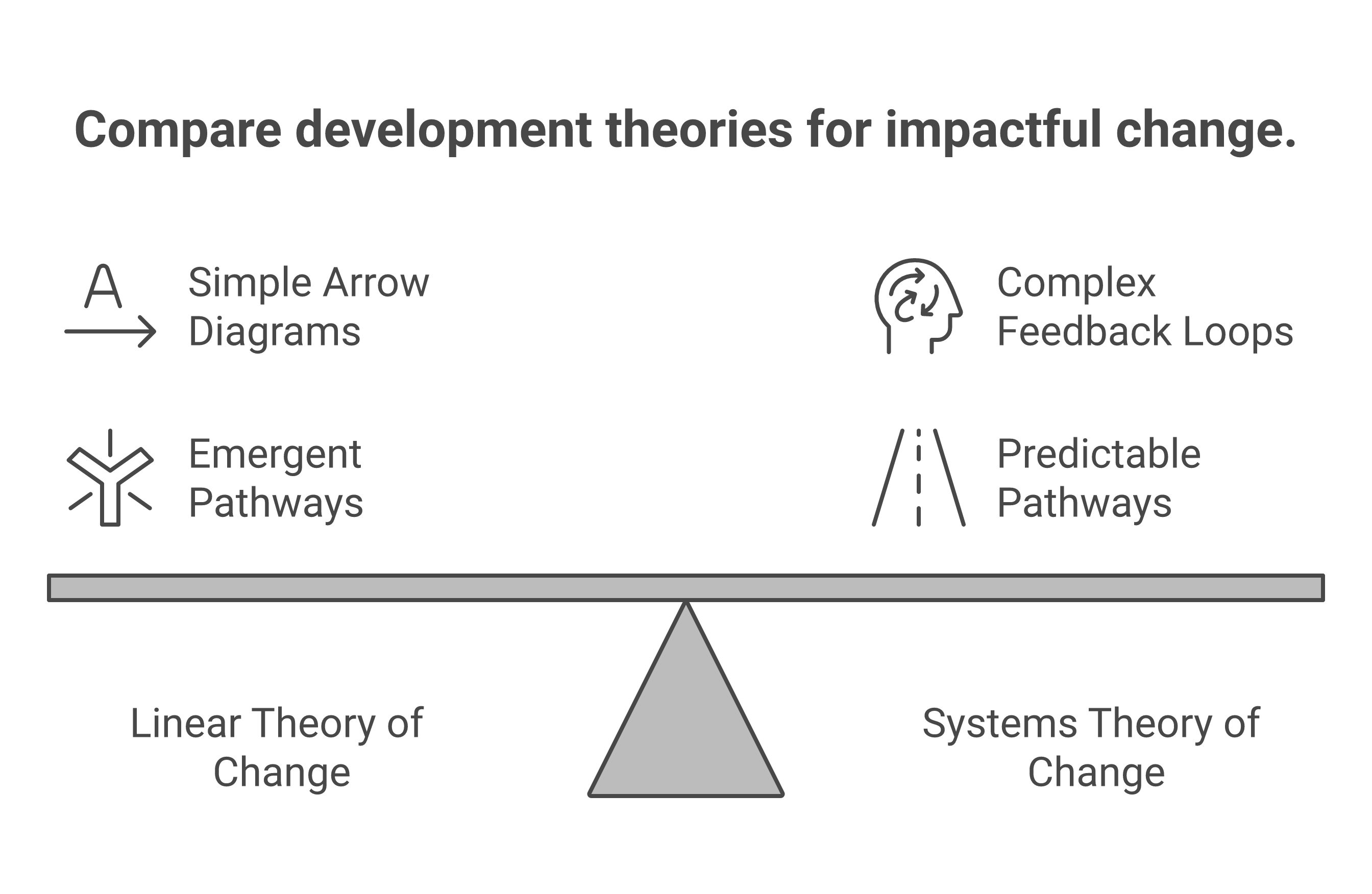
Most theories of change follow a reassuringly linear logic: if we do A, then B will happen, leading to C. Activities produce outputs, outputs lead to outcomes, outcomes create impact. The arrows point one way. The pathway is clear.
For simple interventions (distributing bed nets, building latrines) this linearity works well enough. But for complex programmes that aim to change systems, behaviours, or power structures, linear ToCs are inadequate, and actively misleading. Evaluation scholar Patricia Rogers makes a useful distinction here: some aspects of an intervention are complicated (multiple components, agencies and causal strands), while others are complex, involving recursive causality with reinforcing loops, tipping points and emergent outcomes that no logframe can foresee (Rogers, "Using Programme Theory to Evaluate Complicated and Complex Aspects of Interventions", Evaluation, 2008). Many of the common ToC pitfalls stem from forcing linear logic onto processes that fall in that second category.
When linearity breaks down
Complex programmes operate in systems where multiple actors interact, feedback loops create unexpected dynamics, and the same intervention can produce different results in different contexts. Dave Snowden and Mary Boone's Cynefin framework (Harvard Business Review, 2007) names this directly: in complex contexts, cause and effect can only be understood in retrospect, so the right approach is to probe, sense, and respond rather than to plan the whole pathway in advance. Health system strengthening, governance reform, behaviour change communication, and market systems development all exhibit these characteristics.
Consider India's National Rural Health Mission and its Accredited Social Health Activist (ASHA) programme. A linear ToC might read: train ASHAs → ASHAs provide health education → communities adopt healthier practices → health outcomes improve. But in practice ASHA effectiveness tends to depend on community trust, which is bound up with caste dynamics and local power structures: factors the programme does not control. A qualitative study of ASHA home visits in four villages of rural Uttar Pradesh (Blanchard and colleagues, International Journal for Equity in Health, 2021) found that ASHAs built trusting relationships and encouraged poorer and lower-caste women to give birth in public health centres. Many of those women then met insufficient emergency obstetric care, mistreatment by staff and costly referrals, and the authors attribute persisting inequities to "overlapping contextual issues beyond the ASHAs' purview". The arrow from training to outcomes depends on things the ASHA does not control. Donella Meadows' essay on leverage points makes a related point: where you intervene in a system shapes the result. She ranks parameters such as subsidies, taxes and standards as "the points of least leverage", well below the strength of feedback loops, and a community health worker sits inside feedback loops that a one-way arrow cannot show. The pathway looks more like a web than a line.
Systems thinking approaches
Contribution analysis, developed by Canadian evaluator John Mayne, offers an alternative to attribution. Instead of asking "did our intervention cause this outcome?" it asks "did our intervention make a credible contribution to this outcome, given everything else that was happening?" Mayne's method builds a plausible "contribution story" through iterative steps rather than claiming sole credit (Mayne, "Addressing Attribution through Contribution Analysis", Canadian Journal of Program Evaluation, 2001). This is more honest, and more useful, for complex programmes.
Outcome mapping, developed by Sarah Earl, Fred Carden and Terry Smutylo at Canada's IDRC, focuses on changes in the behaviour of actors the programme interacts with directly, what they call "boundary partners", rather than on ultimate impact (Earl, Carden & Smutylo, Outcome Mapping, IDRC, 2001). This acknowledges that programmes influence but do not control the actions of others.
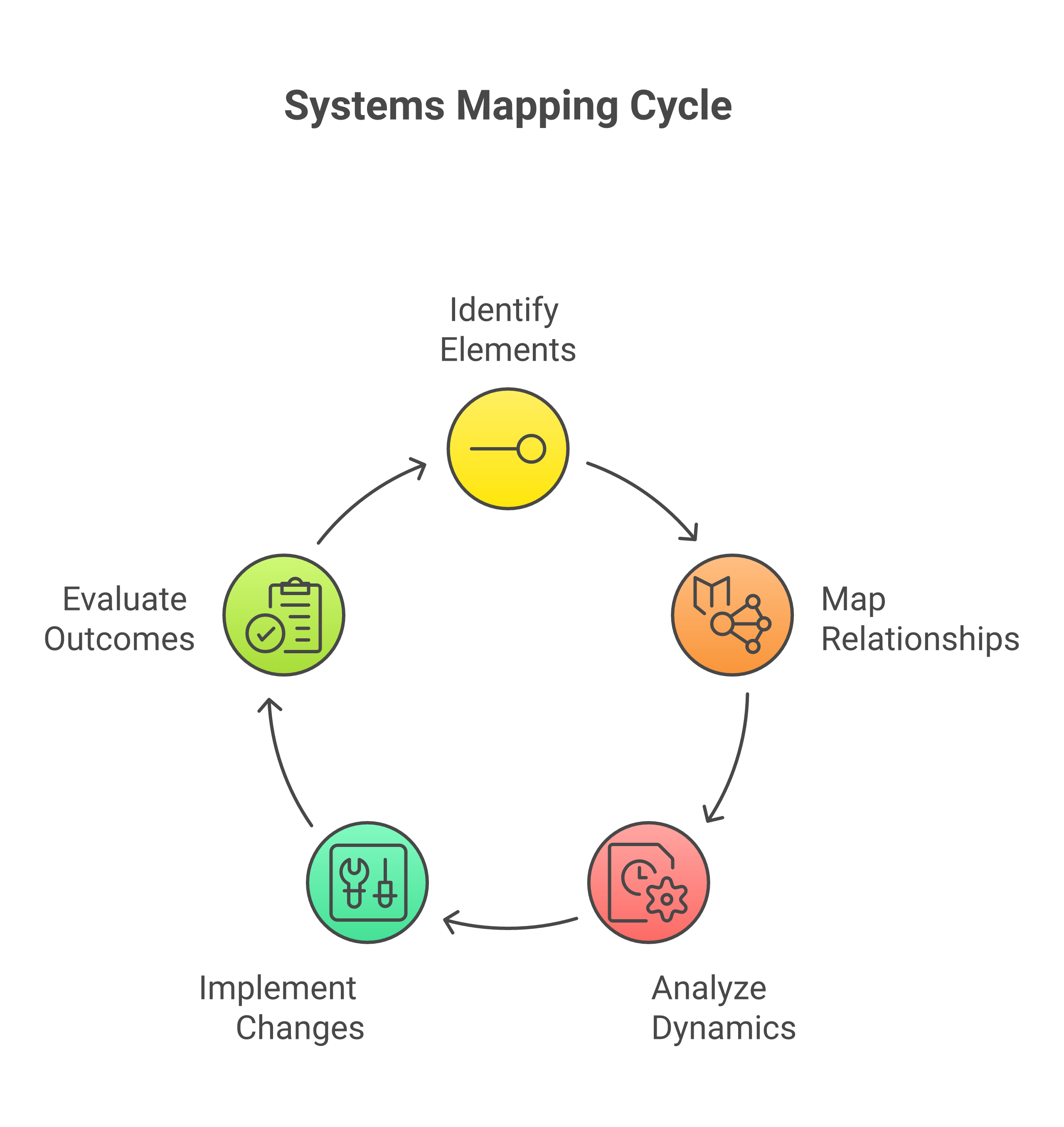
Causal loop diagrams, a staple of system dynamics, map feedback relationships explicitly. When training leads to behaviour change, which leads to community demand, which leads to government response, which creates an enabling environment for further behaviour change: a causal loop diagram captures this circularity in ways a linear ToC cannot. It is the same systems lens Meadows uses to argue that the structure of feedback loops often matters more than the size of inputs in determining how a system behaves. In her ranking of places to intervene in a system, the strength of feedback loops sits well above adjusting numbers such as subsidies and taxes.
Signs your programme needs a complex ToC
- Multiple organisations and sectors are involved
- Success depends on behaviour change by actors you don't control
- Context varies significantly across implementation sites
- Feedback loops and unintended consequences are likely
- The problem itself is contested or poorly defined
"A theory of change that looks neat and complete should make you suspicious. Real change is messy, and honest theories reflect that."
Emergent outcomes
Complex programmes regularly produce outcomes nobody anticipated: what complexity scholars call emergence. Consider, illustratively, a women's livelihoods programme: the headline target might be additional income, yet the change participants value most can turn out to be something the logframe never named, such as the confidence to speak in a group, which grows out of the collective training process itself. A linear ToC focused only on income would miss it. Michael Quinn Patton built an entire evaluation approach around this reality: developmental evaluation, which applies complexity concepts such as nonlinearity and emergence to support programmes that are still finding their shape (Patton, Developmental Evaluation, Guilford Press, 2010).
Good complex ToCs build in space for emergent outcomes. They include "learning questions" alongside impact hypotheses: What unexpected changes are we observing? What pathways are emerging that we didn't anticipate? USAID's complexity-aware monitoring discussion note, written by Heather Britt for USAID's Learning Lab in 2013, recommends exactly this: approaches like sentinel indicators and outcome harvesting that are designed to catch the unforeseen rather than only confirm the plan. This is where adaptive management becomes essential: creating regular opportunities to revisit and revise the theory.
Practical guidance
Start with your best understanding of how change happens, but hold it lightly. Isabel Vogel's review of theory-of-change practice for the UK's DFID reached a similar conclusion: the value of a ToC lies less in the diagram than in the critical thinking and explicit assumptions behind it, revisited as understanding deepens, and it reported frustration "if people feel they have not been able to get beyond boxes and arrows" (Vogel, "Review of the use of Theory of Change in international development", DFID, 2012). So build in regular review points where you examine whether your activities are on track and whether your theory of how change happens still makes sense. Combine quantitative monitoring of outputs with qualitative sensing of system dynamics. And involve diverse stakeholders in ToC development: the more perspectives, the stronger the theory. Vogel's interviewees held that the more people contribute to the critical thinking, the clearer the representation of how change happens.
Complexity calls for a kind of rigour that accepts uncertainty, learns from surprises and adapts based on evidence. Try building your own complex ToC with our Theory of Change Studio. And when you are ready to connect theory to evidence, our free MEL course, The Evidence Question, picks up where the diagram ends.