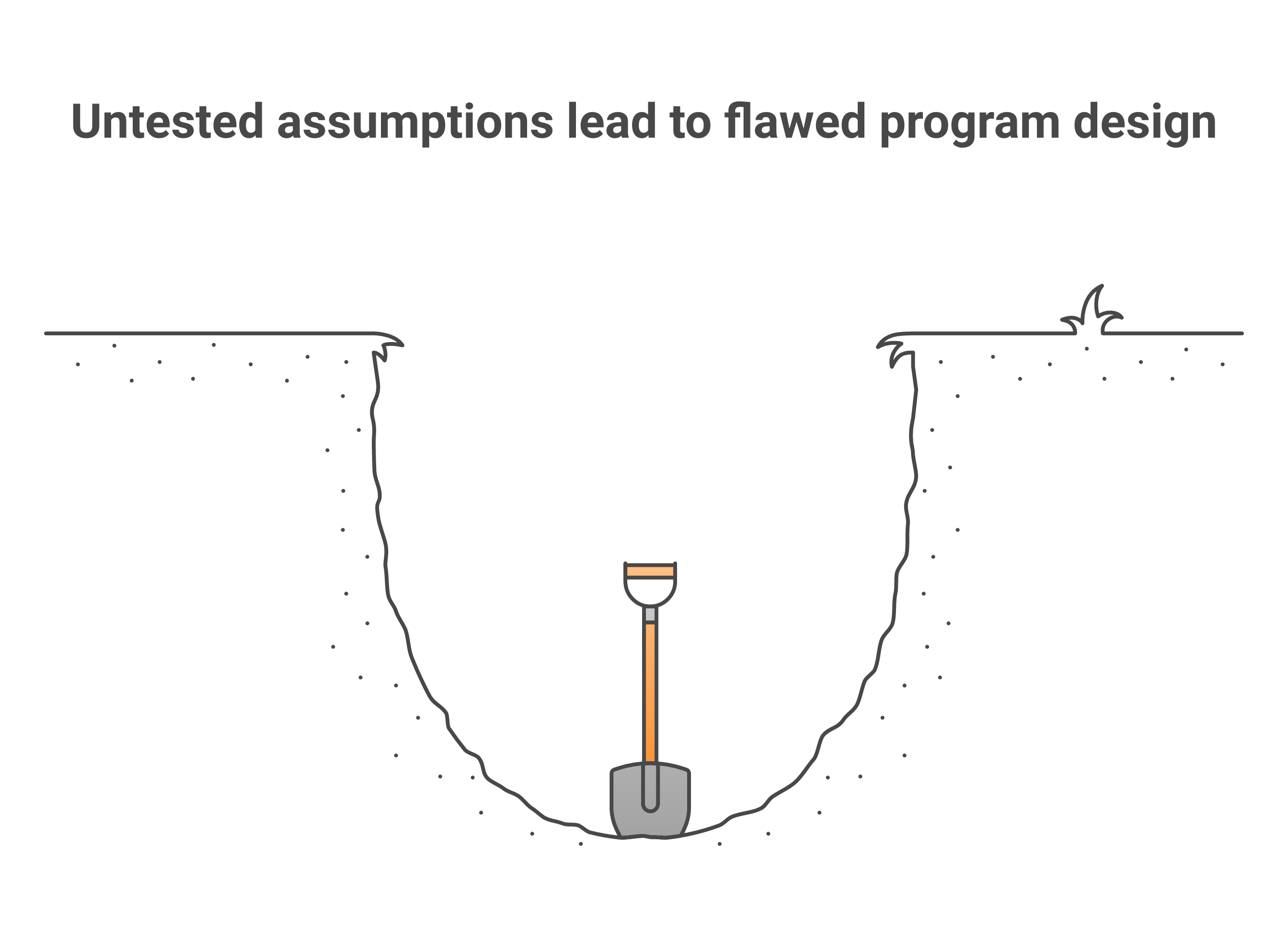
Every programme is built on assumptions. Training will change behaviour. Communities will adopt new practices. Government services will be accessible. Markets will respond to improved supply. These beliefs sit behind every arrow in your theory of change, yet most programmes never test them. This is one of the most common theory of change pitfalls.
When programmes fail, the cause is more often untested assumptions that turned out to be wrong than poor implementation. Isabel Vogel's review of theory of change practice for DFID, drawing on 40 interviews with staff from 25 development organisations, concluded that the quality of a theory of change process rests on "making assumptions explicit".
Why assumptions matter more than activities
Activities are within your control. You can conduct trainings, distribute materials, build infrastructure. But whether those activities produce the intended changes depends entirely on assumptions: conditions outside your direct control that must hold for your logic to work.
A maternal health programme assumes that trained birth attendants will be available when needed. A microfinance programme assumes that borrowers have viable investment opportunities. A girls' education programme assumes that families will allow daughters to attend school. Each assumption is a potential point of failure.
Types of assumptions
Sue Funnell and Patricia Rogers, in Purposeful Program Theory, argue that a useful theory must spell out the conditions under which each causal link is expected to be necessary and sufficient. It helps to sort those conditions into a few distinct types.
Causal assumptions concern the mechanisms of change. "If people know about nutrition, they will eat better." This assumes knowledge translates to behaviour, an assumption repeatedly contradicted by evidence. A 2024 survey of 536 people in two Telangana districts found that pregnant women, lactating mothers and young mothers had low knowledge of iron, vitamin A and iodine, and that they were not adopting appropriate dietary practices except for iodine. The lesson is to measure both knowledge and practice instead of assuming one follows from the other.
Contextual assumptions concern the environment. "Government health facilities will be functioning." In many parts of South Asia, this assumption fails more often than it holds.
Implementation assumptions concern delivery capacity. "Field staff will follow the training protocol." Staff turnover, competing priorities and local adaptation mean implementation rarely matches the design.
Assumption identification checklist
- For each arrow in your ToC, ask: "Under what conditions does this connection hold?"
- For each actor, ask: "What must they do, and why would they do it?"
- For each context, ask: "What must remain stable for this to work?"
- For each resource, ask: "What must be available, and who controls access?"
How to test assumptions
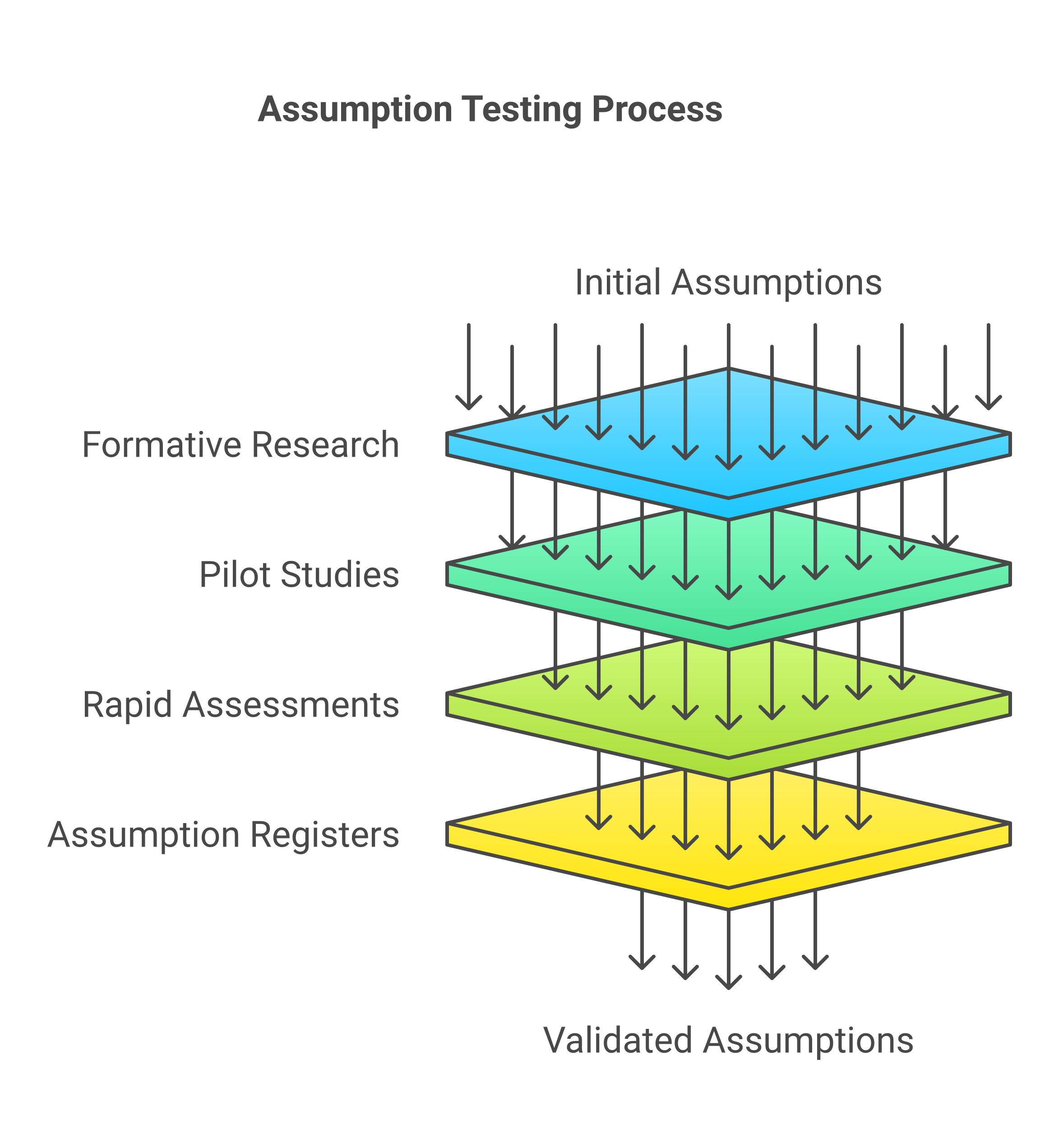
Formative research before programme launch can test critical assumptions cheaply. See BetterEvaluation for a summary of Vogel's review. A reasoned theory of change should rest on assumptions you can probe before you build: are they plausible, does evidence support them, and do the key players agree with them? Focus group discussions, key informant interviews, and market assessments reveal whether your assumptions match reality. Ensuring data quality in the field is essential for these assessments to be trustworthy. A few weeks of formative research can save years of misdirected effort.
Pilot studies test assumptions under real conditions at small scale. The key is testing not just whether the intervention works, but specifically which assumptions hold and which fail. Combining qualitative and quantitative approaches through mixed methods can strengthen this testing.
Rapid assessments during implementation can check assumptions as contexts change. Seasonal patterns, political shifts, and economic changes can invalidate assumptions that were sound at the design stage.
The pre-mortem tests assumptions before a single rupee is spent. Developed by psychologist Gary Klein and described in Harvard Business Review, the technique asks the team to imagine the programme has already failed a year from now, then list the reasons why. By drawing on what Klein calls "prospective hindsight," it surfaces the fragile assumptions that overconfidence and groupthink would otherwise keep unspoken, which are exactly the ones a design team most needs to name.
"An assumption register is as important as a risk register. In fact, your biggest risks are your untested assumptions."
South Asian contexts where assumptions break
Caste dynamics affect who accesses services, who participates in groups, and whose voice is heard. Programmes that assume equal access often reproduce existing inequalities. Choosing indicators that matter requires surfacing these dynamics explicitly.
Gender norms shape mobility, decision-making, and resource control in ways that programme designs frequently underestimate. Assuming women can attend trainings, access markets or control income often fails without specific strategies to address normative barriers.
Seasonal migration means that target populations may be physically absent during key programme periods. Assuming year-round availability of communities is a common failure point.
Building an assumption practice
Make assumption identification a standard part of programme design. The discipline is not new: the logical framework tradition that donors such as USAID and DFID have used for decades already requires teams to name the external assumptions that must hold for results to follow, the fourth column of the classic logframe matrix, and to assess each for criticality and risk. Create an assumption register that tracks each critical assumption, the evidence for or against it, and the plan for testing it. Review assumptions quarterly. And have the courage to redesign when assumptions prove wrong: that is adaptive management in action.
Assumption identification and testing run through our free MEL course, The Evidence Question, and you can pressure-test your own pathways in the ToC Builder Lab.