For decades a quiet orthodoxy governed anti-poverty programmes. It said to give the poor things (food, training, assets) but never just hand them money, because they would waste it. Over the last twenty years a wave of rigorous evaluations has turned that assumption on its head. Today an unconditional cash transfer is often the benchmark against which other interventions are judged: if your programme cannot beat simply giving people the cash it costs to run, why run it?
This post distils what the evidence actually shows, for practitioners deciding how to design or critique a transfer programme. For the full annotated reading list, every study linked, see our Deep Dive on Cash Transfers and the Evidence.
Do people “waste” cash?
The most durable myth is that poor recipients fritter cash away on alcohol and tobacco. The evidence says otherwise. Evans and Popova reviewed 19 studies of that question and found that, almost without exception, transfers had either no significant effect or a significant fall in spending on such goods. On work, Banerjee, Hanna, Kreindler and Olken re-analysed seven randomised trials of government cash transfer programmes in six countries and found no systematic evidence that cash transfers discourage work in those programmes, which answers the stereotype of the “lazy welfare recipient” their paper takes on.
When GiveDirectly handed large unconditional transfers to households in Kenya, Haushofer and Shapiro documented higher consumption, assets, food security and psychological well-being. The transfers ranged from US$404 to US$1,525 in purchasing-power terms, and household monthly consumption rose from $158 to $193 nine months after they began. The gains did not come with higher “vice” spending. Cash, it turns out, is mostly spent on the things poor households obviously need.
Conditions: worth the cost?
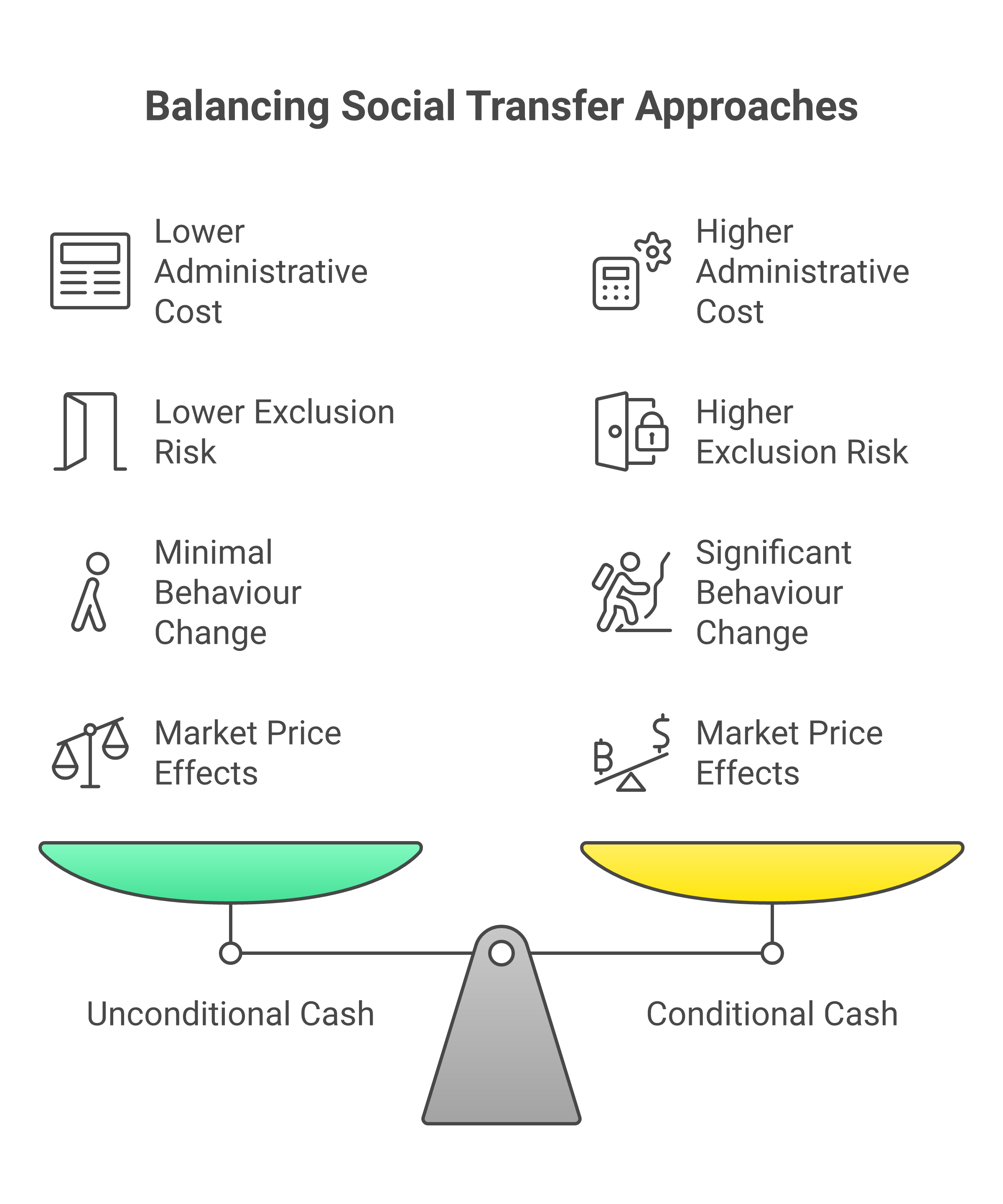
Conditional cash transfers (CCTs), paying families on the condition that children attend school or visit a clinic, are the flagship social policy of much of Latin America and, increasingly, South Asia. But are the conditions doing the work? Baird, Ferreira, Özler and Woolcock’s systematic review of cash transfers and schooling outcomes found that conditions do boost enrolment more than unconditional transfers, but only where they are strictly monitored and enforced. Both kinds raised enrolment compared with no programme, and the review found at best a small effect on learning. Monitoring costs money, and strict conditions can exclude the households that struggle to comply, so the honest answer is that it depends what you are buying. Conditions purchase behaviour change at the price of administrative burden and exclusion.
In practice the policy question is “cash, conditions, or kind: at what administrative cost, and for whom?”
Cash vs. in-kind: the India debate
In India this is not abstract. The Public Distribution System (PDS) supplies subsidised grain under the National Food Security Act, 2013, whose entitlements extend to up to 75 per cent of the rural and 50 per cent of the urban population; reformers periodically propose replacing it with cash. The economics are contested. Cunha, De Giorgi and Jayachandran analysed a randomised programme in Mexico, where villages received boxes of food, equivalent cash or nothing. They show that cash and in-kind transfers have different price effects. Prices fell about 4 per cent under in-kind transfers, while cash raised them by a negligible amount, and the price effects were much larger in the less developed villages. And Reetika Khera’s analysis of Indian data draws on a survey of more than 1,200 rural households in nine states, in which two-thirds of respondents preferred food to cash, and concludes that the right form of support depends on context. Market depth, banking access and what is being delivered all bear on the answer.
Delivery is the hard part
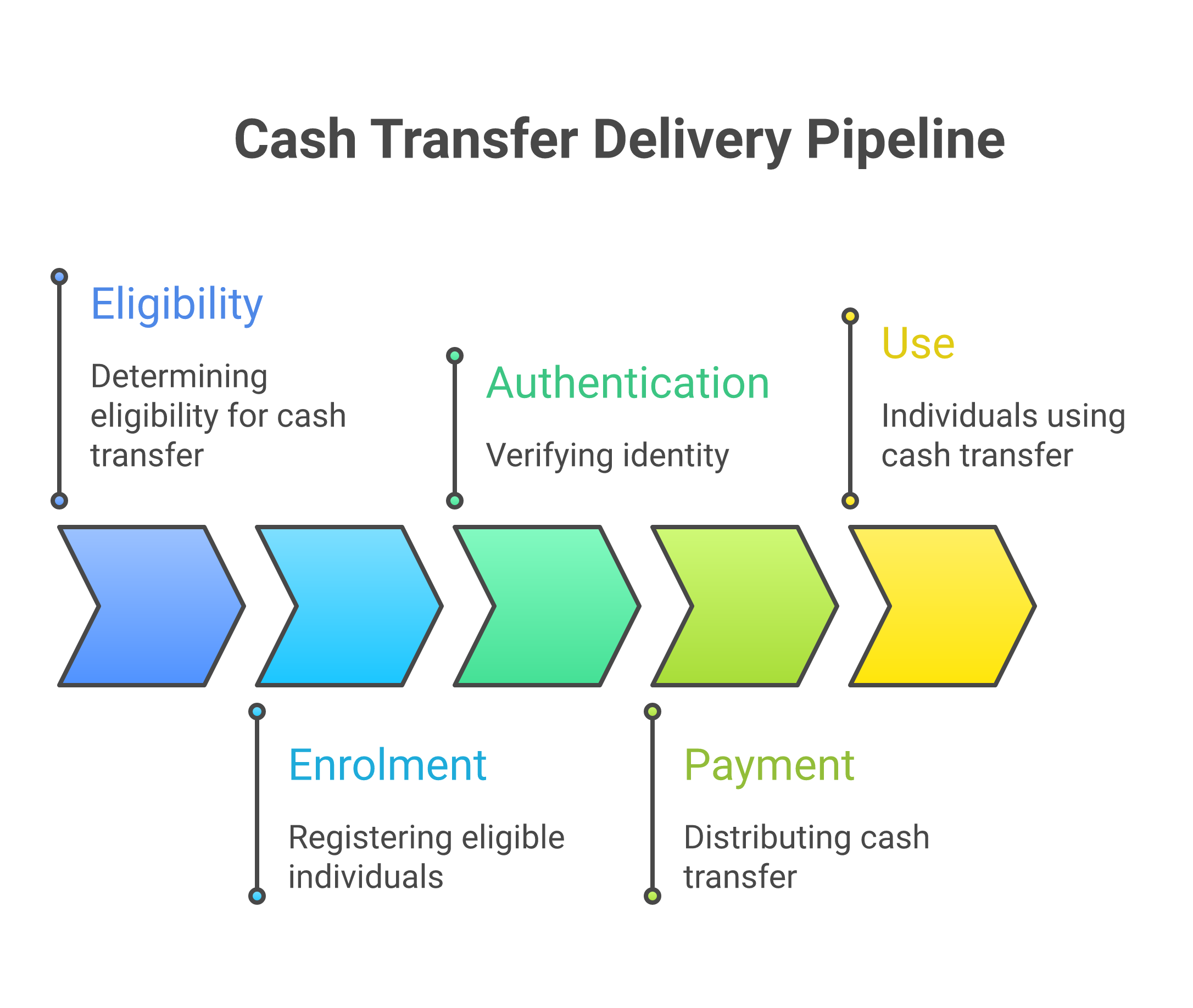
A transfer is only as good as the pipe it travels through. Leakage and ghost beneficiaries can swallow a large share of a budget before it reaches anyone. This is where India’s Direct Benefit Transfer (DBT) push and biometric authentication come in. Muralidharan, Niehaus and Sukhtankar randomised the rollout of payments across 158 sub-districts and 19 million people. Their study of biometric “smartcards” in Andhra Pradesh found faster, more predictable and less corrupt payments, less leakage, and no adverse effect on access to the programmes. These are real state-capacity gains. But the wider literature warns that aggressive authentication can also exclude legitimate beneficiaries who cannot authenticate. Plumbing matters as much as policy.
Cash plus: the graduation approach
For the very poorest, cash alone may not be enough to escape a poverty trap. The “graduation” model (an asset transfer plus coaching, consumption support and savings) was tested across six countries by Banerjee, Duflo and colleagues, who found lasting gains in consumption, assets and well-being at least a year after all implementation ended. For the households furthest behind, the bundle around the cash can matter.
What this means for practitioners
- Use cash as your benchmark. Before designing a complex in-kind programme, ask whether it beats simply transferring the cash it would cost.
- Justify your conditions. Conditions can work, but budget for monitoring and watch for exclusion. If you cannot monitor well, unconditional may be both cheaper and fairer.
- Respect the local market. In thin markets, or where banking is weak, in-kind or hybrid support may still beat cash. Do not assume.
- Design the delivery as well as the policy. Authentication and payment rails decide who actually gets paid, and who gets wrongly excluded.
- Measure exclusion as well as leakage. A “tight” system that drops eligible people is not a success.
Cash transfers are among the best-evidenced tools in development, and “give them cash” is where the design conversation starts. To go deeper, work through the full annotated reading list in our Cash Transfers Deep Dive, or build the underlying skills in our Development Economics and MEL courses.