Why mixed methods?
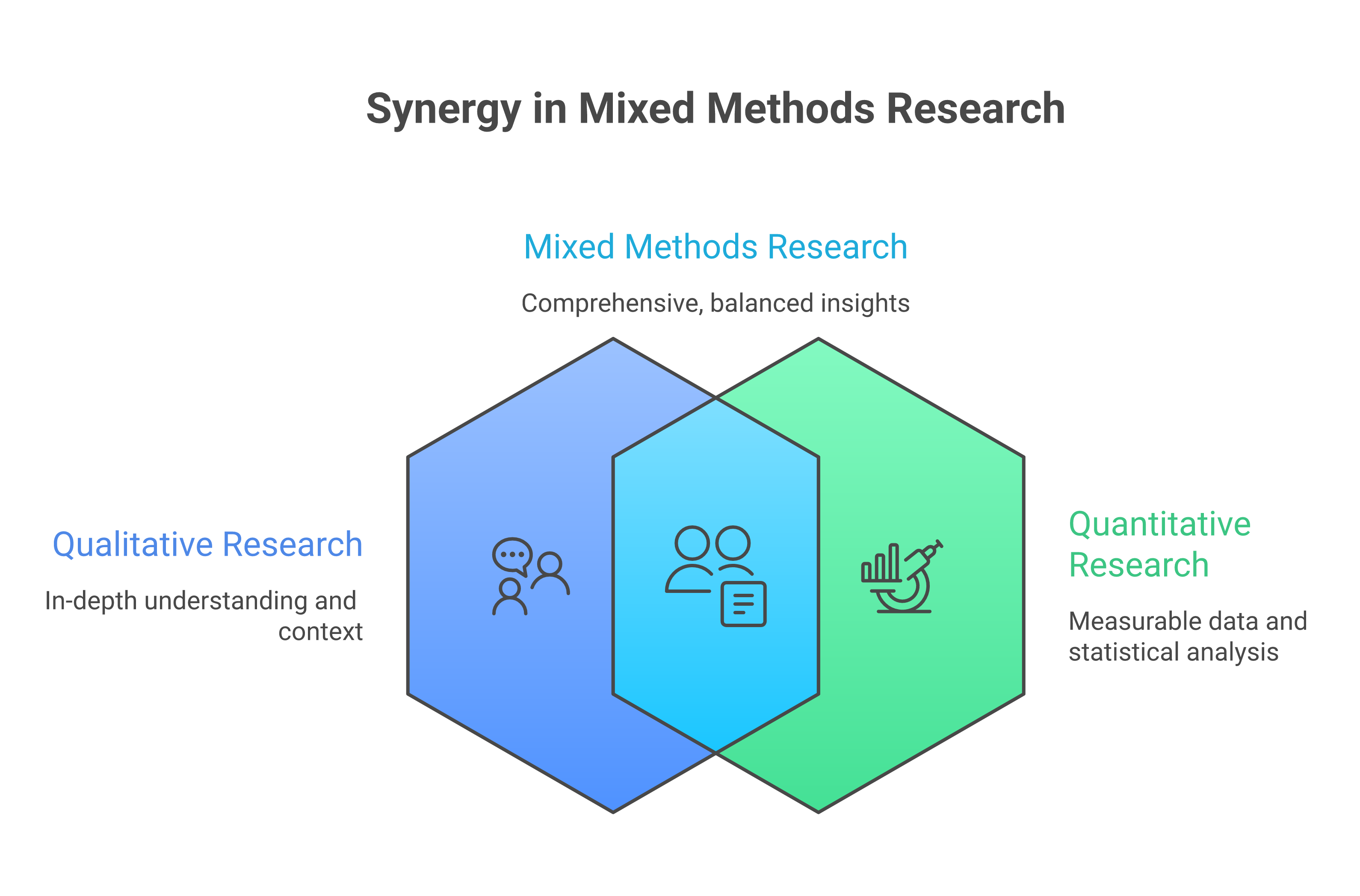
Evaluators have argued for decades about whether numbers or narratives make better evidence. Quantitative purists argue that only numbers can provide the rigour needed for credible evidence. Qualitative champions counter that numbers alone miss the lived experiences that give meaning to development outcomes. Mixed methods evaluation takes a third route and uses each tradition to cover the other's weaknesses. Michael Bamberger's guidance note for InterAction puts the case plainly: there is "rarely a single evaluation methodology that can fully capture all of the complexities of how programs operate in the real world." The unique feature of mixed methods approaches, he writes, is that they seek to integrate quantitative and qualitative approaches to theory, data collection, data analysis and interpretation (Bamberger, Introduction to Mixed Methods in Impact Evaluation, InterAction/BetterEvaluation).
For South Asian development programmes operating in contexts of extraordinary complexity, from the caste dynamics of rural Bihar to the post-conflict settings of Sri Lanka, relying on a single methodological tradition is limiting and can mislead. A randomised controlled trial might tell you that a livelihood programme increased household income by 12%, but it cannot explain why some communities embraced the programme while others resisted it. Conversely, rich ethnographic accounts of programme participation may not tell you whether outcomes can be attributed to the intervention rather than external factors.
Sequential vs concurrent designs
John Creswell and Vicki Plano Clark, in Designing and Conducting Mixed Methods Research, distil the field down to three core designs: the convergent design, the explanatory sequential design, and the exploratory sequential design. Each is suited to different evaluation questions and resource constraints.
Sequential explanatory design begins with quantitative data collection and analysis, followed by qualitative inquiry that helps explain or elaborate on the quantitative findings. This is particularly useful when survey results reveal unexpected patterns. For instance, an evaluation of India's Mahatma Gandhi National Rural Employment Guarantee Act (MGNREGA) might first analyse wage data across districts, then conduct focus groups in outlier districts, those with unusually high or low uptake, to understand contextual factors driving variation.
Sequential exploratory design reverses this order: qualitative research comes first to develop hypotheses, instruments, or typologies, which are then tested quantitatively. This approach works well when evaluating programmes in under-researched contexts. A team evaluating a new adolescent health programme in Nepal's Terai region might begin with participatory workshops to understand local health-seeking behaviours before designing a survey instrument that reflects local realities rather than imported assumptions.
Concurrent or convergent design involves collecting both types of data simultaneously and merging them during analysis. This is the most resource-intensive approach but offers the richest picture. Because both strands run at the same time, it needs a team able to do both from the start. An evaluation of a watershed management programme in Maharashtra might simultaneously conduct a household survey measuring agricultural productivity and ethnographic fieldwork documenting community decision-making processes around water allocation.
The goal of mixed methods, as Creswell and Plano Clark stress, is to integrate two types of data in ways that yield insights neither could produce alone. Paraphrasing Creswell & Plano Clark
The integration challenge
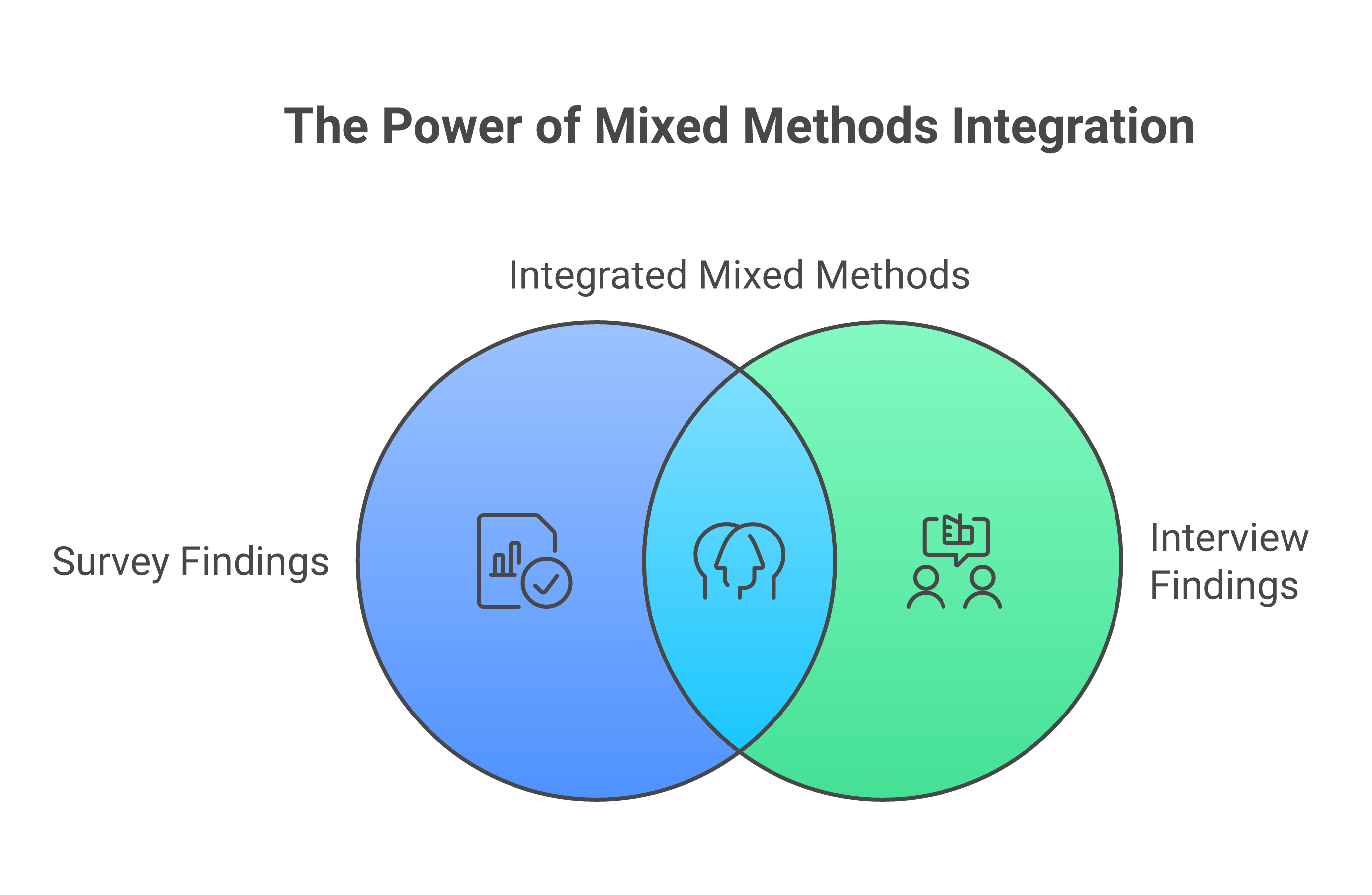
Michael Fetters, Leslie Curry and John Creswell, in their Health Services Research paper on achieving integration in mixed methods designs, set out how to avoid a failure of integration: collecting both quantitative and qualitative data but never bringing them into dialogue. The final report contains a statistics chapter and a qualitative findings chapter that sit side by side without speaking to each other. Fetters and colleagues describe integration at three levels, design, methods, and interpretation and reporting, and argue that it must be deliberately built in at each.
At the design level, integration means ensuring that both strands address the same or complementary evaluation questions, grounded in a clear theory of change. At the methods level, it involves techniques like using qualitative themes to create quantitative variables, selecting qualitative cases based on quantitative results, or using early interviews to shape the survey instrument. At the interpretation level, the same authors recommend building joint displays: tables, matrices or graphs that array both data types side by side so that convergence, divergence, and expansion between the strands become visible. And at the reporting level, findings should be woven together rather than presented in separate sections. It helps to be explicit about why the two strands are combined: Jennifer Greene, Valerie Caracelli and Wendy Graham's classic typology identifies five distinct purposes for mixing: triangulation, complementarity, development, initiation and expansion (Greene, Caracelli & Graham, 1989), and naming the intended purpose up front disciplines the whole design.
South Asian examples in practice
The graduation approach to poverty shows why both strands matter. BRAC, a Bangladeshi NGO, designed it for the households it calls the "ultra-poor". Randomised trials in six countries (Ethiopia, Ghana, Honduras, India, Pakistan and Peru, with the Indian site in West Bengal), each run by a different organisation, were reported by Abhijit Banerjee, Esther Duflo and colleagues in Science (Banerjee et al., 2015, "A multifaceted program causes lasting progress for the very poor"). One year after the programme ended, gains in consumption, household assets and food security had barely declined, and the estimated benefits were higher than the costs in five of the six sites. Yet the numbers alone are silent on how an asset transfer plus training and coaching reshapes a household's trajectory. The authors themselves say more work is needed on the mechanisms, and speculate that the programme may have worked by making beneficiaries "feel that they mattered." BRAC's qualitative and process documentation has been used to explore these mechanisms, from shifts in aspirations to changes in how participants are regarded within the village.
The same logic applies to India's flagship community-health workforce. A large-scale survey can establish whether Accredited Social Health Activists (ASHAs) under the National Health Mission are associated with higher institutional-delivery rates, but it tends not to capture the informal negotiation and persuasion that frontline workers use with reluctant families: the kind of practice knowledge that interviews and observation surface and that often proves decisive for scale-up. Pairing the two strands in a convergent design is what turns "the programme works" into "here is how, and where, it works."
Practical considerations for evaluators
Designing a mixed methods evaluation in South Asia requires careful attention to several practical realities. First, team composition matters enormously. Statisticians and ethnographers often operate with different epistemological assumptions. Building a team that values both traditions, rather than treating one as supplementary, is essential for quality integration and is a hallmark of a strong MEL culture.
Second, timing and sequencing must account for field realities. Monsoon seasons, harvest periods, election cycles, and festival calendars all affect data collection in South Asia. A sequential design that plans qualitative fieldwork during monsoon season in flood-prone areas of Assam will face serious implementation challenges.
Third, budget allocation should reflect a commitment to both strands. Too often, the qualitative component receives a fraction of the budget and is treated as illustrative anecdote rather than rigorous evidence. A credible mixed methods evaluation resources both strands seriously, and the integration work is easy to assume will happen for free when it rarely does. Bamberger notes that mixed methods evaluations often need extra time (for team building, for example) and money, and that the manager has to budget for the extra time and money.
Finally, ethical considerations multiply in mixed methods designs. Participants in qualitative components share personal narratives that require careful handling, particularly in contexts where caste, gender, or political dynamics create vulnerability. Informed consent processes must be adapted for each data collection method, survey instruments must reflect local realities, and confidentiality protocols must account for the identifiability of qualitative participants in small communities.
Getting started
For evaluation teams new to mixed methods, the best starting point is a clear articulation of what each method will contribute to the evaluation questions. If the quantitative component could answer the question alone, adding qualitative work merely for decoration wastes resources and participants' time. Similarly, if the qualitative inquiry is sufficient, collecting survey data for the appearance of rigour serves no one. Mixed methods should be chosen when, and only when, the evaluation questions require both types of evidence to be answered adequately. When that condition is met, the resulting evaluation will be far more useful to programme managers, policymakers, and the communities the programme serves. For practical guidance on structuring your evaluation framework, try our MEL Lab. For a structured grounding, our free Mixed Methods 101 and Qualitative Methods 101 decks cover the designs discussed here.