The Blame Trap
Walk into many development organisations in South Asia and ask what happens when a programme fails to meet its targets. The answer, more often than not, involves some version of blame. The field team blames the community for low participation. The programme team blames the field team for poor implementation. The management blames the programme team for unrealistic planning. And the donors blame the management for poor results. Everyone is pointing fingers, and no one is learning.
Blame culture appears in every sector, and it is particularly damaging in development work. Development work operates in conditions of profound uncertainty: interventions interact with complex social systems in ways that are inherently unpredictable. Failure is an inevitable feature of working at the frontier of social change, and it says little about competence. Yet most organisations treat failure as something to be hidden, explained away, or punished when it should be examined and learned from. ALNAP's "Lessons of lessons" meta-analysis of about two decades of its Lessons Papers on humanitarian responses found that lessons about structural, system-wide problems changed little over time and stayed observational rather than instructional.
The cost of this culture is enormous. When staff fear punishment for honest reporting, data quality deteriorates. When programme managers hide negative findings, the organisation loses the feedback loops needed to improve. When donors penalise failure and reward good news, organisations optimise for favourable reports over real impact. The entire system conspires against the learning that development work desperately needs. As we explore in stories of evidence-based pivots, it takes real courage to follow uncomfortable evidence.
What Psychological Safety Looks Like
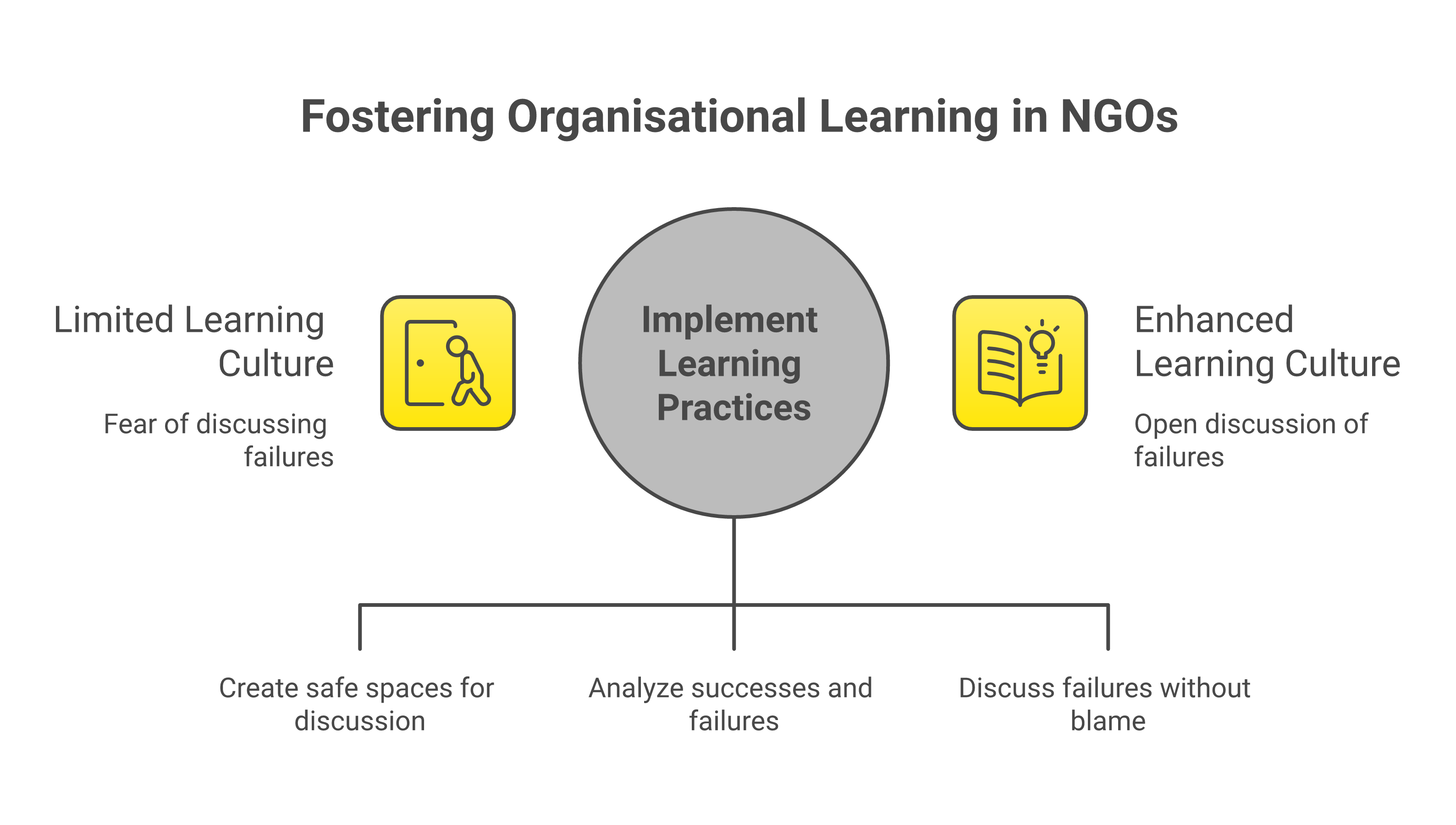
The concept of psychological safety, originally introduced by Edgar Schein and Warren Bennis in the 1960s and later developed by Harvard professor Amy Edmondson, describes an environment where people feel safe to take interpersonal risks: admitting mistakes, asking questions, offering dissenting opinions, and flagging problems without fear of punishment or humiliation. Edmondson's study of hospital teams produced a now-famous counterintuitive finding: the better-led units, with better relationships among staff, reported more errors. Edmondson read this as a sign that staff there felt safe enough to report mistakes, and that units with punitive managers reported fewer of them. In development organisations, that same safety is the foundation on which a learning culture must be built.
Psychological safety does not mean lowering standards or avoiding accountability. It means separating the judgment of the work from the judgment of the person. A programme that fails to achieve its outcomes is a learning opportunity and carries no indictment of the team that implemented it. A field officer who reports that beneficiaries are not engaging with the programme is providing valuable intelligence.
In practice, psychological safety shows up in a few behaviours. Leaders who model vulnerability by sharing their own mistakes and uncertainties. Team meetings where dissent is actively invited rather than merely tolerated. Performance reviews that assess learning and adaptation alongside target achievement. Reporting systems that ask "what did we learn?" alongside "what did we achieve?": framed around indicators that actually matter, not just vanity metrics.
"In a learning organisation, the question is never 'whose fault was it?' The question is 'what can we do differently?' That single shift changes everything.": A veteran NGO leader in Mumbai
After-Action Reviews: A Practical Tool
One of the most effective tools for building a learning culture is the after-action review (AAR): a structured reflection process introduced by the US Army in the mid-1970s and since taken up by humanitarian and development organisations. This after-action review guidance from USAID's Bureau for Humanitarian Assistance, held in the ALNAP library, defines an AAR as an assessment that lets team members and leaders discover what happened and why, reassess direction and review both successes and challenges. In the Army version, as David Garvin describes it, discussion revolves around four questions: What did we set out to do? What actually happened? Why did it happen? What are we going to do next time? AARs are conducted after significant activities (programme launches, training events, emergency responses, evaluation exercises) while the experience is still fresh.
The power of AARs lies in their structure and regularity. They are routine practices embedded in the organisation's workflow. A livelihoods programme might conduct an AAR after every market linkage event. A health programme might review every community health camp. An education programme might debrief after every teacher training cycle. The cumulative effect of these regular reflections is a steady accumulation of practical knowledge that improves programme quality over time.
Critical success factors for AARs include: timeliness (conducting them within days of the event, while memories are fresh), inclusivity (involving all team members regardless of hierarchy), documentation (recording insights in a shared, searchable format), and follow-through (actually implementing the changes identified). An AAR that generates recommendations but no action is worse than no AAR at all, because it teaches staff that reflection is performative.
Safe Spaces for Failure
The boldest precedent comes from Engineers Without Borders Canada, which from 2008 published an annual Failure Report in which its staff describe projects that went wrong. The 2011 edition covers a programme to build the capacity of farmers' organisations in Burkina Faso, and the 2010 edition describes a district water-monitoring system in Malawi that lapsed once NGO funding for data collection ended. EWB later launched a web portal, AdmittingFailure.com, to widen the conversation, and William Gates Sr. of the Gates Foundation called the initiative bold leadership in his foreword to the 2010 report. EWB's experience punctured a common fear: the organisation found that transparency about failure built trust instead of costing it donors. Some development organisations in South Asia have begun creating similar intentional spaces for sharing and learning from failure, and participatory MEL approaches can help by giving communities a voice in defining what success and failure look like. A handful of NGO networks now run quarterly "Fail Fest"-style sessions where programme managers present their biggest failures from the preceding quarter, what they learned, and how they adapted. These are deliberately framed as celebratory, with recognition for the "most instructive failure" and the "bravest pivot."
Other teams borrow "red team" exercises for major programme designs, where a designated group's role is to challenge assumptions, identify weaknesses, and argue for alternative approaches. These exercises surface potential failure points before implementation rather than after, and they normalise critical questioning as a constructive rather than adversarial practice.
A natural extension is the internal "failure library": a documented collection of programme components that did not work, with analysis of why and what was learned. Where organisations require new staff to read it during onboarding, and ask programme designers to check fresh proposals against documented failures, the library becomes a defence against repeating known mistakes, turning what ALNAP describes as the costly habit of relearning the same lessons into institutional memory.
The Leadership Imperative
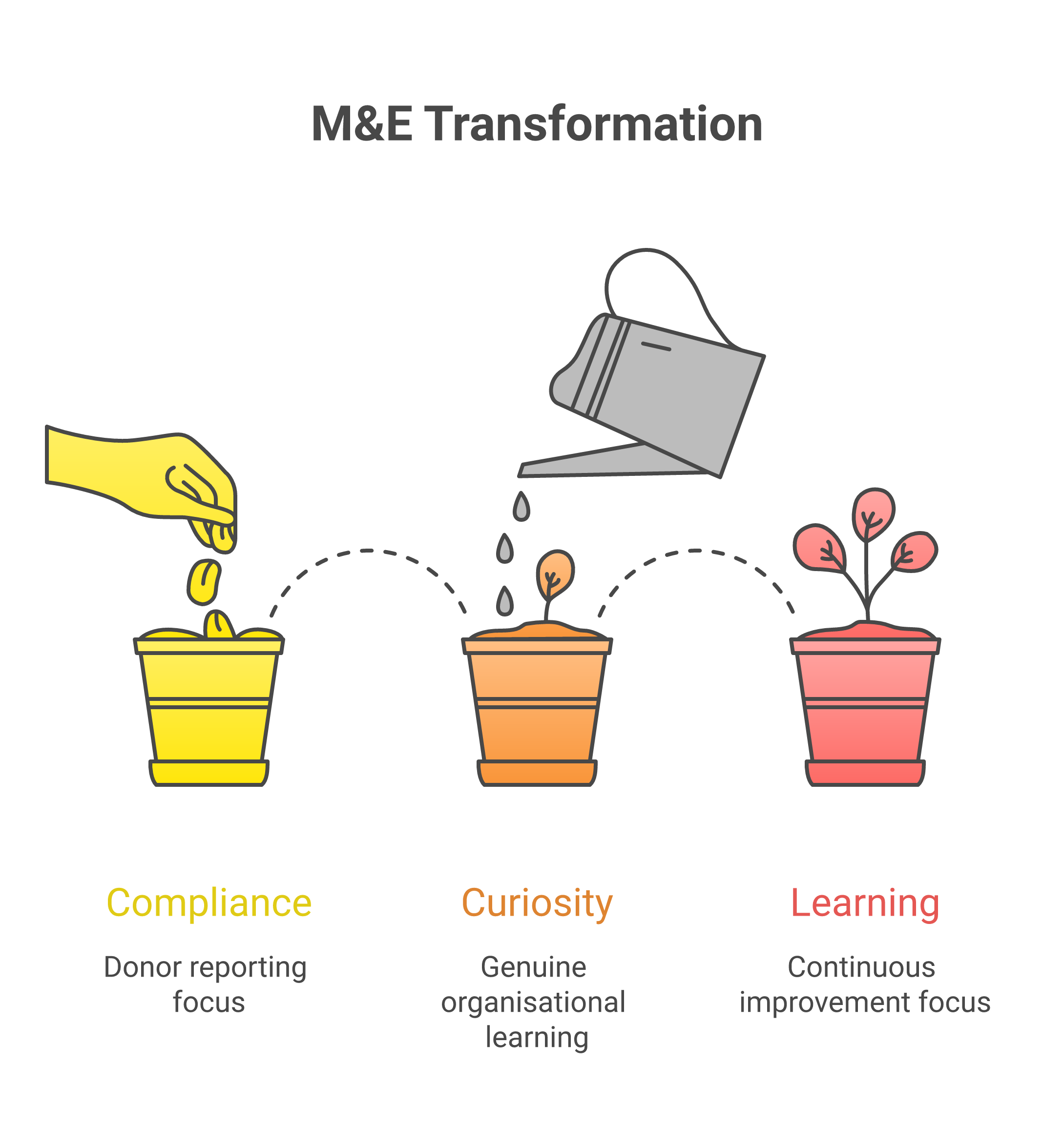
Culture change starts at the top. No amount of AAR facilitation guides or learning frameworks will transform an organisation whose leaders punish honesty and reward spin. The single most powerful thing a development leader can do to build a learning culture is to publicly share their own failures and what they learned from them. When a CEO tells the team, "I made a strategic error last quarter, here is what happened and what I learned," it sends an unmistakable signal that learning from failure is valued at the highest levels.
Donors have a major role too. Funding frameworks that require only success stories and upward-trending indicators actively undermine learning cultures. The clearest institutional attempt to change this is USAID's Collaborating, Learning and Adapting (CLA) framework, a set of practices combining strategic collaboration, continuous learning and adaptive management. USAID's own case summary, published by the OECD, says that a growing body of evidence shows adaptive leadership and the open embrace of learning from failure improve an organisation's ability to learn and adapt. A related principle comes from Michael Quinn Patton, who has argued for decades through utilisation-focused evaluation, which holds that an evaluation should be judged by its utility and actual use by its intended users. Yet, as ALNAP's work on evaluating humanitarian action repeatedly shows, the uptake of evaluation findings remains the sector's weakest link, which makes the culture this article describes the precondition for evidence to be used at all. Its guidance also lists drawing lessons to improve policy and practice, and enhancing accountability, as the reasons for doing an evaluation. Tools like the MEL Lab can help teams design learning-oriented frameworks from the outset. This shift, while still minority practice, represents the kind of systemic change that the development sector needs to become a learning enterprise.
For practitioners who want to ground this culture in solid method, our free MEL course, The Evidence Question, connects learning culture to the day-to-day craft of monitoring and evaluation.