Few debates in the development sector generate as much heat as "ToC vs logframe." Some practitioners dismiss logframes as rigid relics. Others view theories of change as vague diagrams that resist accountability. Both positions miss the point.
A Theory of Change and a Logical Framework are different tools designed for different purposes. Used together, they are more powerful than either alone.
What each tool does best
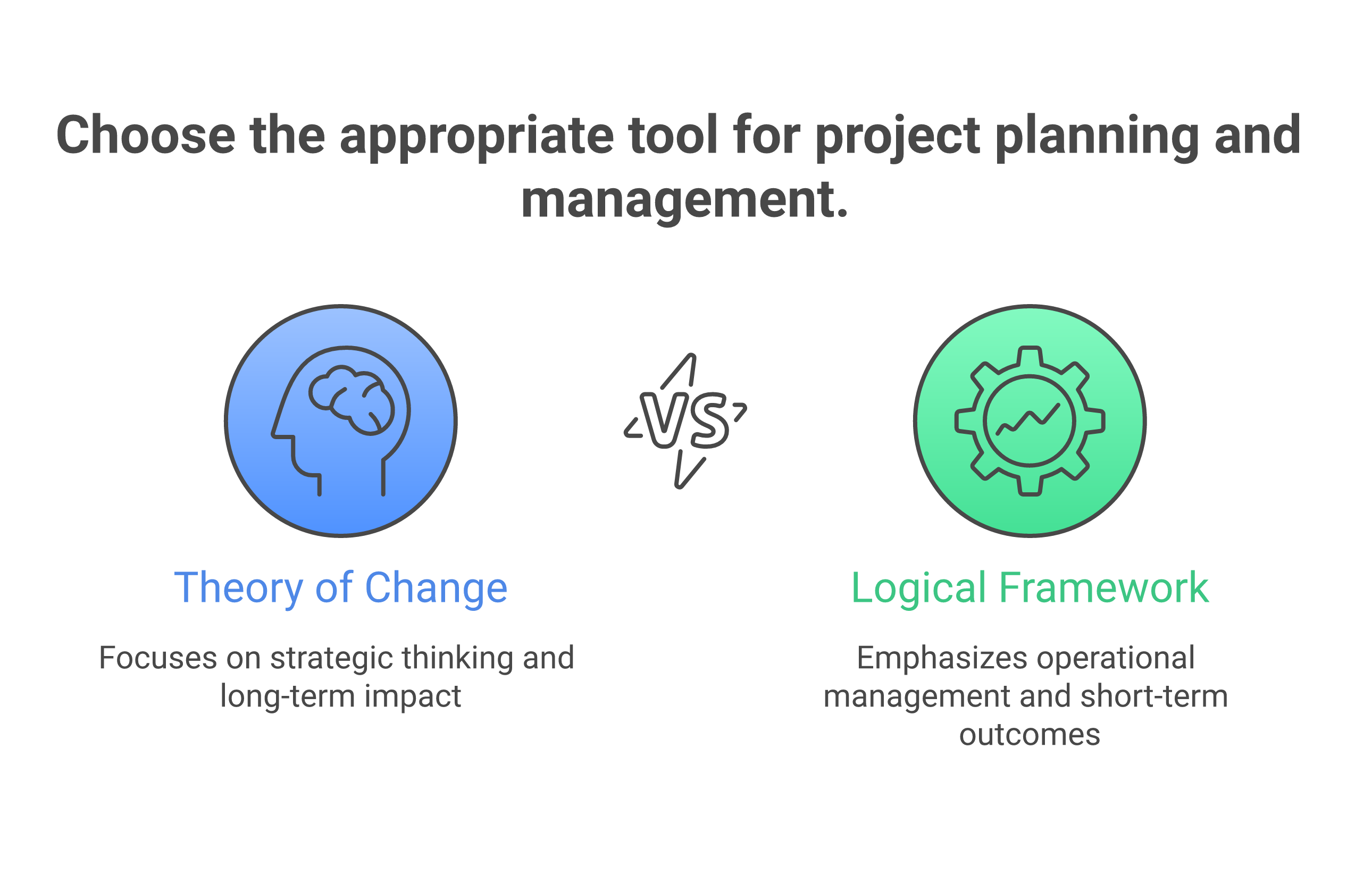
A Theory of Change is a strategic thinking tool. It maps how and why change happens, makes assumptions explicit, identifies multiple causal pathways, and provides a foundation for learning. It answers: "What is our best understanding of how this intervention creates change?" Carol Weiss popularised the term "theory of change" in a 1995 volume from the Aspen Institute's Roundtable on Community Change. She argued that complex community initiatives are hard to evaluate because the assumptions that inspire them are poorly articulated, and that evaluators should trace the "mini-steps" connecting activities to long-term goals (Weiss 1995, as described in the Theory of Change Community's account of ToC origins).
A Logical Framework is an operational management tool. It links activities to outputs to outcomes with specific, measurable indicators and targets. It provides a structure for monitoring progress and reporting to stakeholders. It answers: "What will we do, what will we measure, and how will we know we are on track?" The logframe is the older of the two. In 1969, after Congress asked whether aid projects were actually achieving their goals, USAID commissioned staff of Practical Concepts Incorporated, whose principal architects were Leon Rosenberg and Lawrence Posner, to analyse its project evaluation system. The analysis found planning too vague, management responsibility unclear and evaluation adversarial, and the logframe was developed in response (see PCI's own 1979 manual, The Logical Framework: A Manager's Guide, and, for the wider history, the Logical Framework Approach article).
The false dichotomy
The tension between ToC and logframe often has more to do with institutional dynamics than with a real methodological disagreement. Donors who require logframes are asking for accountability and measurability. Evaluators who advocate ToCs are asking for theoretical depth and learning. Both needs are legitimate.
Problems arise when one tool is forced to do the other's job. A logframe used as a theory of change oversimplifies causal relationships: a pattern we explore in detail in 5 Common Theory of Change Pitfalls. The critique is long-standing. Des Gasper of the Institute of Social Studies argued in 2000 that the logframe is "a crude way of conceiving cause-effect linkages", that it struggles to describe slow, recursive cause-effect links and lacks an explicit time dimension, and, citing Hoksbergen's critique of USAID evaluations, that sharply separating means from ends tends to downgrade process values such as participation (Gasper, "Logical Frameworks: Problems and Potentials"). A ToC used for operational monitoring, conversely, lacks the specificity needed for tracking progress.
Common mistakes
- Creating a logframe without first developing a Theory of Change (measuring without understanding)
- Creating a ToC without translating it into a logframe (understanding without tracking)
- Treating the logframe as a contract rather than a living management tool
- Making the ToC so complex it cannot guide practical decisions
How to use both together
This sequencing reflects our own preference, and published work supports it. Isabel Vogel's widely cited 2012 review for DFID, drawing on 40 interviews with staff from 25 development organisations, concluded that a theory of change should stay flexible and that it is at its best when it combines logical thinking with deeper critical reflection (Vogel, Review of the use of 'Theory of Change' in international development). A 2019 article in the Canadian Journal of Program Evaluation makes the integration case directly, arguing that embedding the theory of change within the logframe gives "a stronger and more holistic understanding of program progress". Drawing on one recent theory-based evaluation, it notes that logframes and theories of change are often developed in parallel and rarely integrated in practice (Freer & Lemire, "Can't See the Wood for the Logframe").
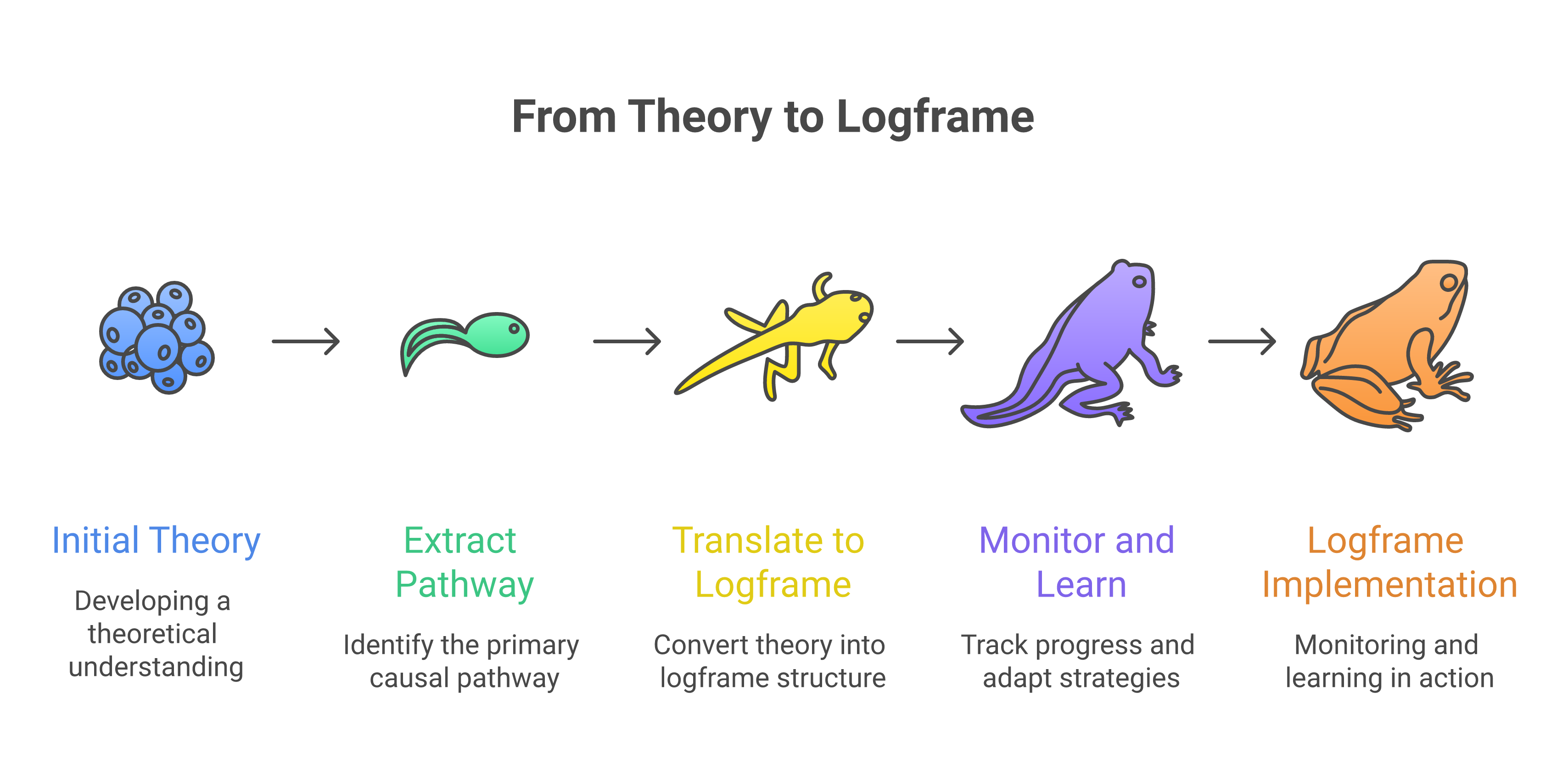
Step 1: Develop your Theory of Change first. Map out how you believe change happens, including assumptions and alternative pathways.
Step 2: Identify the primary causal pathway from your ToC, the chain of results you will focus on delivering and monitoring.
Step 3: Translate that primary pathway into a logframe. Activities and outputs come from your intervention strategy. Outcomes and goals come from your theory of change. Indicators come from asking "how would we know if this change is happening?"
Step 4: Use the logframe for routine monitoring and reporting. Use the ToC for periodic strategic reflection and adaptive management.
"The logframe tells you whether you are doing things right. The Theory of Change tells you whether you are doing the right things."
What donors actually want
Most donors today accept, and many require, both tools. The FCDO's Programme Operating Framework makes senior responsible owners accountable for a theory of change linking programme activities to intended outcomes, and requires programme reviews against "an agreed results framework or logframe". USAID's Collaborating, Learning, and Adapting (CLA) framework (implementing-partner version) listed testing and exploration of theories of change among its learning components, alongside adaptive management; USAID stopped administering foreign assistance awards on 1 July 2025. Major foundations have travelled the same road. The UK charity Comic Relief commissioned a 30-day review of theory of change practice in 2011, combining a literature search with 32 interviews. It reports Comic Relief's own working definition from its 2007 guidance: a theory of change "represents people's understanding of how change happens", covering "the pathways, factors and relationships that bring and sustain change in a particular context" (James, Theory of Change Review, commissioned by Comic Relief).
When donors seem to want "just a logframe," they often actually want clarity about what you will achieve and how you will track it. A well-constructed logframe derived from a solid ToC provides exactly that.
Try it yourself
ImpactMojo's Theory of Change Studio and Logframe Builder are designed to work together. Build your ToC to clarify your thinking, then use the logframe tool to translate it into a practical monitoring framework. The tools guide you through the connection between strategic theory and operational measurement. For the thinking behind both tools, our free MEL course, The Evidence Question, and the shorter Logframe 101 deck go deeper.