Skip to content
An ImpactMojo Special · Marginalia

Capacity for Irony

Ten scenes from the development sector, where the language of help meets the people it claims to help.

Marginalia, because the reply is the note the field scribbles in the margin of the sector's script — and because the margin is exactly where those voices usually get filed. In each drawing, someone in a lanyard says the thing the sector says; someone who does the actual work — a field officer, an ASHA, a farmer, a beneficiary — says the thing the sector tends not to write down. This is an affectionate roast, not a takedown. The jokes are drawn; the footnotes are real.

The pitch — what the sector says The reply — what the field says back The evidence — why the reply is right

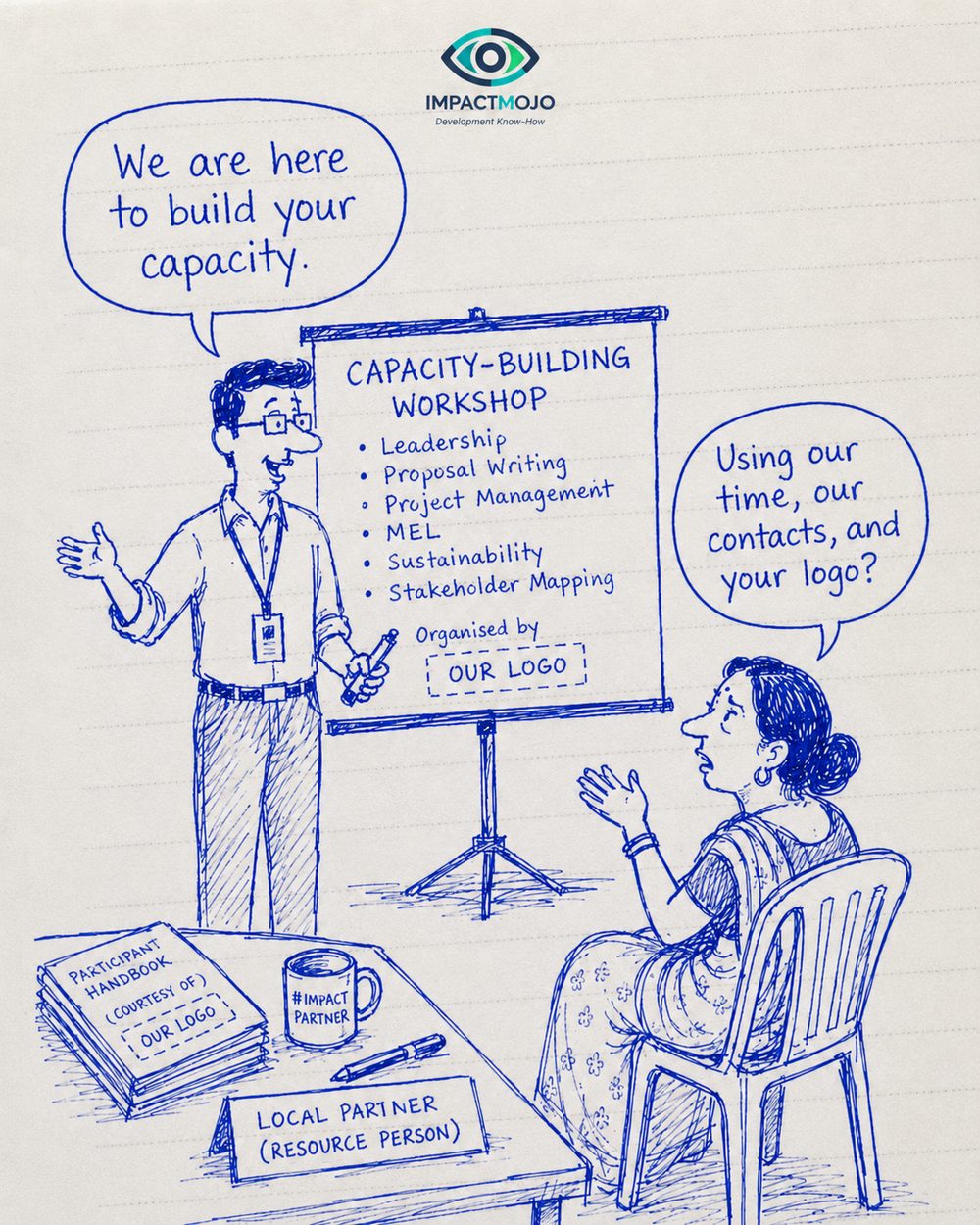
01 A facilitator in a lanyard at a flipchart reading 'Capacity-Building Workshop', saying 'We are here to build your capacity.' A woman in a sari seated opposite replies, 'Using our time, our contacts, and your logo?'
The pitch“We are here to build your capacity.” The reply“Using our time, our contacts, and your logo?”

Whose capacity, built by whom

“Capacity building” is one of the sector's most-used phrases and one of its most quietly loaded. In Peace Direct's 2021 global consultation Time to Decolonise Aid, participants singled it out as language that “suggests that local communities and organisations lack skills” — a framing that casts the visitor as the source of competence and the host as the deficit to be fixed.1

The arithmetic underneath makes the irony sharper. Grand Bargain signatories committed in 2016 to channel at least 25% of humanitarian funding “as directly as possible” to local and national actors.2 Years on, the share reaching them directly is still measured in low single digits — by independently verifiable data, under 2% in recent years.3 The capacity, the contacts and the funding mostly stay upstream; the local partner supplies the room, the relationships and the legitimacy.

Workshops that genuinely transfer power tend to look different — they pay local institutions to lead, not to host. The cartoon's question is the one the budget line usually answers honestly.

Sources: 1, 2, 3

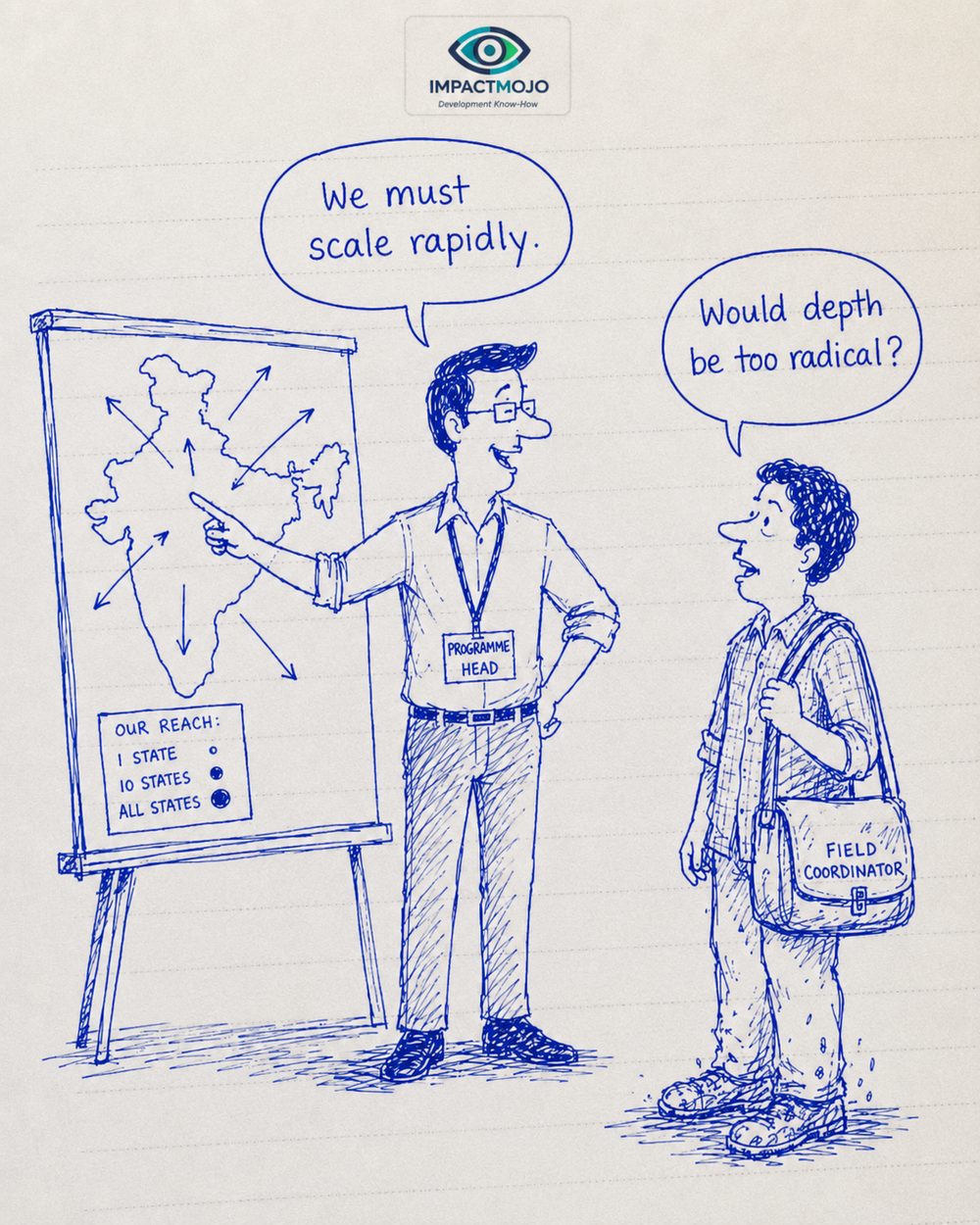
02 A Programme Head at a flipchart showing a map of India with arrows fanning out and a reach scale of 1 state, 10 states, all states, saying 'We must scale rapidly.' A Field Coordinator replies, 'Would depth be too radical?'
The pitch“We must scale rapidly.” The reply“Would depth be too radical?”

Scaling the form, not the function

Scale is the sector's reflex ambition — more districts, more states, all states. But Matt Andrews, Lant Pritchett and Michael Woolcock warn that organisations routinely scale the form of success without its function, a pattern they call isomorphic mimicry: adopting the charts, manuals and “best practice” of effective programmes to look capable while the underlying capability stays thin.4

Stretching that thin layer too fast produces what they term premature load bearing — placing weight on a system before it can carry it, which discredits the very reform and exhausts the people delivering it.5 Depth — the slow work of getting one place to actually work — isn't the timid option in this cartoon. It's the radical one, because it resists the incentive to grow the map faster than the competence.

Sources: 4, 5

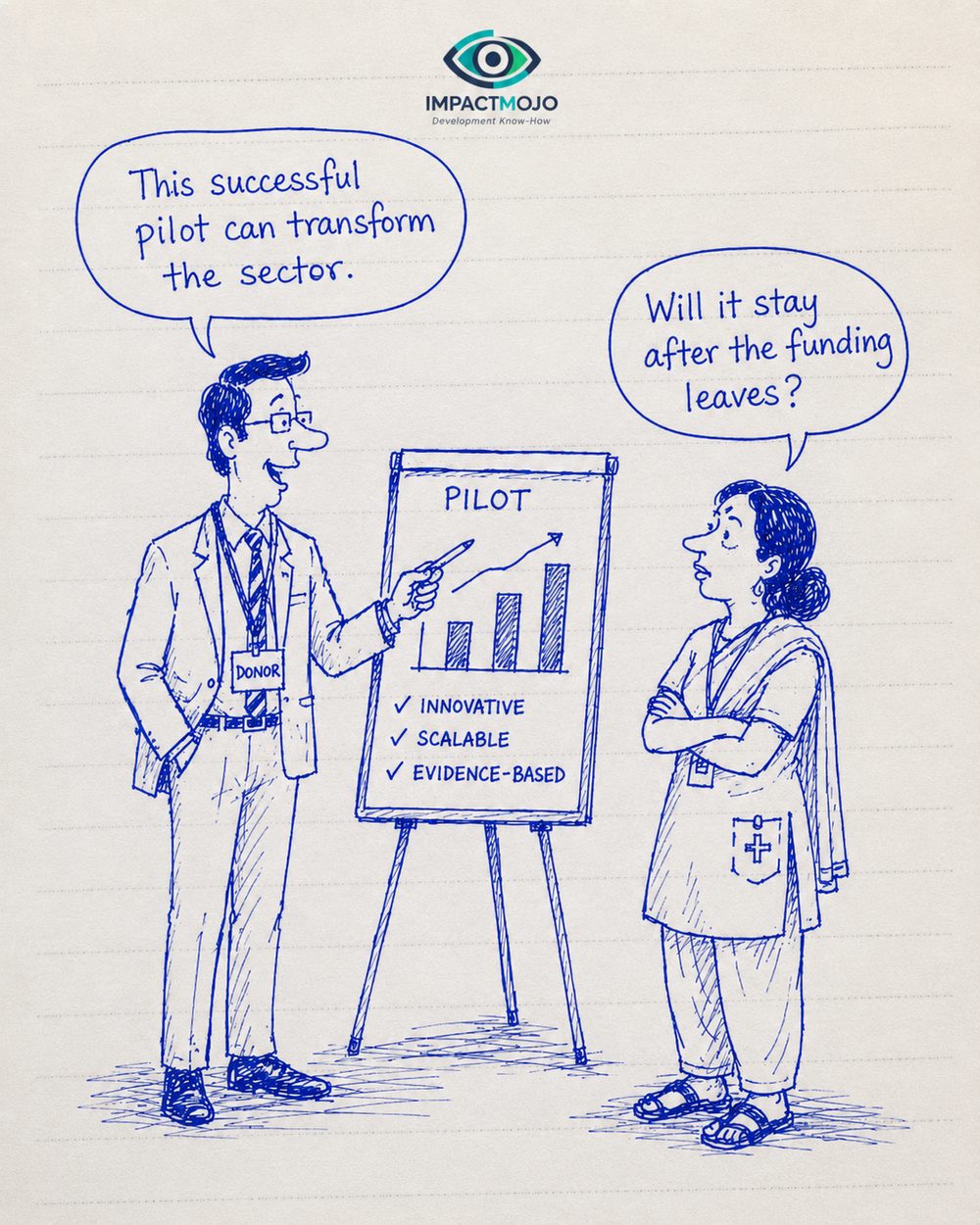
03 A donor representative in a suit by a chart labelled 'Pilot — Innovative, Scalable, Evidence-Based', saying 'This successful pilot can transform the sector.' A health worker with arms folded replies, 'Will it stay after the funding leaves?'
The pitch“This successful pilot can transform the sector.” The reply“Will it stay after the funding leaves?”

The pilot that never lands

The development and global-health worlds run on pilots, and they have a name for what happens next: pilotitis — the chronic inability to move beyond the pilot stage. The term crystallised around 2012, when practitioners noticed that the great majority of mobile-health pilots never reached scale.6

The pathology is structural, not accidental. Pilots are sized to donor grant cycles, so they are designed to demonstrate rather than to last. Uganda's experience became the cautionary tale: dozens of uncoordinated mHealth pilots ran at once, none interoperable or scalable, until the government called a moratorium on new ones.6 The reply in the cartoon — will it survive the funding cliff — is precisely the variable a pilot is built to ignore.

Sources: 6

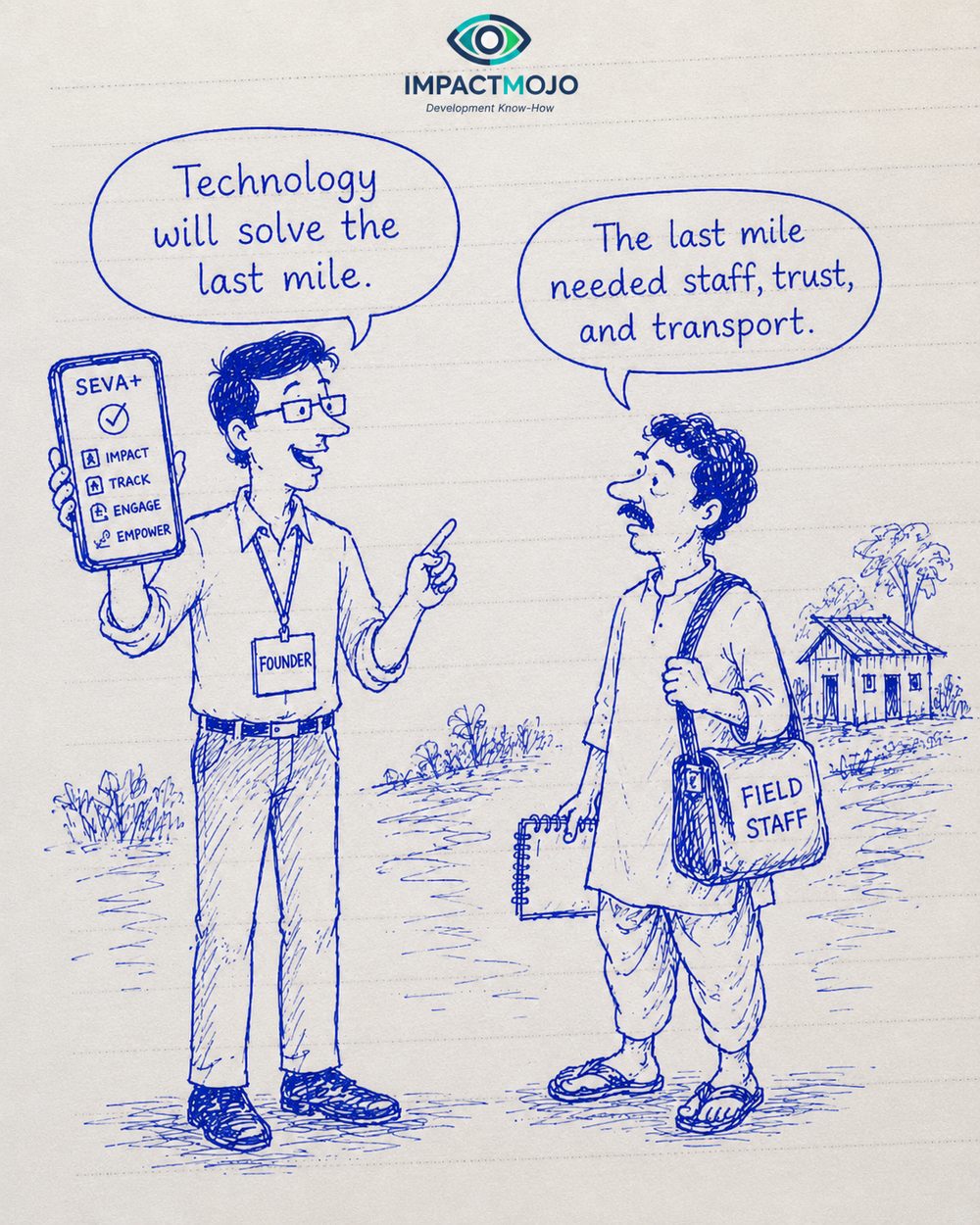
04 A founder holding up a smartphone app called 'SEVA+' with Impact, Track, Engage, Empower, saying 'Technology will solve the last mile.' A field staff member with a bag and notebook, standing near a hut, replies, 'The last mile needed staff, trust, and transport.'
The pitch“Technology will solve the last mile.” The reply“The last mile needed staff, trust, and transport.”

Technology amplifies; it does not substitute

Kentaro Toyama spent years building and watching technology projects across the global South before arriving at what he calls the Law of Amplification: technology amplifies existing human and institutional capacity and intent — it does not substitute for them.7

Where there are motivated staff, community trust and a way to physically get there, an app can multiply their reach. Where those are missing, the same app amplifies the absence — and the hardware ends up, in Toyama's phrase, gathering dust in a storeroom.7 The last mile is rarely a software problem. It is a staffing, trust and logistics problem wearing a software costume.

Sources: 7

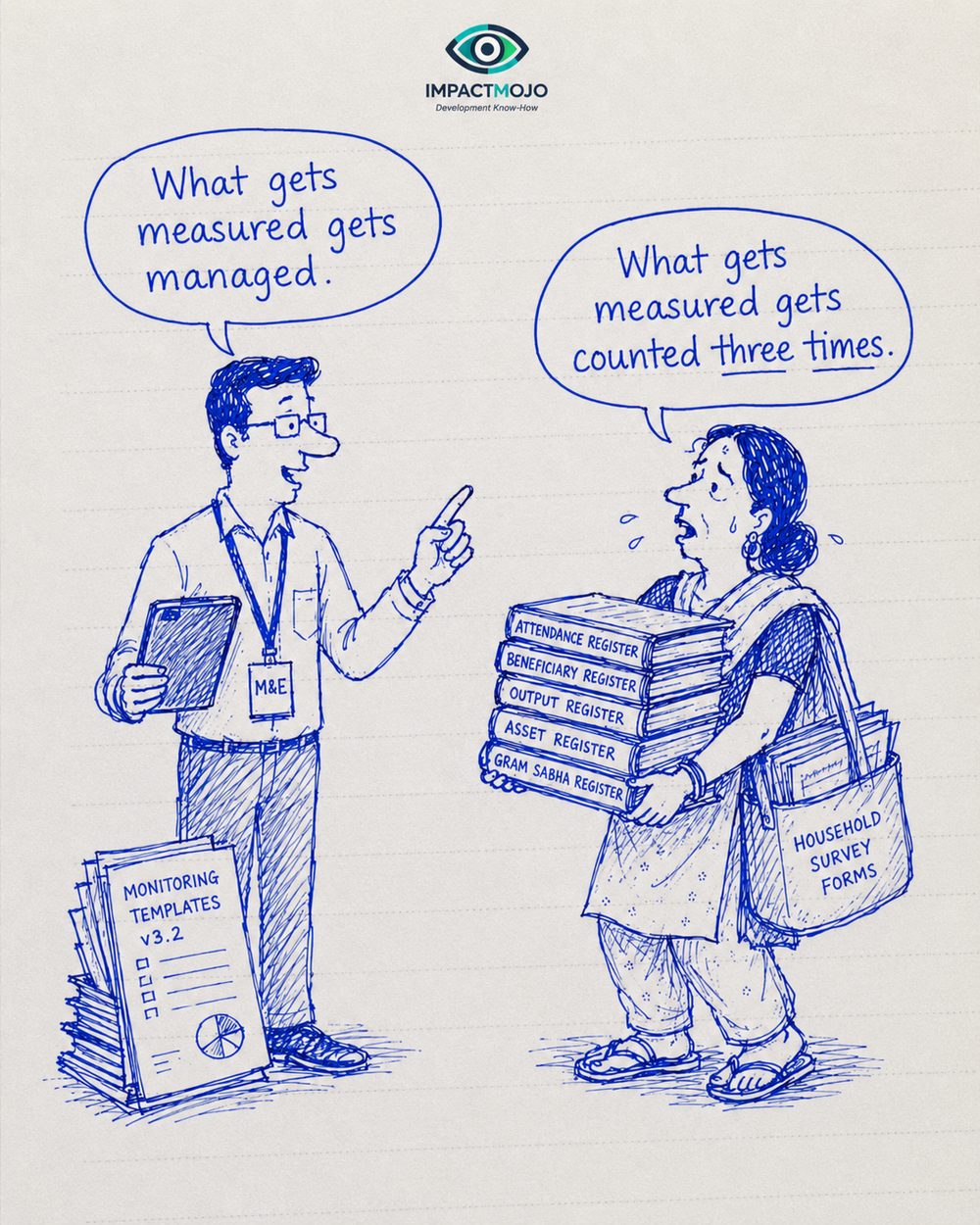
05 An M&E officer holding a tablet and pointing, saying 'What gets measured gets managed.' A woman carrying a tall stack of registers — attendance, beneficiary, output, asset, gram sabha — and a bag of household survey forms replies, 'What gets measured gets counted three times.'
The pitch“What gets measured gets managed.” The reply“What gets measured gets counted three times.”

The register that measures diligence, not health

The management cliché has an older, sharper cousin — Goodhart's Law: when a measure becomes a target, it ceases to be a good measure, because people optimise the number rather than the thing it was meant to represent.8

On the frontline, the cost is counted in hours. A five-country study of primary-care facilities found health workers spend on the order of nine hours a month — sometimes up to fifteen — simply filling reporting forms, often re-entering the same figures across overlapping registers.9 India's ASHAs now maintain ten-plus paper registers alongside a growing stack of apps and dashboards, so a single visit can be recorded three times over.10

“Counted three times” isn't a joke about innumeracy. It describes parallel reporting systems that measure the worker's diligence far more reliably than they measure anyone's health.

Sources: 8, 9, 10

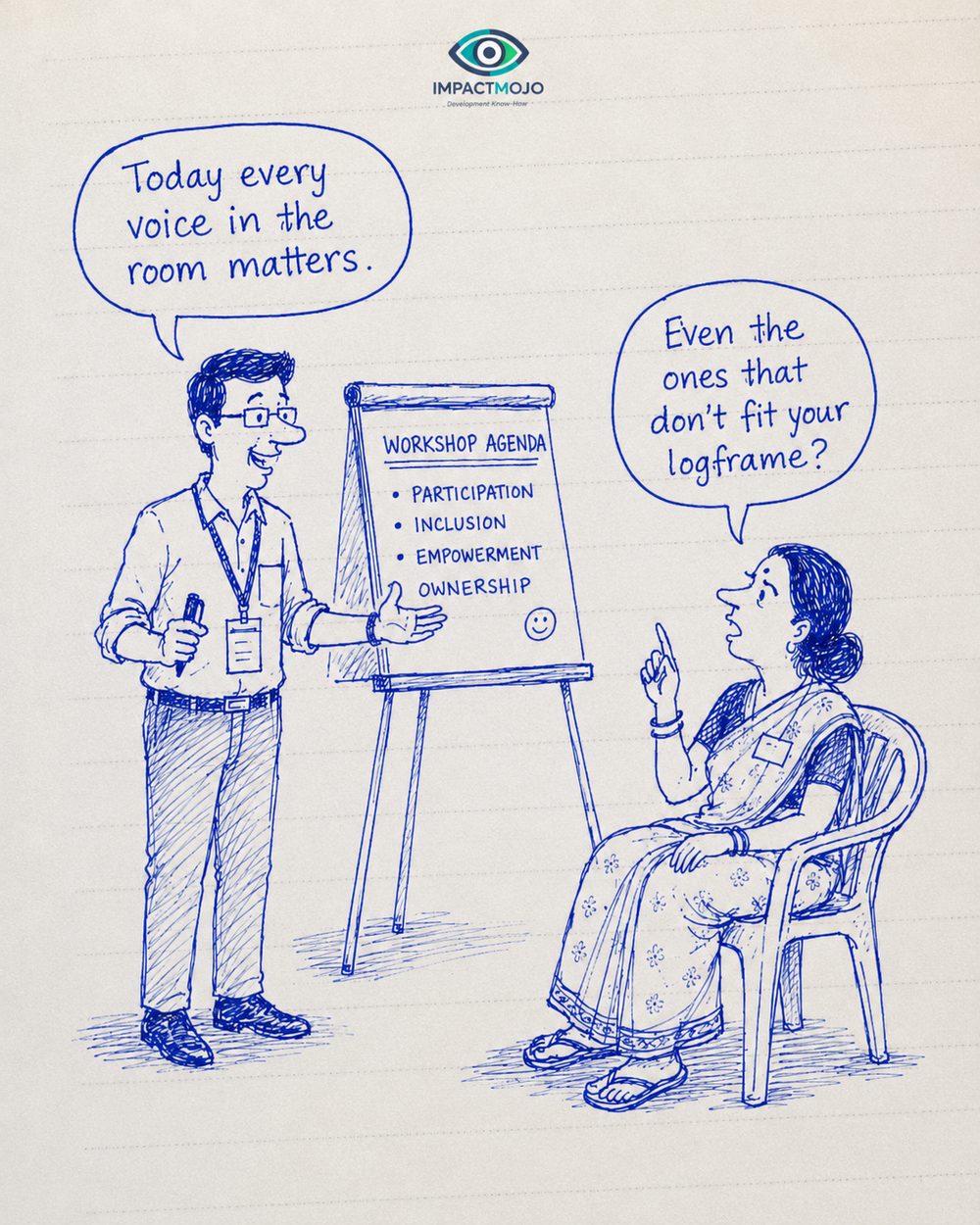
06 A facilitator at a flipchart headed 'Workshop Agenda — Participation, Inclusion, Empowerment, Ownership' with a smiley face, saying 'Today every voice in the room matters.' A seated woman raises a finger and replies, 'Even the ones that don't fit your logframe?'
The pitch“Today every voice in the room matters.” The reply“Even the ones that don't fit your logframe?”

The voices the grid can't hold

Participation is the sector's most democratic-sounding word. In Participation: The New Tyranny?, Bill Cooke and Uma Kothari argued that the rhetoric can mask its opposite — that “the discourse itself, and not just the practice, embodies the potential for unjustified exercises of power,” with funders retaining the real decisions beneath the language of inclusion.11

The logframe is where that filtering happens quietly. Objectives, indicators and activities are fixed in advance, in a grid; a voice that doesn't map onto a pre-agreed cell has nowhere to go in the document, however much it matters in the room. The reply isn't anti-participation — it asks whether the format can hear what it didn't already plan to ask.

Sources: 11

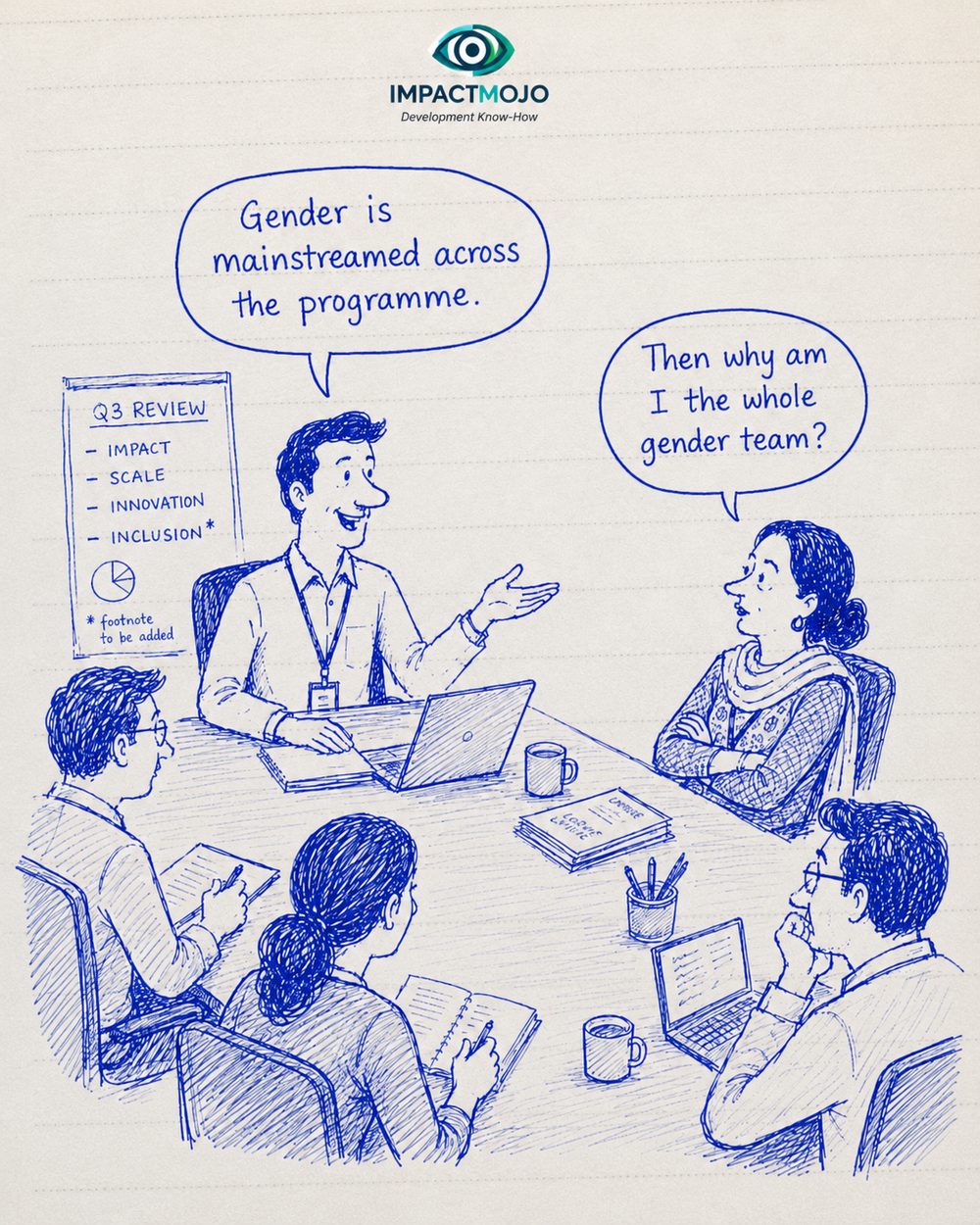
07 At a Q3 review meeting listing Impact, Scale, Innovation and Inclusion with a 'footnote to be added', a manager says 'Gender is mainstreamed across the programme.' A woman at the table replies, 'Then why am I the whole gender team?'
The pitch“Gender is mainstreamed across the programme.” The reply“Then why am I the whole gender team?”

The patriarchal cooking pot

In 1997 the Zambian feminist Sara Hlupekile Longwe gave the sector its most enduring image of how good intentions disappear: the patriarchal cooking pot. Development agencies, she wrote, take in policies for women's advancement and produce no output — the commitments “evaporate” inside a bureaucracy whose own culture they threaten.12

“Mainstreaming” can be the mechanism of evaporation rather than its cure. If gender is declared everyone's responsibility without budget, authority or accountability attached, it quietly becomes no one's — except the lone officer in the cartoon who is, in practice, the entire gender team. Mainstreamed, in that telling, means dispersed until invisible.

Sources: 12

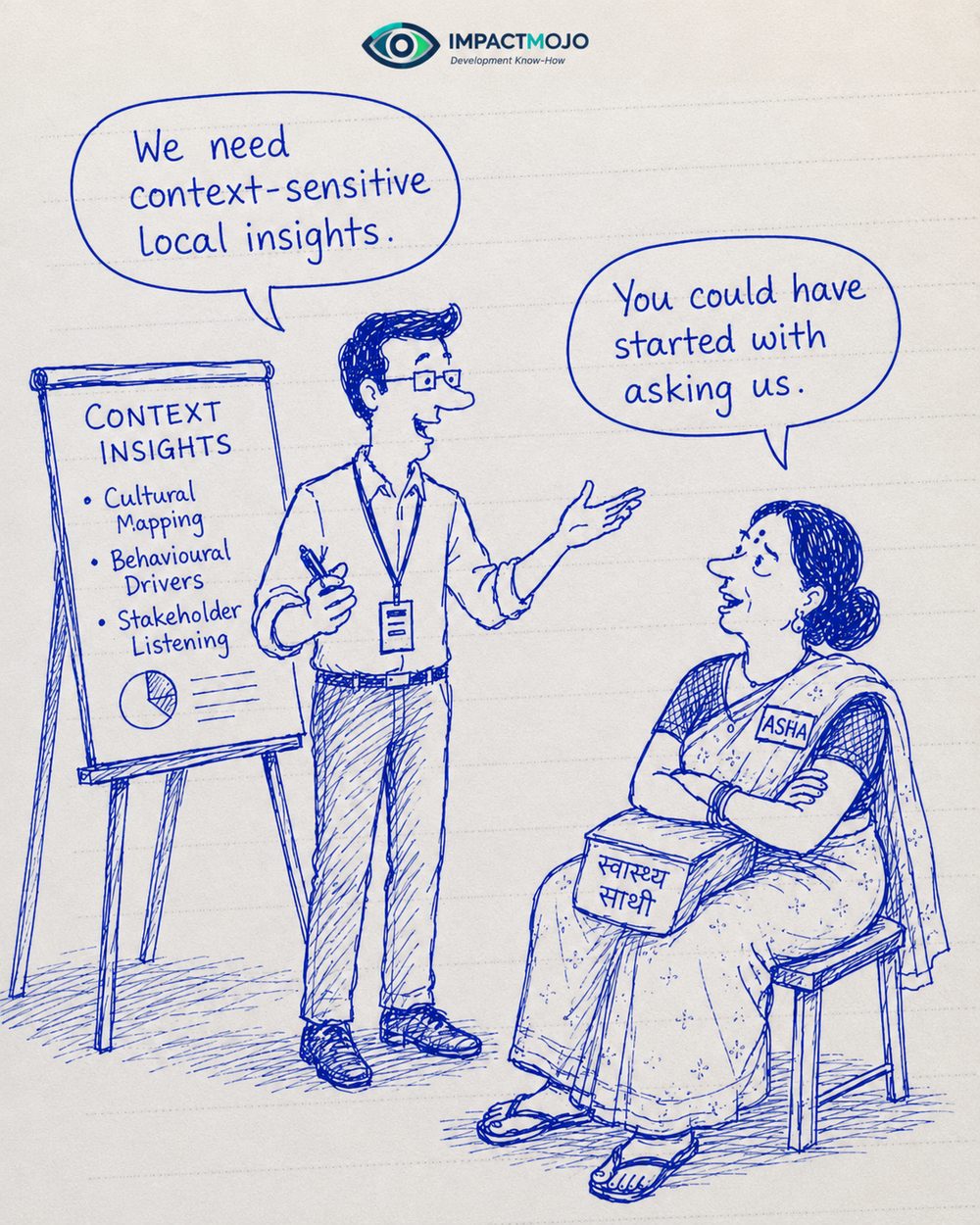
08 A facilitator at a flipchart headed 'Context Insights — Cultural Mapping, Behavioural Drivers, Stakeholder Listening', saying 'We need context-sensitive local insights.' A seated ASHA worker with a 'Swasthya Saathi' bag replies, 'You could have started with asking us.'
The pitch“We need context-sensitive local insights.” The reply“You could have started with asking us.”

Putting the first last

Robert Chambers built a career on a reversal he summed up as putting the first last. In Whose Reality Counts? he showed that rural people can analyse their own complex, diverse realities with precision — realities that frequently contradict the top-down version held by visiting professionals.13 The scarce resource is rarely local insight; it is outsiders willing to ask first and design second.

India already pays for that insight and then routes around it. More than a million ASHAs — women chosen by and embedded in their own communities — hold exactly the context-sensitive knowledge the flipchart is reaching for.14 The cartoon's line is not a complaint; it's a sequencing note. The listening was supposed to come before the workshop, not as its findings.

Sources: 13, 14

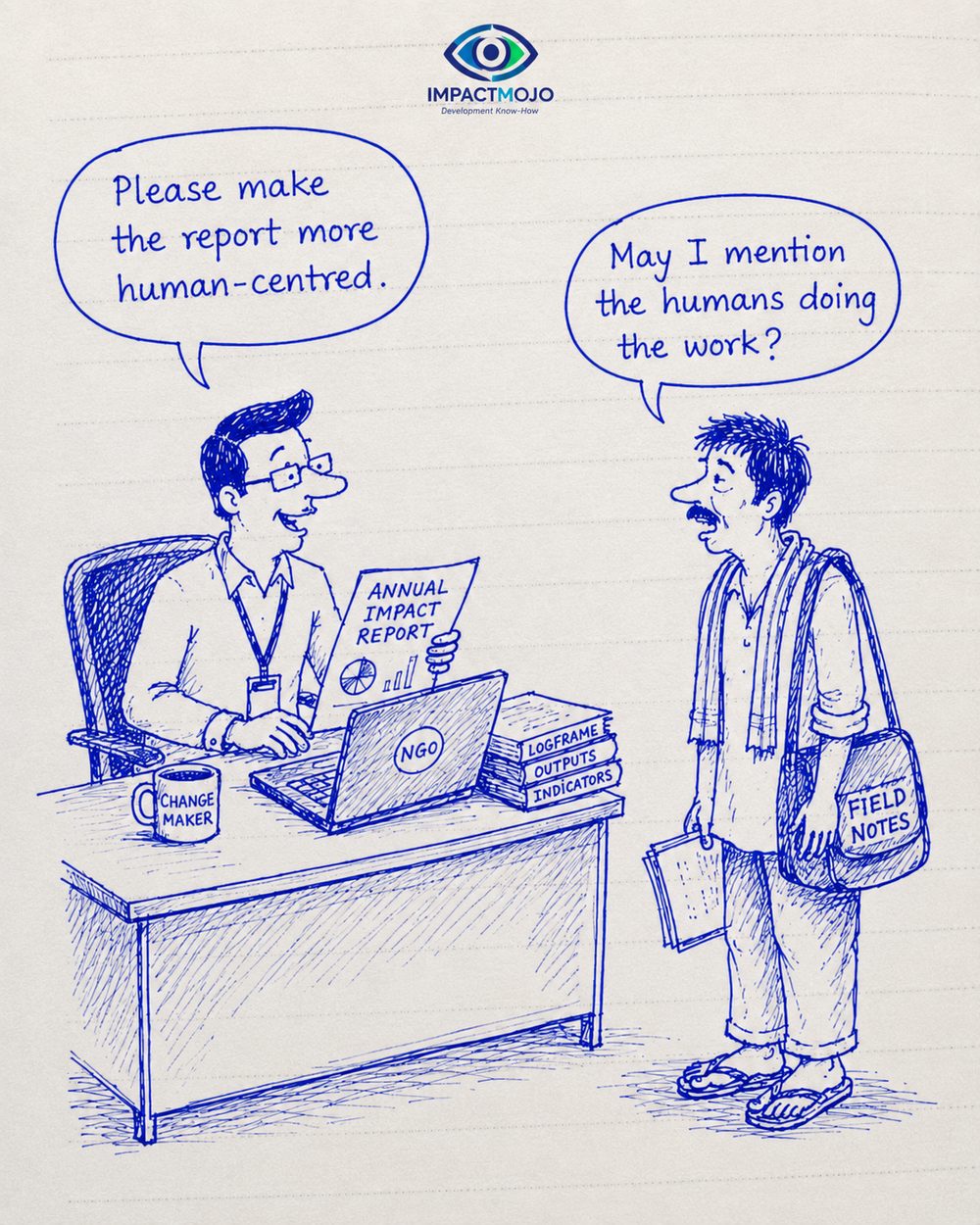
09 An NGO manager at a desk with an 'Annual Impact Report', a laptop and books labelled Logframe, Outputs and Indicators, saying 'Please make the report more human-centred.' A field worker with a 'Field Notes' bag replies, 'May I mention the humans doing the work?'
The pitch“Please make the report more human-centred.” The reply“May I mention the humans doing the work?”

The humans the report forgets

Impact reports are full of “beneficiaries” and conspicuously short on the people who produce the impact. The WHO estimates that around six million women work in health worldwide for no pay or below-market pay, effectively subsidising health systems with their labour — and roughly a quarter of those unpaid women are in India, mostly in community health roles.15

Women contribute about 5% of global GDP through health work — some US$3 trillion a year — of which nearly half is unrecognised and unpaid.16 A genuinely human-centred report would have a line for them. The field worker's request is modest and damning at once: before centring the humans, name the ones already holding the programme up.

Sources: 15, 16

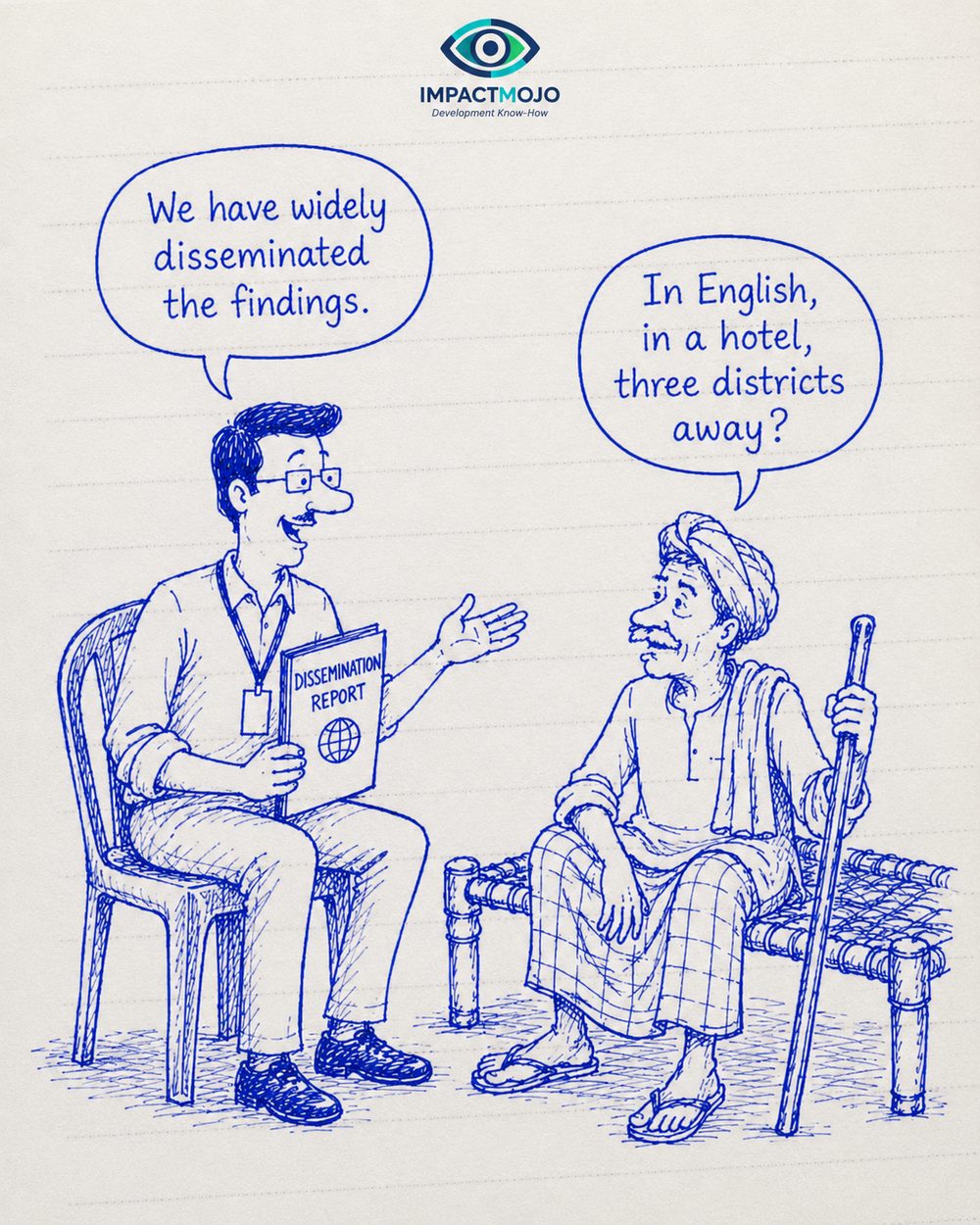
10 A researcher holding a 'Dissemination Report', saying 'We have widely disseminated the findings.' An older man seated on a charpai with a walking stick replies, 'In English, in a hotel, three districts away?'
The pitch“We have widely disseminated the findings.” The reply“In English, in a hotel, three districts away?”

Published, not shared

Dissemination is where knowledge is supposed to return to the people who supplied it. But India's 2011 Census recorded only about 10% of the population as able to speak English at all17 — so a report launched in English, in a district-town hotel, has by construction excluded almost everyone whose lives it documents.

The medium quietly selects the audience. A finding that never travels in the language, format or place of the community it studied has been published, not shared. It is a fitting last panel, because it asks the question the other nine circle around: when the sector talks about impact, who is actually in the room to hear it — and who was only ever in the data?

Sources: 17

A note on the joke

Every person in a lanyard in these cartoons is, mostly, trying. The point of the second speech bubble is not that the field is foolish — it's that the people closest to the work usually already know the thing the system is slowly, expensively rediscovering. The fastest way to be less ironic is to put them first.

Notes & Sources

  1. Peace Direct, Adeso, Alliance for Peacebuilding & WCAPS, Time to Decolonise Aid: Insights and Lessons from a Global Consultation (2021). — peacedirect.org
  2. Inter-Agency Standing Committee, “Why is the target of 25% of humanitarian funding to local and national actors so important?” (Grand Bargain). — interagencystandingcommittee.org
  3. Development Initiatives, “Funding to local and national actors,” Falling Short? Humanitarian Funding and Reform. — devinit.github.io
  4. Matt Andrews, Lant Pritchett & Michael Woolcock, Building State Capability: Evidence, Analysis, Action (Oxford University Press, 2017). — global.oup.com
  5. Lant Pritchett, Michael Woolcock & Matt Andrews, “Capability Traps? The Mechanisms of Persistent Implementation Failure,” Center for Global Development Working Paper 234 (2010). — cgdev.org
  6. GSMA Mobile for Development, “Pilot-itis: What's the cure?” (on the failure of mHealth pilots to scale, and Uganda's 2012 moratorium). — gsma.com
  7. Kentaro Toyama, Geek Heresy: Rescuing Social Change from the Cult of Technology (PublicAffairs, 2015); and “Technology as Amplifier in International Development,” iConference (2011). — kentarotoyama.org (PDF)
  8. On Goodhart's Law in health systems: “'When a Measure Becomes a Target, It Ceases to Be a Good Measure',” PMC. — pmc.ncbi.nlm.nih.gov
  9. “The burden of recording and reporting health data in primary health care facilities in five low- and lower-middle income countries,” BMC Health Services Research (2021). — ncbi.nlm.nih.gov
  10. New Lines Magazine, “India's Digital Health Push Is Overworking Its Front-Line Women” (ASHAs maintaining 10+ registers alongside apps and dashboards). — newlinesmag.com
  11. Bill Cooke & Uma Kothari (eds.), Participation: The New Tyranny? (Zed Books, 2001). — pure.york.ac.uk
  12. Sara Hlupekile Longwe, “The Evaporation of Gender Policies in the Patriarchal Cooking Pot,” Development in Practice 7(2): 148–156 (1997). — tandfonline.com
  13. Robert Chambers, Whose Reality Counts? Putting the First Last (Practical Action / ITDG, 1997); see also Rural Development: Putting the Last First (1983). — practicalactionpublishing.com
  14. India Development Review (IDR), “Who are India's frontline health workers and what do they do?” (more than 1 million ASHAs nationwide). — idronline.org
  15. World Health Organization, “Female health workers drive global health” (commentary). — who.int
  16. Women in Global Health, Subsidizing Global Health: Women's Unpaid Work in Health Systems (2022). — womeningh.org
  17. Census of India 2011, language data (about 10.2% of the population reported the ability to speak English); summarised in “Indian English,” Wikipedia. — en.wikipedia.org