Here is a pattern that plays out across the development sector: an organisation invests weeks developing a beautiful Theory of Change. Stakeholders are consulted. Pathways are mapped. Assumptions are identified. The ToC is printed in colour for the proposal. And then it sits in a drawer for three years until someone asks for it during the evaluation.
This pattern is one of the sector's most expensive forms of waste, because a ToC that nobody uses produces no learning, however sound it was.
Why ToCs die
The most common reason is simple: nobody builds in a process for reviewing them. Once the programme starts, operational pressures take over. Monthly reports track activities and outputs against indicators. Quarterly reviews focus on burn rates and deliverables. The strategic questions that the ToC is designed to answer: Is our theory of change still valid? Are our assumptions holding? Are we seeing the changes we expected?: never get asked.
A second reason is fear. If the ToC turns out to be wrong, perhaps falling into one of the common ToC pitfalls, what does that mean for the programme? For the team? For the relationship with the donor? The honest answer is that finding out your theory is wrong is valuable information, but saying so openly takes a level of psychological safety that many organisations lack. In a study of 51 work teams in a manufacturing company, Amy Edmondson found that team psychological safety, a shared belief that the team is safe for interpersonal risk-taking, was associated with learning behaviour (Administrative Science Quarterly, 1999).
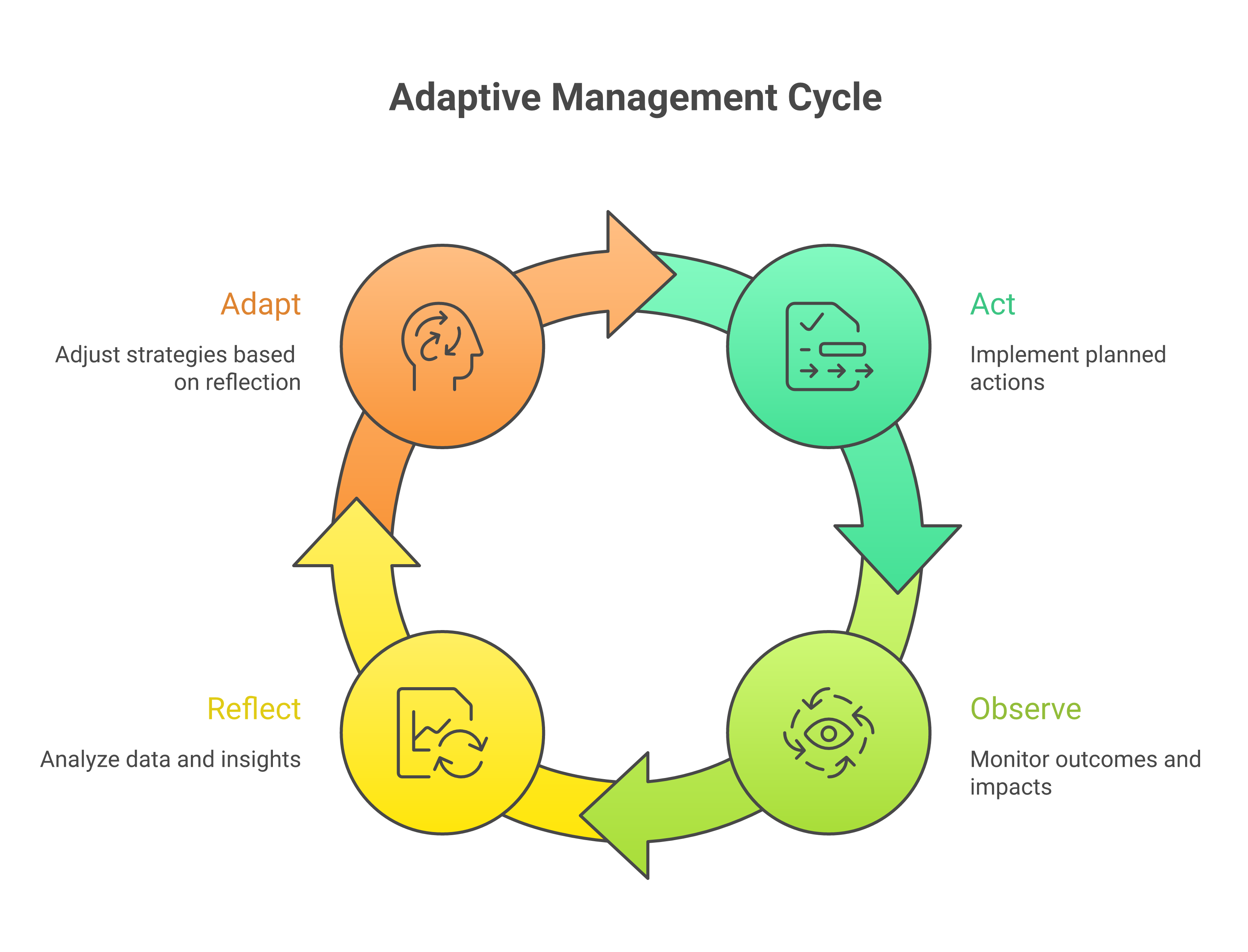
The adaptive management approach
Adaptive management treats programme implementation as a series of learning cycles rather than a fixed plan to be executed. The core cycle is: act → observe → reflect → adapt → act again. The term comes from natural resource management, where C. S. Holling and Carl Walters developed it in the 1970s (Holling, ed., Adaptive Environmental Assessment and Management, 1978). In development aid the idea gained ground through the 2014 Doing Development Differently manifesto, a statement from an October 2014 workshop at Harvard University, signed by more than 400 practitioners. It describes successful initiatives as working on problems that local people define, blending design and implementation "through rapid cycles of planning, action, reflection and revision", and managing risk by making "small bets". A development-sector method with the same logic is Problem-Driven Iterative Adaptation (PDIA), set out by Matt Andrews, Lant Pritchett and Michael Woolcock in a 2012 working paper. They argued that many reforms are isomorphic mimicry, in which governments pretend to reform by changing what policies or organisations look like rather than what they do, a dynamic that feeds "capability traps". A later paper in the series, Doing Iterative and Adaptive Work, covers the step after a problem has been identified: performing real-time experimental iterations.
DFID (now FCDO) and USAID jointly funded the Global Learning for Adaptive Management (GLAM) initiative, which ran from December 2017 to December 2021. ODI led the alliance, with IDS, Oxfam, the International Rescue Committee, Oxford Policy Management, Social Impact and ThoughtWorks as partners, and its stated aim was to identify, operationalise and promote rigorous evidence-based approaches to adaptive management. On the US side, USAID's Collaborating, Learning and Adapting (CLA) framework (the version for implementing partners) set out components of collaborating, learning and adapting to build into the Program Cycle, among them testing and exploring theories of change, plus enabling conditions such as organisational culture and resources. USAID stopped administering foreign assistance awards on 1 July 2025, so this describes the agency's practice up to then.
The key insight is that adaptation is a sign of learning. Programmes that never change course are rigid, whatever the quality of their management. For programmes operating in complex environments, this flexibility is essential.
Building review triggers
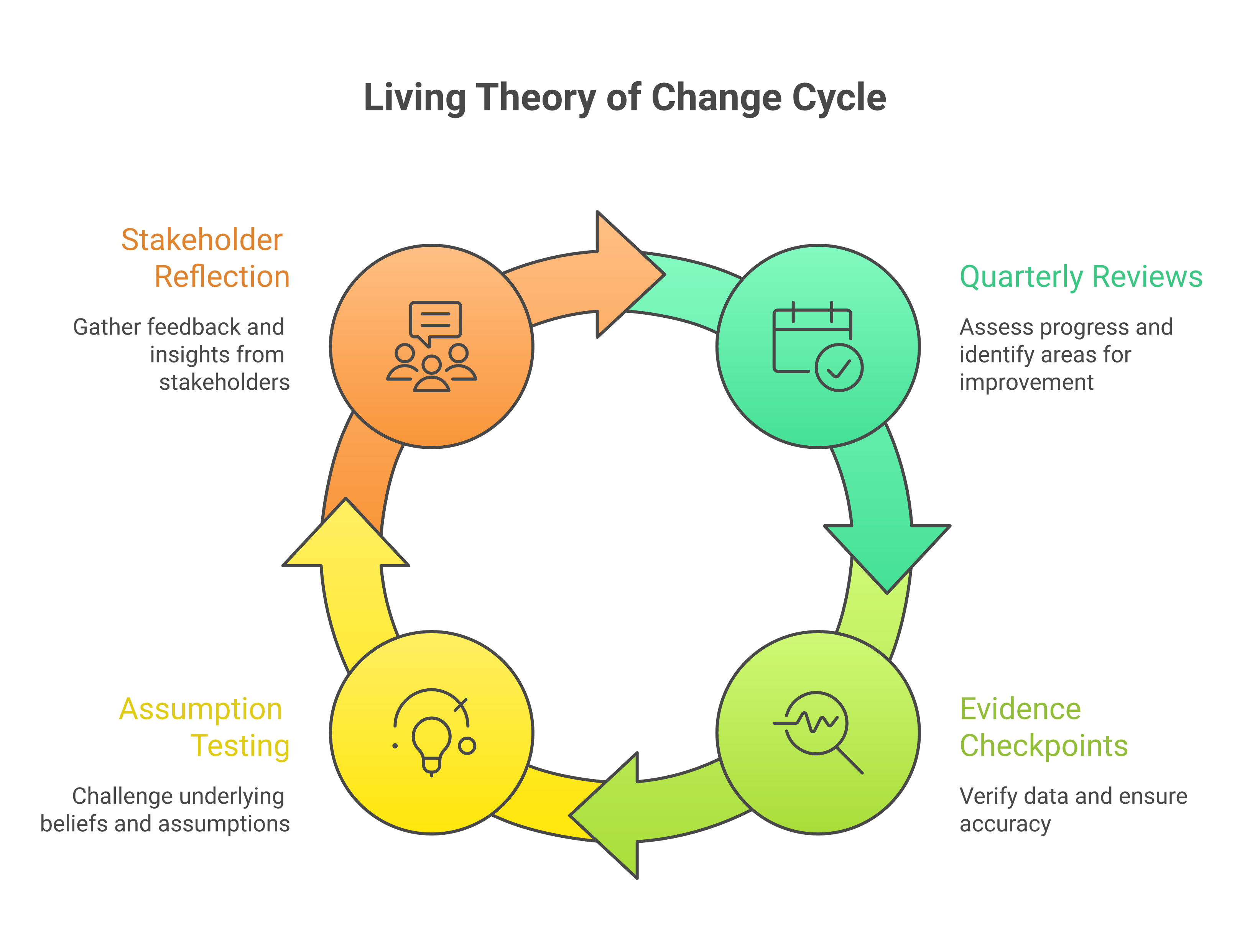
- Time-based: Quarterly ToC reviews built into the programme calendar
- Evidence-based: Automatic review when monitoring data shows unexpected patterns
- Context-based: Review when significant external changes occur (policy shifts, crises, elections)
- Milestone-based: Review at key programme transitions (pilot to scale, phase changes)
What a ToC review looks like
A quarterly ToC review need not be elaborate. In 2-3 hours, a programme team can address: Which assumptions have we tested or observed? What evidence supports or contradicts our causal pathways? What unexpected changes are we seeing? What should we do differently?
The discipline is in asking these questions regularly and acting on the answers. Document decisions and their rationale. Track adaptations over time. Share learning with stakeholders, including donors. Systematically testing your assumptions provides the evidence base for these reviews.
"The best Theory of Change is one that has been proven wrong in several places and updated accordingly. That is the scientific method applied to development."
When to pivot and when to persist
Not every piece of contradictory evidence warrants a change in strategy. The challenge is distinguishing between signal and noise: between evidence that your theory is fundamentally wrong and evidence that implementation needs adjustment.
Persistence is warranted when: the evidence is preliminary, the theory is supported by strong prior evidence, and the contradictory signal could be explained by implementation factors. Pivoting is warranted when: multiple sources of evidence converge, the assumptions underlying your pathway have clearly failed, and continuing the current approach would waste resources.
Making It Practical
Start with what you have. You do not need a perfect adaptive management system to begin. Schedule your first ToC review. Ask the hard questions. Document what you learn. Share it with your donor. Many of the largest funders have invested directly in adaptive approaches: USAID through CLA, DFID and USAID through GLAM, and the FCDO's Programme Operating Framework asks business cases to set out key assumptions in the theory of change "with an adaptive approach where evidence is weak". Honest learning is often more welcome than practitioners assume. And use tools like ImpactMojo's Theory of Change Studio to make the review process visual and collaborative.
The goal is a habit of asking whether your understanding of change still matches reality, and the courage to update it when it does not.
If you want to build this muscle properly, our free MEL course, The Evidence Question, covers adaptive management and treats adaptive learning as a core part of evaluation practice.