Rethinking who evaluates
For decades, the dominant model of development evaluation has positioned communities as subjects: sources of data to be extracted, analysed, and reported by external experts. Communities answer surveys, participate in focus groups, and share their stories, but they rarely shape the evaluation questions, design the methods, or interpret the findings. Building a culture of learning requires changing this dynamic. This extractive model is ethically problematic, and it produces worse evaluation as well. The CDA Collaborative's Listening Project, which gathered the views of nearly 6,000 people on the receiving end of aid across some 20 countries, found that recipients rarely ask for more aid; they ask for aid that listens, and the dominant, expert-driven model too often fails to hear what communities actually know (Anderson, Brown & Jean, Time to Listen, 2012). Communities understand their own realities in ways that external evaluators, however skilled, simply cannot.
Across South Asia, a quiet revolution is underway. Communities are moving from being objects of evaluation to active partners in it. Self-help groups are designing their own monitoring frameworks. Farmer producer organisations are collecting and analysing data on market access and crop yields. Youth volunteers are conducting neighbourhood-level assessments of service delivery. These experiments in participatory evaluation are producing richer, more actionable evidence, and fundamentally shifting power dynamics in the process.
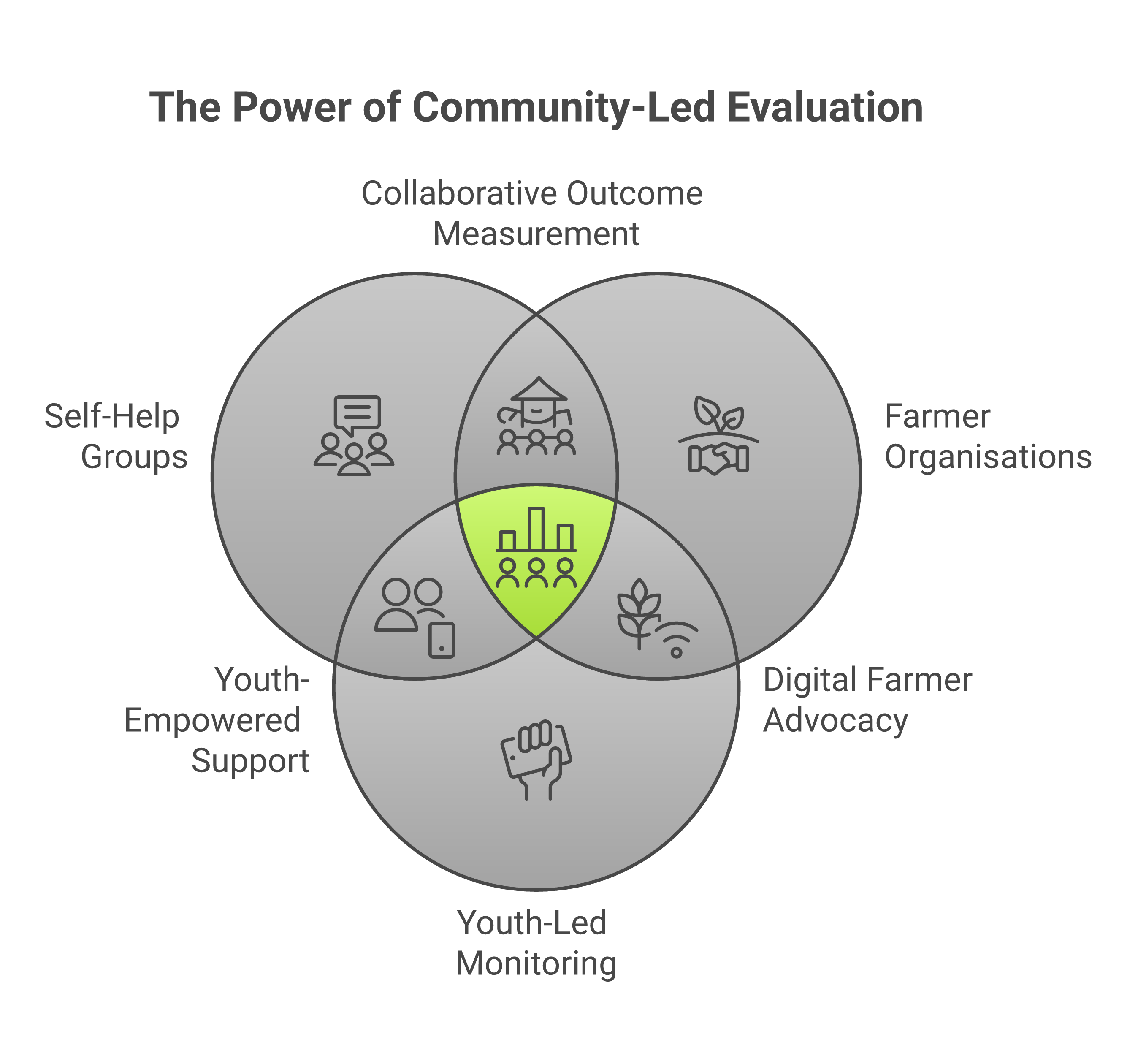
Self-help groups as monitors: Tamil Nadu
In the Dharmapuri district of Tamil Nadu, a federation of women's self-help groups (SHGs) has developed a remarkable community-led monitoring system for local government services. What started as informal complaints about non-functioning handpumps and absent health workers has evolved into a structured, data-driven accountability mechanism that local officials now take seriously.
The system works through a network of "community monitors": SHG members who collect monthly data on 15 indicators covering health services, water supply, school functioning, and public distribution system performance. The indicators were identified through a series of community assemblies where women articulated what mattered most to their families, and external consultants had no part in designing them. Clean water ranked above healthcare. Functioning anganwadis ranked above school infrastructure. The priorities reflected lived reality, and donor frameworks came second.
Data collection uses a simple paper-based system with colour-coded scorecards: green for satisfactory, yellow for needs improvement, red for non-functioning. Monthly data is aggregated at the federation level and presented to block-level officials at quarterly interface meetings. The approach echoes the community scorecard: a citizen-led monitoring tool, widely documented by the World Bank across South Asia, that pairs user-generated ratings of services with face-to-face interface meetings between communities and providers to agree on fixes. The simplicity of the system is its strength. SHG members with minimal formal education can collect, understand, and present the data. And because the monitors are community members who use the services themselves, the data has a credibility that external monitoring cannot match, a powerful lesson in data quality in the field.
The results have been tangible. In the first year, the proportion of functional handpumps in monitored villages increased from 60% to 85%. Health worker attendance at sub-centres improved from 65% to 82%. Notably, the district administration began requesting the SHG data for their own planning processes, a remarkable reversal of the usual information flow.
"When we started presenting data to the officials, they were surprised. They said, 'You have better information than we do.' That was the moment everything changed.": Lakshmi, SHG federation leader, Dharmapuri
Farmer producer organisations as data partners: Maharashtra
In Vidarbha, Maharashtra, a region scarred by agrarian crisis and farmer suicides, a network of farmer producer organisations (FPOs) has pioneered a participatory approach to monitoring agricultural livelihoods. The programme, supported by a national agricultural research institution, trains FPO members in simple data collection methods that serve both the farmers' own decision-making needs and the institution's research objectives.
Each participating FPO maintains a "crop diary" system where designated farmer-monitors record weekly observations on crop health, water availability, pest incidence, input costs, and market prices. The diaries use a combination of structured checklists and open narrative sections. The structured data feeds into a district-level database that researchers use for agricultural monitoring. The narratives capture qualitative insights (early warning signs, local coping strategies, market rumours) that quantitative systems miss entirely. This combination of structured and narrative data exemplifies the power of mixed methods.
What makes this system participatory is the feedback loop: what Keystone Accountability terms "Constituent Voice", the practice of collecting feedback, reporting back to the people who gave it and acting on what they say. Aggregated data is returned to FPOs in monthly bulletins that include price trend analyses, pest alerts, and comparative yield data across the network. Farmers reported that the bulletins helped them make better planting and selling decisions. The data flows in both directions, from farmers to researchers and from researchers back to farmers, creating a partnership instead of a one-way extraction pipeline. Reviews of beneficiary feedback mechanisms stress that a loop is only closed when the person who gave the input learns what happened with it (INTRAC, 2017), which is what the monthly bulletins do.
Youth as neighbourhood monitors: Kolkata
In three informal settlements along Kolkata's Eastern Metropolitan Bypass, a youth development programme has trained 45 young people aged 16-22 as "neighbourhood monitors" who conduct quarterly assessments of living conditions, service access, and safety in their communities. The programme challenges the assumption that rigorous monitoring requires professional evaluators.
Youth monitors use a mobile phone-based tool to document conditions across six domains: water and sanitation, road access, electricity, safety (particularly for women and girls), waste management, and access to government schemes. They photograph infrastructure problems, geo-tag service delivery points, and record short video testimonials from community members. The data is uploaded to a shared dashboard visible to both the community and local ward councillors.
The programme's most innovative feature is the "community report card": a quarterly public event where youth monitors present their findings to an audience of residents, local officials, and NGO staff. These events have become forums for real dialogue about priorities and accountability, a living example of what the Core Humanitarian Standard, stewarded by the CHS Alliance, frames as a commitment to affected communities: that people can safely raise concerns and complaints and see them addressed. In one memorable session, youth monitors presented data showing that 70% of streetlights in their settlement were non-functional. The ward councillor, present in the audience, committed to repairs within a month, and youth monitors followed up to verify compliance.
Beyond its accountability function, the monitoring programme has had profound effects on the young monitors themselves. Participants report increased confidence, improved analytical skills, and a stronger sense of civic agency. Several have gone on to community organising roles. The programme demonstrates that participatory evaluation can be simultaneously a data collection strategy and a youth development intervention.
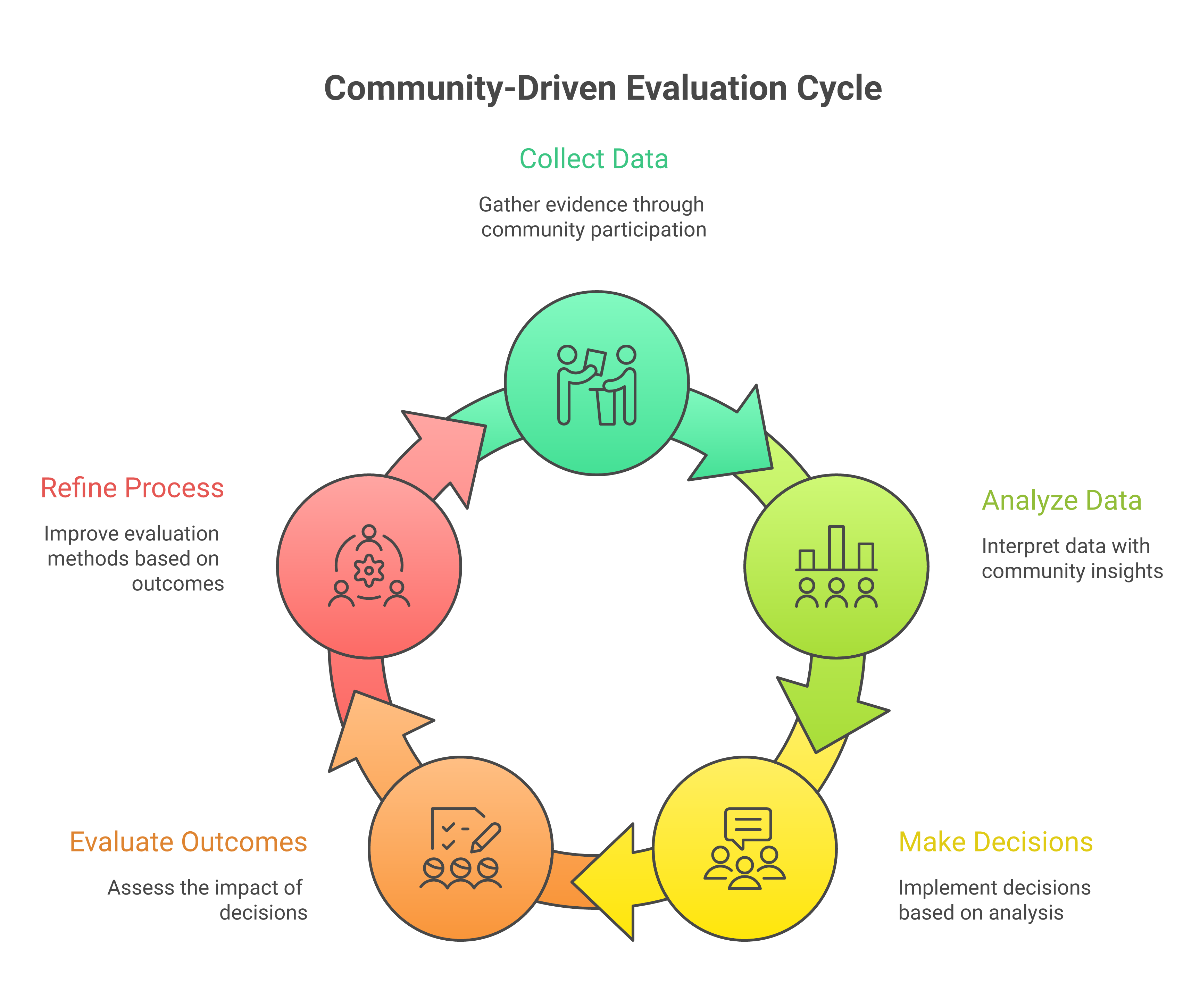
The path forward
These three examples share a common thread: they treat communities as active knowledge producers. The evidence they generate is as rigorous as any other, and in many cases it is more valid because it is grounded in contextual understanding that external evaluators lack. The stakes are real: Ground Truth Solutions, which runs one of the largest databases of feedback from people affected by crisis, consistently finds that most aid recipients feel they have little say over the help they receive: in some recent surveys, only around a third believed they could influence the response at all. For the development sector in South Asia, the more pressing question now is how to scale participatory monitoring while preserving the community ownership that makes it powerful. The broader South Asian development landscape increasingly supports this shift toward localisation. Doing so responsibly also requires attention to ethical research practices.
To situate these approaches within a broader evaluation practice, our free MEL course, The Evidence Question, covers participatory and community-led methods alongside the conventional toolkit.