In conventional evaluation, communities are subjects: people from whom data is extracted. In participatory MEL, communities become agents: people who define what success looks like, collect their own evidence, and use findings to drive their own priorities.
The shift is about power: who decides what gets measured, who interprets the findings, and who benefits from the knowledge produced. Robert Chambers put this at the centre of development practice with his book Whose Reality Counts?, which sets the priorities of poor people against those of distant professionals (Chambers, Whose Reality Counts?, 1997, Intermediate Technology Publications). The ethical dimensions of research in South Asia make these questions especially urgent.
What makes MEL participatory
Participatory MEL gives communities real influence over the evaluation questions, the methods used, the interpretation of findings, and the decisions that follow. Helping to collect data for someone else's framework does not meet that bar.
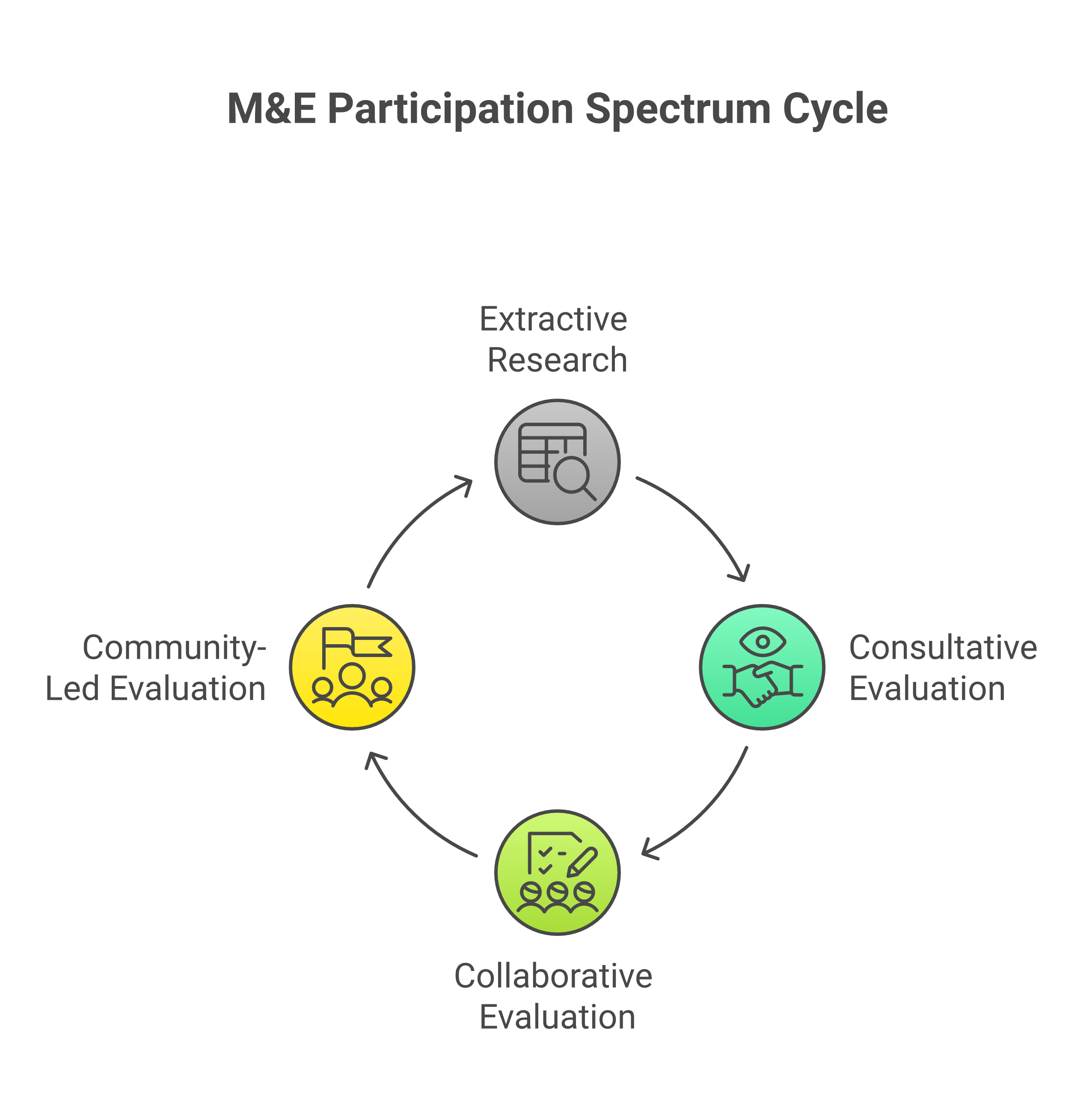
The spectrum ranges from consultative participation (asking communities for input on externally designed frameworks) to transformative participation (communities designing and conducting their own evaluations with external support). Published typologies use different labels along the same line. Sarah White (1996, Development in Practice) separates nominal, instrumental, representative and transformative participation, and Jules Pretty (1995, World Development) lists seven forms, from manipulative participation to self-mobilisation. The IDS literature review by Estrella and Gaventa, Who Counts Reality? (1998), remains the foundational survey of how these approaches differ across stakeholders and contexts, and covers how participatory monitoring and evaluation has been used by NGOs, donors, governments and communities.
Methods that work
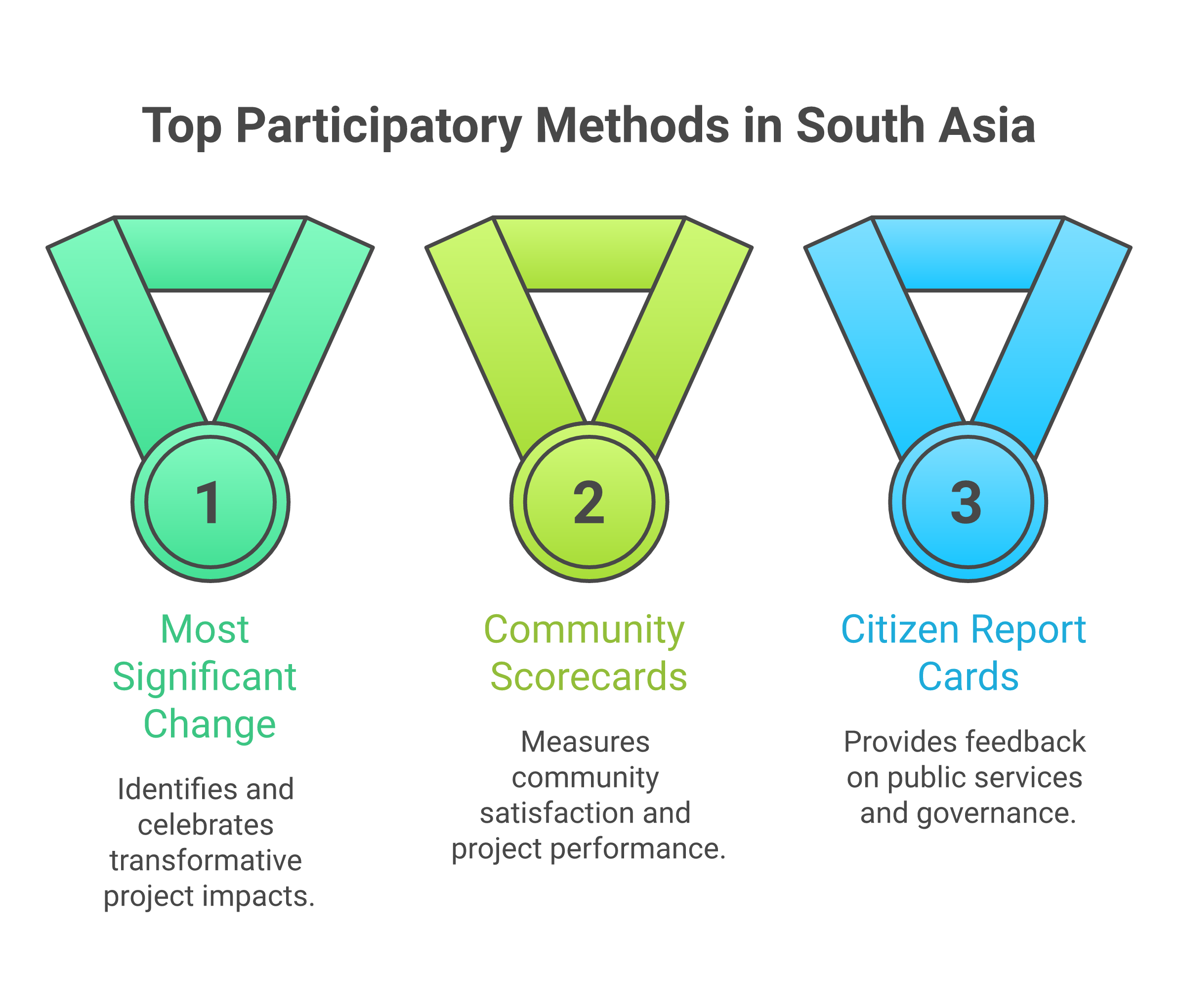
Most Significant Change (MSC), developed by Rick Davies and Jess Dart, asks stakeholders to share stories of the most significant change they have observed; stories are then discussed, selected, and analysed collectively through layers of an organisation. Their Guide to Its Use (2005) sets out the technique in ten steps. MSC is particularly powerful for capturing unexpected outcomes and understanding why change happens as well as whether it happens, because the stories come from participants rather than from a list of indicators and each one records why the change matters to the person telling it.
Community scorecards (a hybrid of social audit, community monitoring, and citizen report cards) enable communities to assess service quality against their own criteria, creating structured dialogue between service providers and users and forming powerful community feedback loops. The Centre for Good Governance's 2006 pilot in Andhra Pradesh applied the tool to two primary health centres.
Participatory ranking and mapping methods allow communities to identify and prioritise issues using their own knowledge. Wealth ranking, resource mapping, and seasonal calendars capture information that standard surveys miss.
Citizen report cards, first used in Bangalore in 1993 by Samuel Paul and colleagues, who went on to set up the Public Affairs Centre in 1994. The method uses large-scale surveys of households that use public services, designed with community input, and publishes the results as evidence for advocacy, so that the agencies concerned come under public pressure to improve. The first Bangalore report card covered eight agencies, including the Electricity Board, the Water and Sewerage Board and Telecom, and the exercise was repeated in 1999. The Public Affairs Centre later carried out report cards in other Indian cities, and the original Bangalore report cards became a model later adapted across India and beyond.
Where evaluation needs to track changes in the behaviour of actors a programme can influence but not control, outcome mapping (developed by Sarah Earl, Fred Carden, and Terry Smutylo at Canada's IDRC (2001)) offers a participatory alternative to rigid logframes by tracking changes in the behaviour, relationships, activities and actions of the people and organisations a programme works with directly, which it calls "boundary partners."
When to use participatory approaches
- When you need to understand why change is or isn't happening as well as whether
- When community ownership of findings matters for sustainability
- When standard indicators miss what communities actually value
- When power imbalances between organisations and communities need addressing
- When local knowledge is essential to interpreting quantitative data
South Asian examples
India's self-help group movement offers one of the world's largest examples of participatory monitoring. SHGs track their own savings, loan repayment, and meeting attendance. Under the National Rural Livelihoods Mission (launched in June 2011 and built on the principle that the poor and their institutions lead planning, implementation, and monitoring), community resource persons drawn from the groups themselves train others in basic book-keeping, data collection, and analysis. The Ministry of Rural Development's capacity-building handbook sets out training in keeping SHG books, for community resource persons, and for the monitoring sub-committees of village and cluster federations. The data may not meet academic standards of rigour, but it serves its primary purpose: enabling groups to manage themselves.
A related model is the community-led social audit of MGNREGA, India's rural employment guarantee. Under the government's social audit initiative, local auditors, in Bihar women affiliated with self-help groups, hold community meetings to assess whether MGNREGA is working as intended, as described by researchers at Yale's Inclusion Economics, who are now studying the expanded audits. (MGNREGA was repealed from 1 July 2026 and replaced by the Viksit Bharat G RAM G Act 2025, which raises the guarantee to 125 days.) The evidence on what such audits achieve is mixed. A study of Andhra Pradesh found a modest fall in leakage per labour-related irregularity and a positive but statistically insignificant effect on employment, and repeated audits did not deter irregularities (Afridi and Iversen, 2014).
In Nepal, community-based organisations working on forest management have used participatory monitoring for decades. The 1993 Forest Act gave forest users' groups legal rights over community forests. From 2003, Bird Conservation Nepal, the Federation of Community Forest Users, Nepal (FECOFUN), IUCN-Nepal and two forestry projects piloted a scheme in which the groups gather the biodiversity information they need to manage their own forests (Vickers, RECOFTC). Community forest user groups track forest health, resource extraction, and benefit distribution using locally meaningful indicators.
The most rigorous evaluation is useless if nobody acts on it. The most imperfect community assessment is valuable if it drives real improvement.
Challenges and limits
Participatory MEL has limits. Power dynamics within communities mean that participatory processes can be captured by local elites, and gender, caste and class shape whose voice is heard in "community" discussions. Facilitation skill matters enormously: poor facilitation produces participation theatre rather than real engagement.
There is also a tension between participatory approaches and donor requirements for standardised, comparable data. Data quality standards designed for controlled settings may not fit participatory contexts. Reconciling locally meaningful indicators with globally comparable metrics remains an ongoing challenge.
Getting started
Start small. Choose one component of your monitoring system and explore how communities could contribute meaningfully. It could be as simple as community-defined indicators alongside your standard ones, or as ambitious as community-led data collection with training and support. The test is whether power is actually shared. A consultation after which nothing changes does not count.
Our free MEL course, The Evidence Question, covers the wider MEL toolkit, from theory of change and indicator design to data collection, evaluation design and learning systems, so you can judge where participatory methods fit.