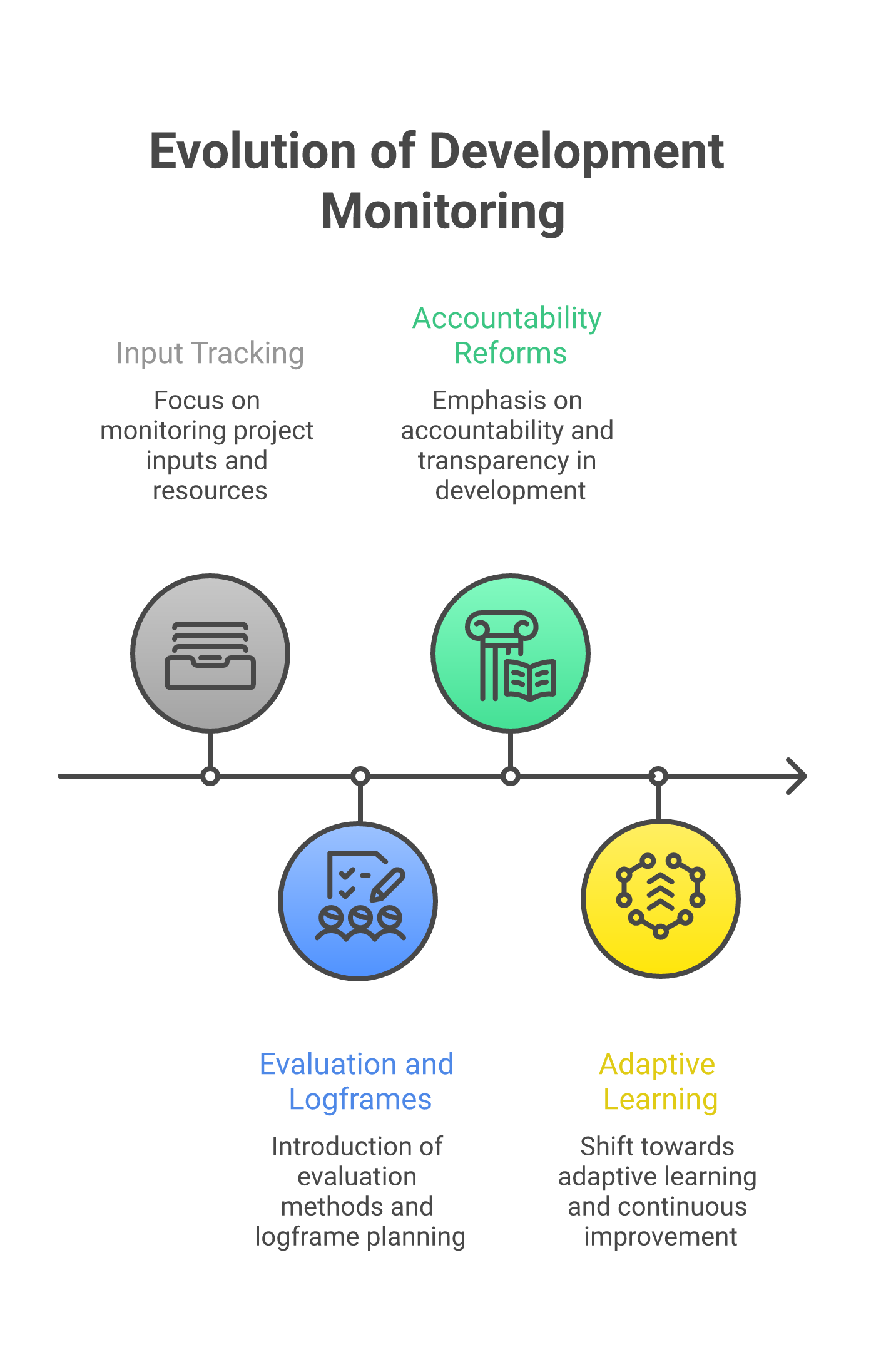
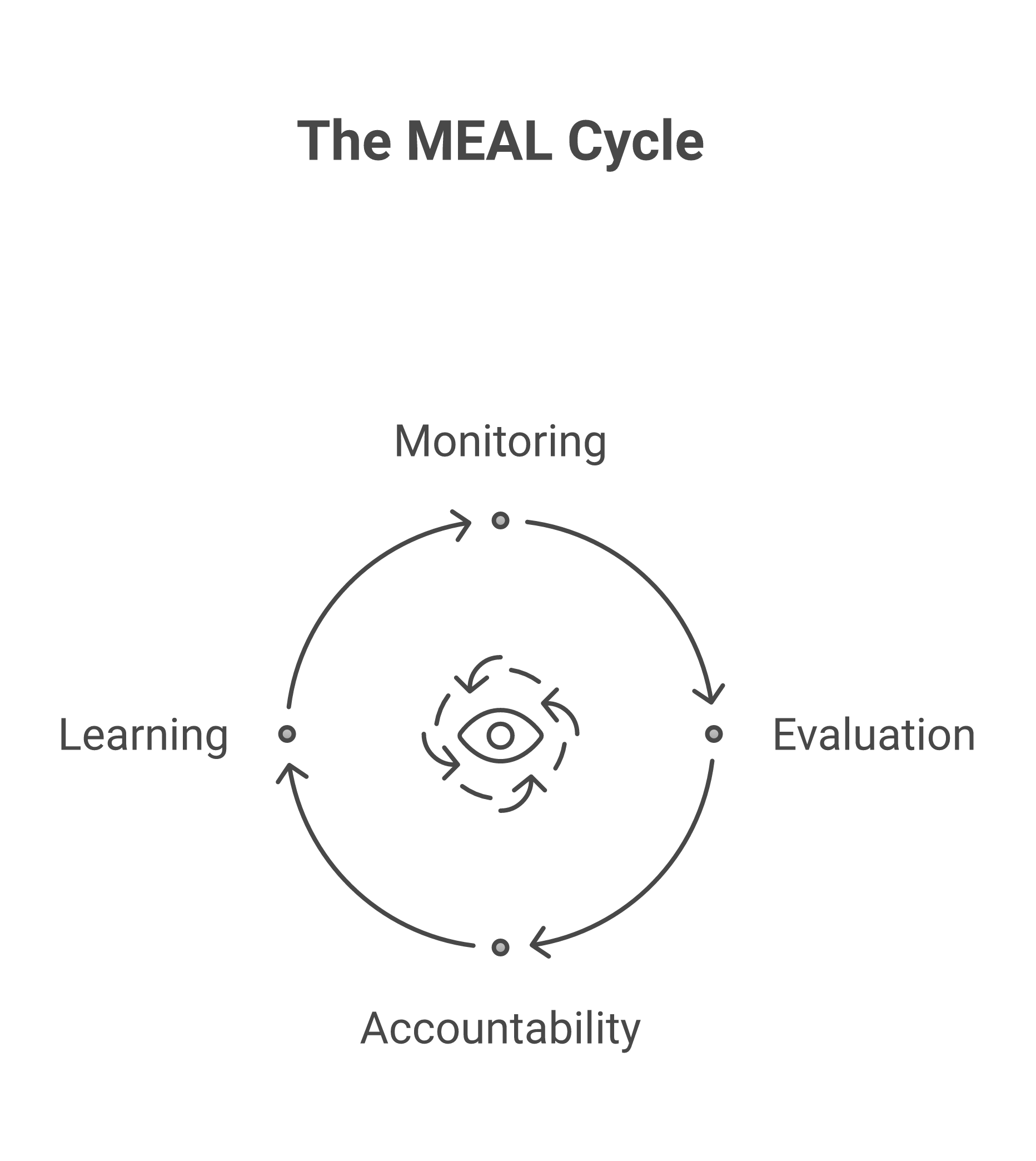
The acronym MEAL (Monitoring, Evaluation, Accountability, and Learning) is so commonplace in the development sector today that it is easy to forget how recently it emerged. The path from simple project monitoring to the integrated framework we use now reflects decades of hard-won lessons about what it takes to create lasting change. This post follows the main steps, from input tracking to the combined practice many organisations call MEAL.
The early days: monitoring as bookkeeping (1960s–1970s)
In the early decades of international development, monitoring meant tracking money. Did the funds arrive? Were they spent as planned? Colonial-era and post-independence development programmes focused on input tracking: how many wells built, how many schools constructed, how many tonnes of grain distributed.
This approach treated development as an engineering problem: design the intervention, allocate resources, deliver outputs. The assumption was that if inputs were correct, outcomes would follow automatically. There was little systematic effort to check whether this assumption held.
By the late 1960s the problem was visible inside the largest donor. In 1969 USAID commissioned Practical Concepts Incorporated (PCI) to analyse its project evaluation system. PCI later described three basic problems: planning was too vague, so evaluators could not compare what was planned with what happened; management responsibility was unclear; and evaluation was an adversarial process.
Project managers, PCI wrote, were reluctant to be held responsible for impact because too many important factors lay outside their control. Those three findings are what the logical framework was built to address.
The rise of evaluation (1980s–1990s)
The 1980s brought a fundamental shift. Donors and governments began asking "did it work?" as well as "what did we do?" The logframe then spread among aid agencies. The logical framework (logframe) was developed in the late 1960s, in 1969 for USAID by Leon J. Rosenberg, first while at Fry Consultants and then through his firm Practical Concepts Incorporated, after USAID commissioned an analysis of its own project evaluation system, at a time when Congress was pressing the agency to show whether its projects actually achieved their goals. The original USAID version was a 4x4 matrix. Variants of the matrix, laying out objectives, indicators, means of verification, and assumptions, have been used by agencies including Sida, NORAD, GIZ and DFID. By the 1980s the matrix had been adopted across the major donors and had become the default planning and monitoring tool.
This era saw the rise of impact evaluation as a discipline. Randomised controlled trials (RCTs), long established in medical research, began appearing in development contexts. The World Bank and bilateral donors invested heavily in evaluation departments. The OECD Development Assistance Committee (DAC) codified its influential evaluation criteria in 1991 (relevance, effectiveness, efficiency, impact, and sustainability), which remain the benchmark today. The DAC added a sixth, coherence, in its 2019 revision.
"The logframe gave us structure. But structure without learning is just bureaucracy with better formatting."
"[Project managers] ended up not accepting any responsibility for results.": Practical Concepts Incorporated on its 1969 analysis for USAID, The Logical Framework: A Manager's Guide (1979)
Yet evaluation remained largely an external exercise. Consultants arrived at programme end, produced reports that few read, and departed. The gap between evaluation findings and programme improvement was enormous. Evaluation in these years was often an adversarial exercise, as PCI's account of USAID in 1969 shows. In the mid-1990s evaluator Carol Weiss made the case for theory-based evaluation: her 1995 essay "Nothing as Practical as Good Theory" argued that evaluations should rest on the theory of change behind an intervention, and that programmes are hard to evaluate because the assumptions behind them are rarely made explicit, an idea that fed the theory of change thinking that later became common in the sector.
The accountability turn (2000s)
Accountability to the people aid is meant to serve became a formal concern in humanitarian work around the turn of the century. The Sphere Handbook, first published in 2000, set minimum standards for humanitarian response. The Humanitarian Accountability Partnership (HAP) was established in 2003 as the sector's first international self-regulatory body. The 2004 Indian Ocean tsunami and the humanitarian response that followed revealed systematic failures in how aid organisations answered to affected communities, and the Tsunami Evaluation Coalition published a joint evaluation of it in 2006.
The Paris Declaration on Aid Effectiveness (2005) and the Accra Agenda for Action (2008) extended accountability to the relationship between donors and partner countries. The Paris Declaration's five principles are ownership, alignment, harmonisation, managing for results, and mutual accountability.
This period transformed M&E into MEA: Monitoring, Evaluation, and Accountability. Organisations began establishing complaint mechanisms, feedback loops, and transparency standards. The acronym had its first expansion.
The learning revolution (2010s)
The final piece, Learning, emerged from frustration. Despite decades of monitoring and evaluation, the development sector kept repeating the same mistakes. Evaluation reports gathered dust. Monitoring data sat in spreadsheets that nobody analysed. The problem was a learning deficit, and information was plentiful. Former USAID administrator Andrew Natsios captured a related danger in his 2010 essay "The Clash of the Counter-bureaucracy and Development", warning that "those development programs that are most precisely and easily measured are the least transformational, and those programs that are most transformational are the least measurable."
This was also the decade of the so-called credibility revolution. Randomised evaluations became prominent in development economics. The Abdul Latif Jameel Poverty Action Lab (J-PAL), founded at MIT in 2003 by Abhijit Banerjee, Esther Duflo and Sendhil Mullainathan, helped make them central to the field. Banerjee and Duflo, with Michael Kremer, won the 2019 Nobel Memorial Prize in Economics for their experimental approach to alleviating global poverty.
In parallel, the adaptive management movement took institutional form at USAID, which introduced guidance on its Collaborating, Learning, and Adapting (CLA) framework in 2010 on an experimental basis and put it into formal agency guidance in 2012. The movement, championed by organisations like DFID (now FCDO) as well as USAID, argued that programmes needed to be designed for learning as well as measurement. USAID was closed on 1 July 2025, and its remaining programmes moved to the State Department.
Key milestones in the history of MEL
- 1969: Leon Rosenberg develops the Logical Framework for USAID
- 1991: OECD DAC publishes evaluation criteria
- 1995: Carol Weiss makes the case for theory-based evaluation
- 2000: Sphere Handbook first edition
- 2003: HAP established; J-PAL founded at MIT
- 2005: Paris Declaration on Aid Effectiveness
- 2012: USAID puts Collaborating, Learning, and Adapting into formal guidance
- 2019: OECD DAC criteria updated (adds coherence)
MEAL in South Asia today
South Asia offers its own examples. India's Deendayal Antyodaya Yojana-National Rural Livelihoods Mission (DAY-NRLM) had mobilised 10.05 crore rural women households into more than 90.90 lakh self-help groups by mid-2025, according to the Ministry of Rural Development. It is one of the largest community-driven M&E systems in the world, with self-help groups conducting their own monitoring, and a very large base for community-driven M&E systems. In Bangladesh, BRAC set up a Research and Evaluation Division in 1975, inside the organisation, to help design its programmes, monitor progress and assess impact. BRAC's approach blurs the line between programme management and evaluation.
The region faces distinct challenges: the sheer scale of programmes, linguistic diversity that complicates data quality in the field, and the tension between donor-driven accountability frameworks and locally meaningful learning processes.
What the history shows
Each addition to the acronym, from M to M&E to MEL to MEAL, marks something earlier practice left out: checking results, answering to the people affected, and using what was found. Monitoring without evaluation is activity without assessment. Evaluation without accountability is assessment without answerability. And all of it without learning is measurement without meaning. Getting the fundamentals right, starting with designing indicators that actually matter, is where good practice begins.
In practice MEAL works best as one system in which monitoring data feeds evaluation, evaluation findings reach the people affected, and the lessons change the next plan. ImpactMojo's courses and labs are built around that view. If you are new to the field, start with our free MEL Basics 101 deck; for the full treatment, work through The Evidence Question, our flagship MEL course.