Skip to content
An ImpactMojo Special · Marginalia

The Fine Print

Ten scenes where the headline claim meets the condition buried beneath it.

The Fine Print is the second essay in the Marginalia series. Every development promise has a clause the slide leaves out — inclusion with stairs, ownership without the budget, evidence that never reaches the allocation. In each drawing the lanyard reads the headline; the field reads the small type underneath. An affectionate roast, footnoted in earnest.

The pitch — the headline claim The reply — the clause underneath The evidence — why the clause holds

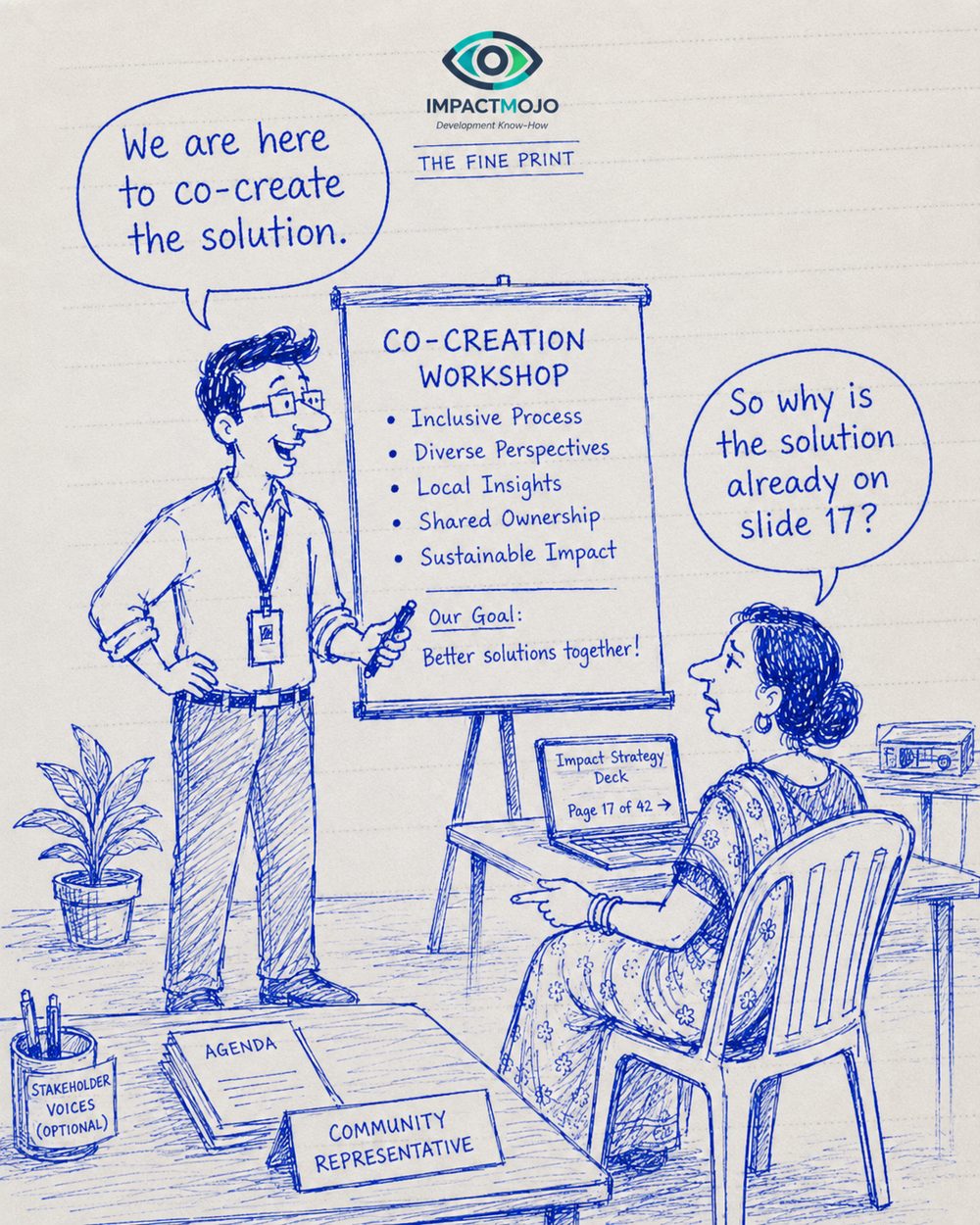
01 A facilitator at a 'Co-Creation Workshop' flipchart (Inclusive Process, Diverse Perspectives, Local Insights) says 'We are here to co-create the solution.' A seated community representative, pointing at an Impact Strategy Deck open at 'Page 17 of 42', replies 'So why is the solution already on slide 17?'
The pitch“We are here to co-create the solution.” The reply“So why is the solution already on slide 17?”

Participation that has already decided

Sherry Arnstein’s 1969 Ladder of Citizen Participation sorts “participation” into three groups: nonparticipation, degrees of tokenism, and degrees of real citizen power. Consultation and placation sit in the middle band — they look participatory but reserve the actual decisions for the people who called the meeting.1

A workshop whose recommended solution is already printed on slide 17 of 42 is placation, not co-creation. Genuine co-creation redistributes the pen — the agenda, the options, and the right to say no — not just the seating. The community representative’s question is a ladder check: are we sharing power, or staging its appearance?

Sources: 1
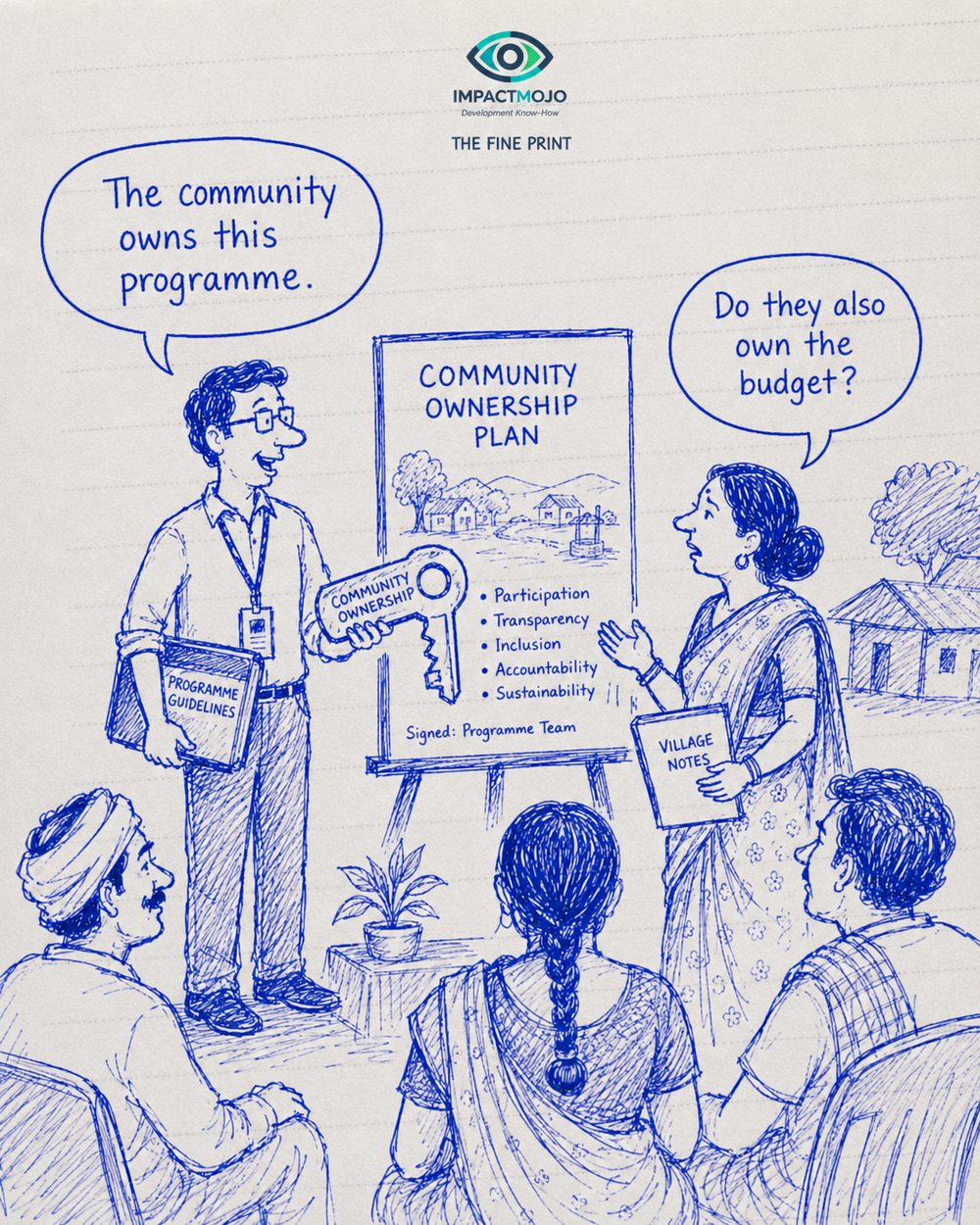
02 A programme officer at a 'Community Ownership Plan' poster holding a key labelled 'Community Ownership' says 'The community owns this programme.' A woman holding 'Village Notes' replies 'Do they also own the budget?'
The pitch“The community owns this programme.” The reply“Do they also own the budget?”

Ownership without the cheque-book

“Ownership” is the most-claimed and least-resourced word in programme design. Participatory budgeting — pioneered in Porto Alegre in 1989 — showed what it means in practice: ordinary people deciding how a real budget is spent, “real power over real money.”2 Ownership of a plan, without authority over the money, is responsibility handed down without resources handed over.

The pattern repeats at the funding level. Grand Bargain signatories pledged to move at least 25% of humanitarian funding to local and national actors; the share reaching them directly is still in the low single digits.3 Communities are asked to own outcomes while the budget stays upstream. The question on the cartoon is the one the signature block rarely answers.

Sources: 2, 3

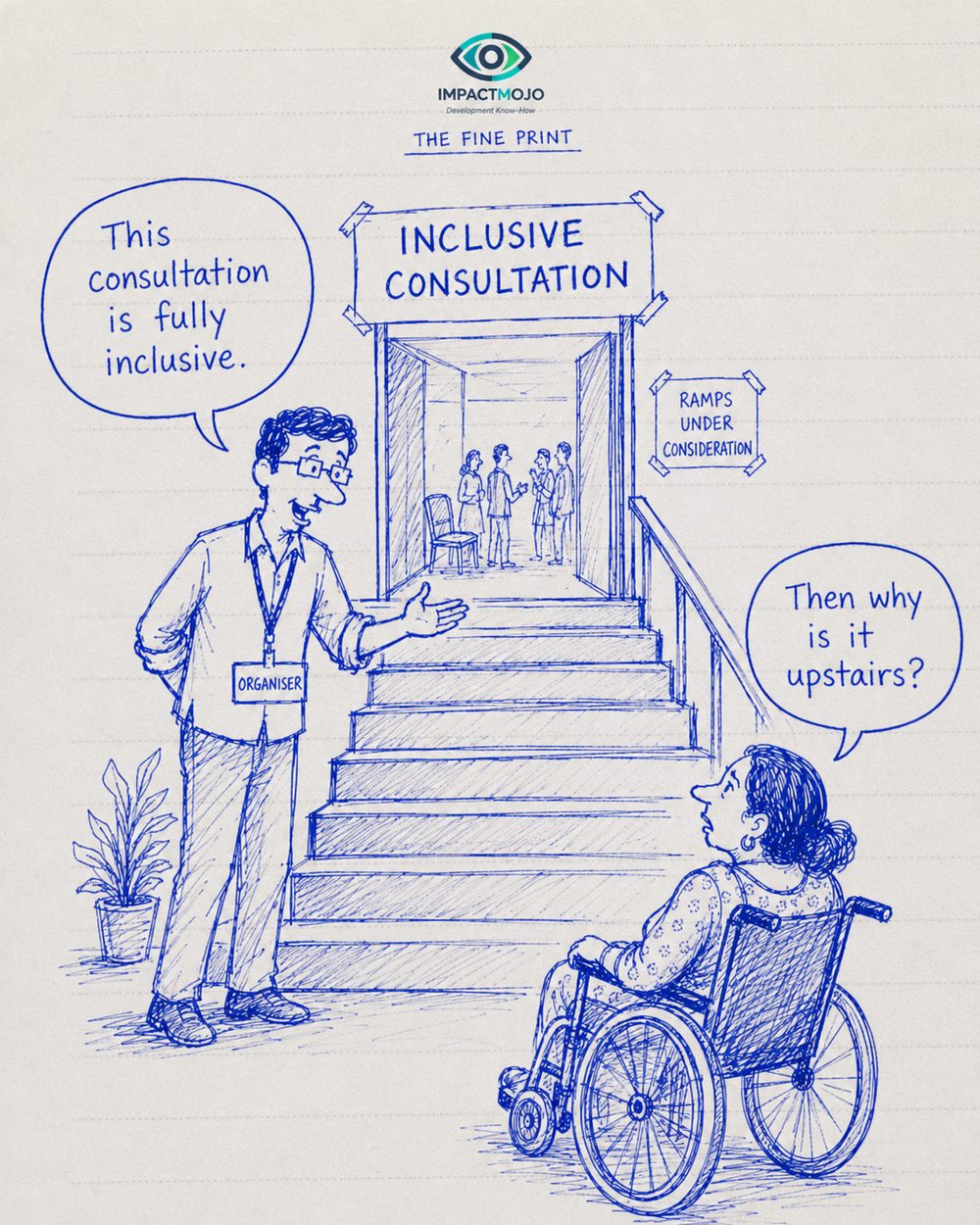
03 An organiser at the foot of a staircase under an 'Inclusive Consultation' sign (with a small 'ramps under consideration' note) says 'This consultation is fully inclusive.' A woman using a wheelchair at the bottom of the stairs replies 'Then why is it upstairs?'
The pitch“This consultation is fully inclusive.” The reply“Then why is it upstairs?”

Inclusion with the ramp still “under consideration”

India ratified the UN Convention on the Rights of Persons with Disabilities in 2007; Article 9 obliges states to ensure access to the physical environment on an equal basis with others.5 The Rights of Persons with Disabilities Act, 2016 (in force 2017) makes accessibility of public buildings a legal duty and set a five-year deadline to retrofit existing ones — a deadline that has since lapsed.4

A consultation announced as “fully inclusive” from the top of a staircase, with ramps “under consideration,” has already excluded the people it names. Inclusion is not a value statement on a banner; it is a measurable property of the room. If the wheelchair user cannot get in, the inclusion is in the fine print, not the building.

Sources: 4, 5

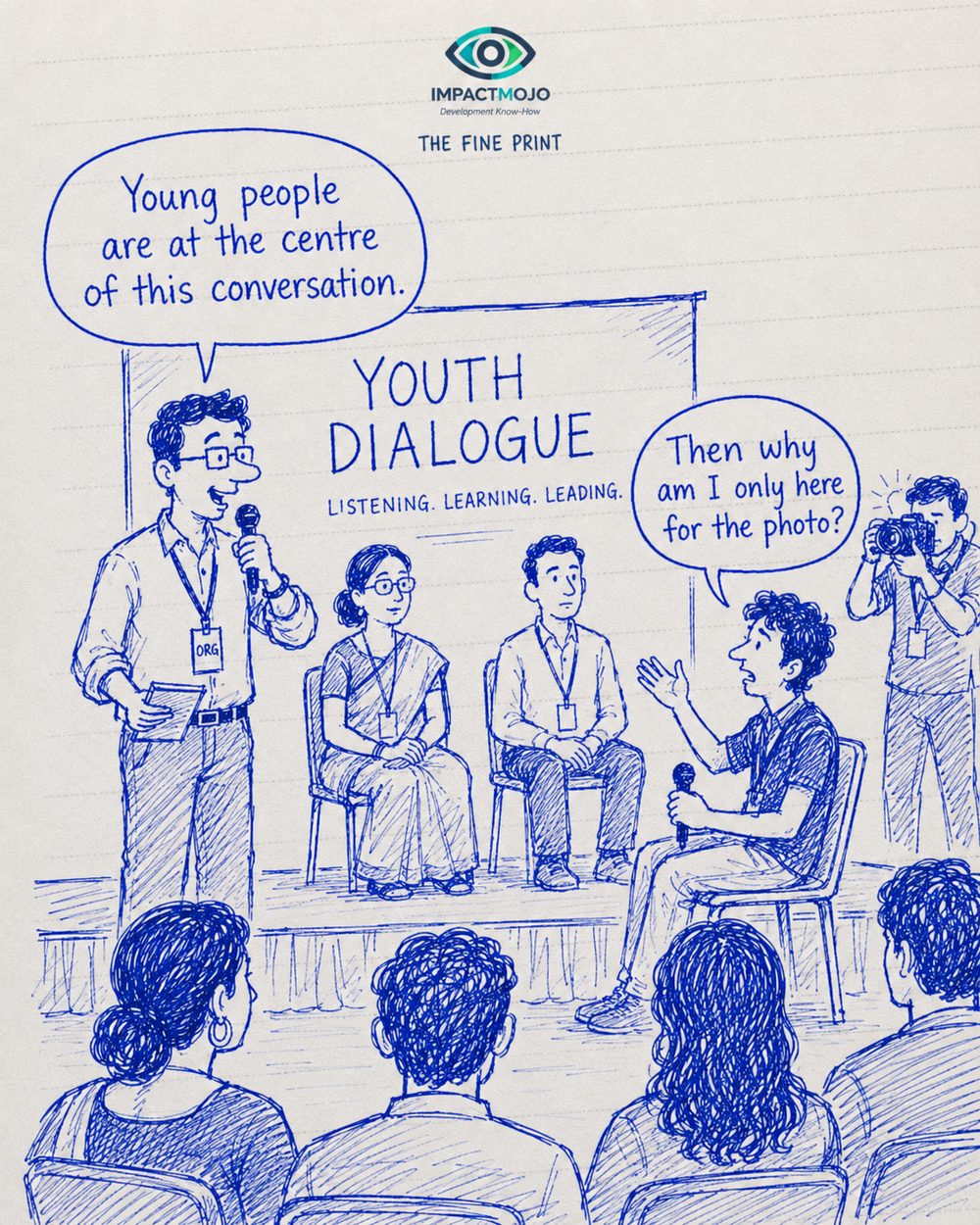
04 A host on a 'Youth Dialogue — Listening. Learning. Leading.' stage says 'Young people are at the centre of this conversation.' A young panellist, as a photographer's flash goes off, replies 'Then why am I only here for the photo?'
The pitch“Young people are at the centre of this conversation.” The reply“Then why am I only here for the photo?”

Decoration on the dais

Roger Hart’s 1992 Ladder of Children’s Participation (UNICEF) adapts Arnstein for young people, and names the bottom three rungs bluntly: manipulation, decoration, and tokenism — the last defined as young people appearing to have a voice but with little choice about what they say, “participation for a photo opportunity.”6

A seat on the stage under a “Youth Dialogue” banner, timed for the camera, is decoration unless young people helped set the agenda and can change the outcome. The panellist’s line is the difference between being at the centre and being placed at the centre for the duration of the photograph.

Sources: 6

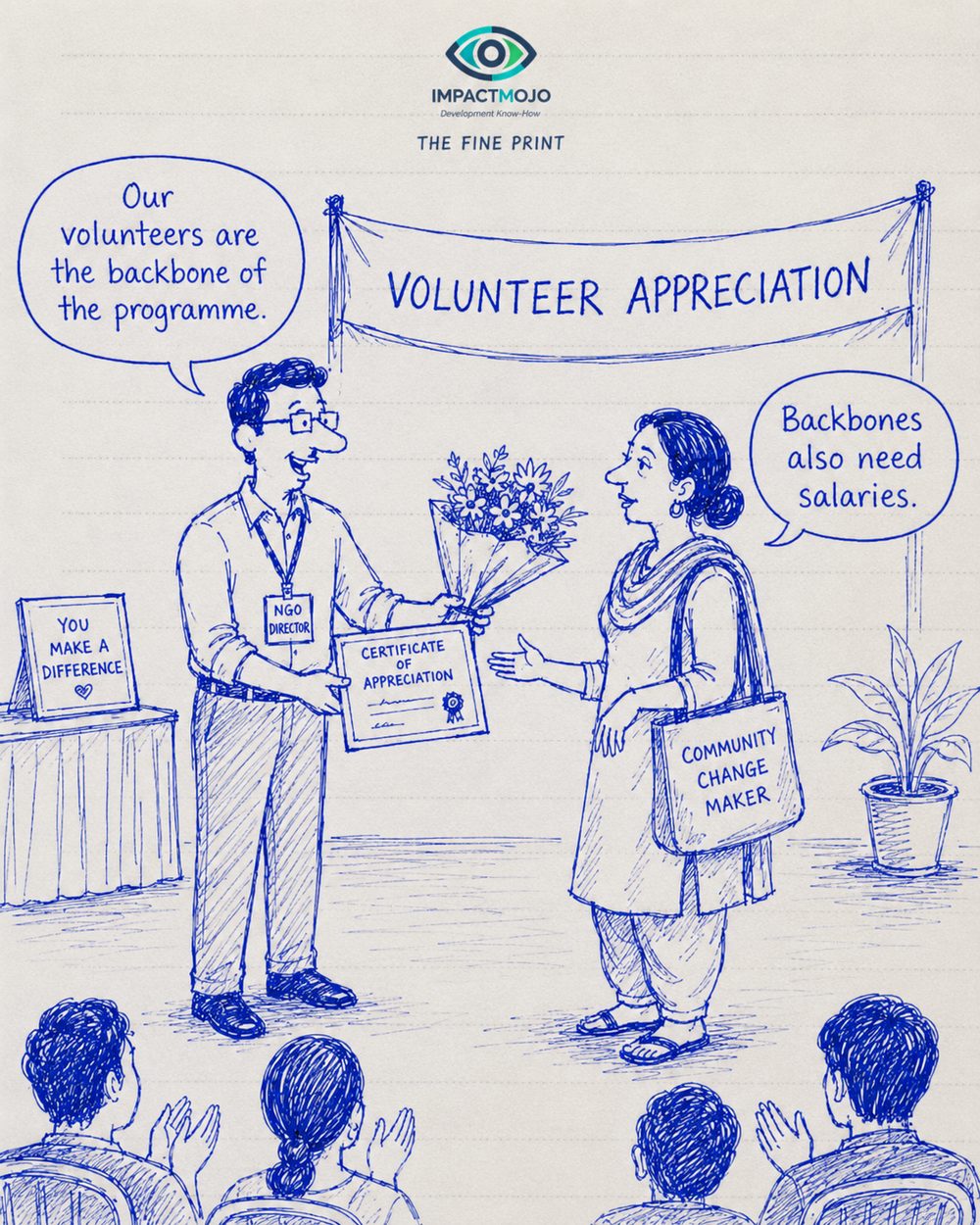
05 Under a 'Volunteer Appreciation' banner an NGO director hands a certificate and flowers, saying 'Our volunteers are the backbone of the programme.' A community changemaker replies 'Backbones also need salaries.'
The pitch“Our volunteers are the backbone of the programme.” The reply“Backbones also need salaries.”

The word “volunteer” doing budgetary work

The WHO estimates that around six million women work in health worldwide for no pay or below-market pay, effectively subsidising health systems with their labour — and roughly a quarter of the unpaid are in India, mostly in community health roles.7 Women in Global Health calls this what it is: an unrecognised subsidy, with women contributing some 5% of global GDP through health work, nearly half of it unpaid.8

India’s ASHAs are designated “volunteers” and paid honoraria that fall below minimum wage, precisely so the obligation to pay a salary never attaches. Calling essential, scheduled, accountable labour “volunteering” is the device by which the budget line disappears. A certificate of appreciation is not a pay cheque.

Sources: 7, 8

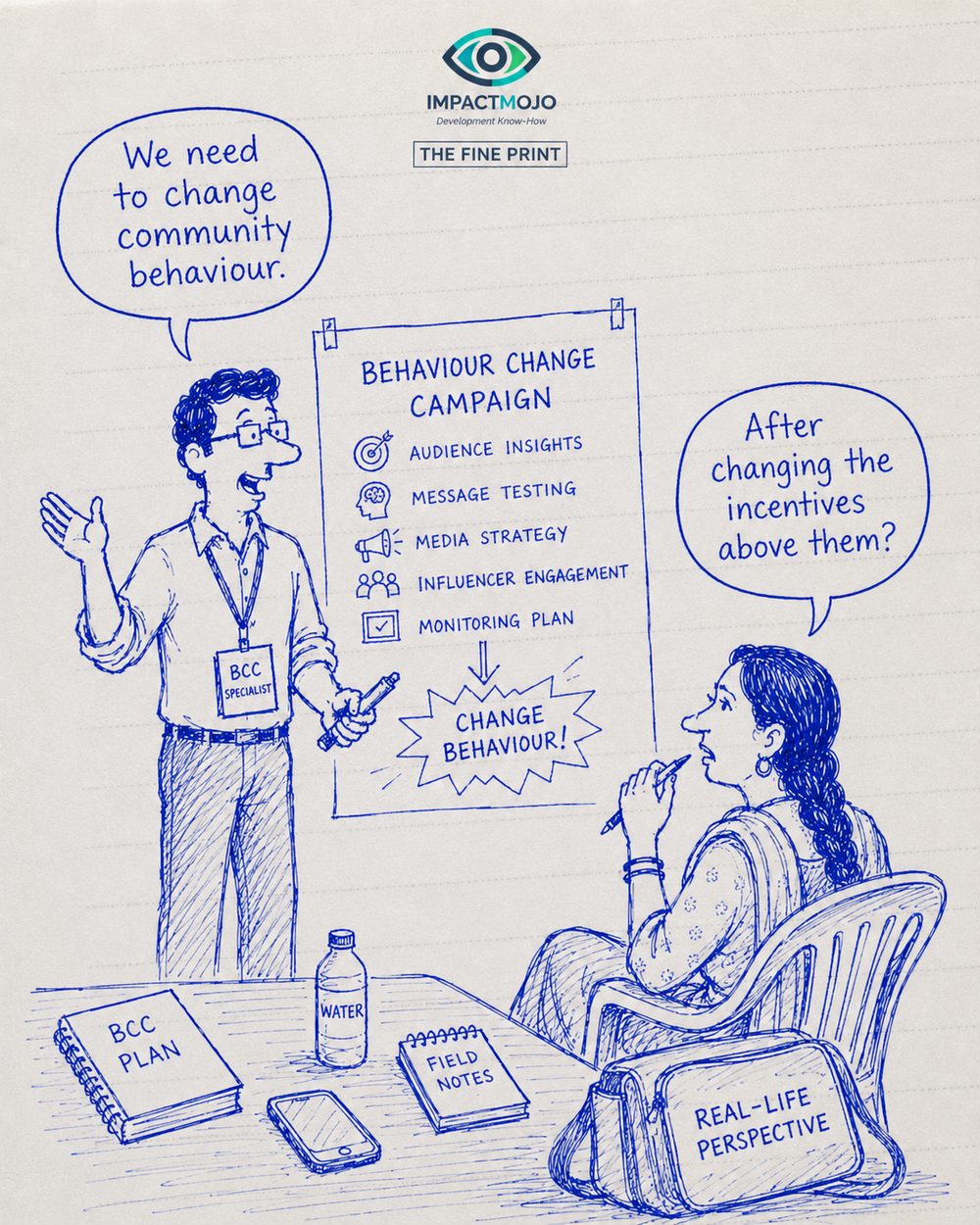
06 A BCC specialist at a 'Behaviour Change Campaign' flipchart says 'We need to change community behaviour.' A woman with a 'Real-Life Perspective' bag replies 'After changing the incentives above them?'
The pitch“We need to change community behaviour.” The reply“After changing the incentives above them?”

Lifestyle drift

Public health has a name for what the cartoon catches: lifestyle drift — the tendency for interventions that begin by targeting upstream, structural causes to drift downstream into changing individual behaviour, because individual-level fixes feel more tractable.10

The WHO’s work on the commercial determinants of health makes the cost explicit: the prices, products, wages and marketing that shape what people do are set far above the household, yet campaigns relocate the blame onto personal choice.9 Asking people to change behaviour while the incentives above them stay fixed treats a structural problem as a personal failing — and usually fails.

Sources: 9, 10

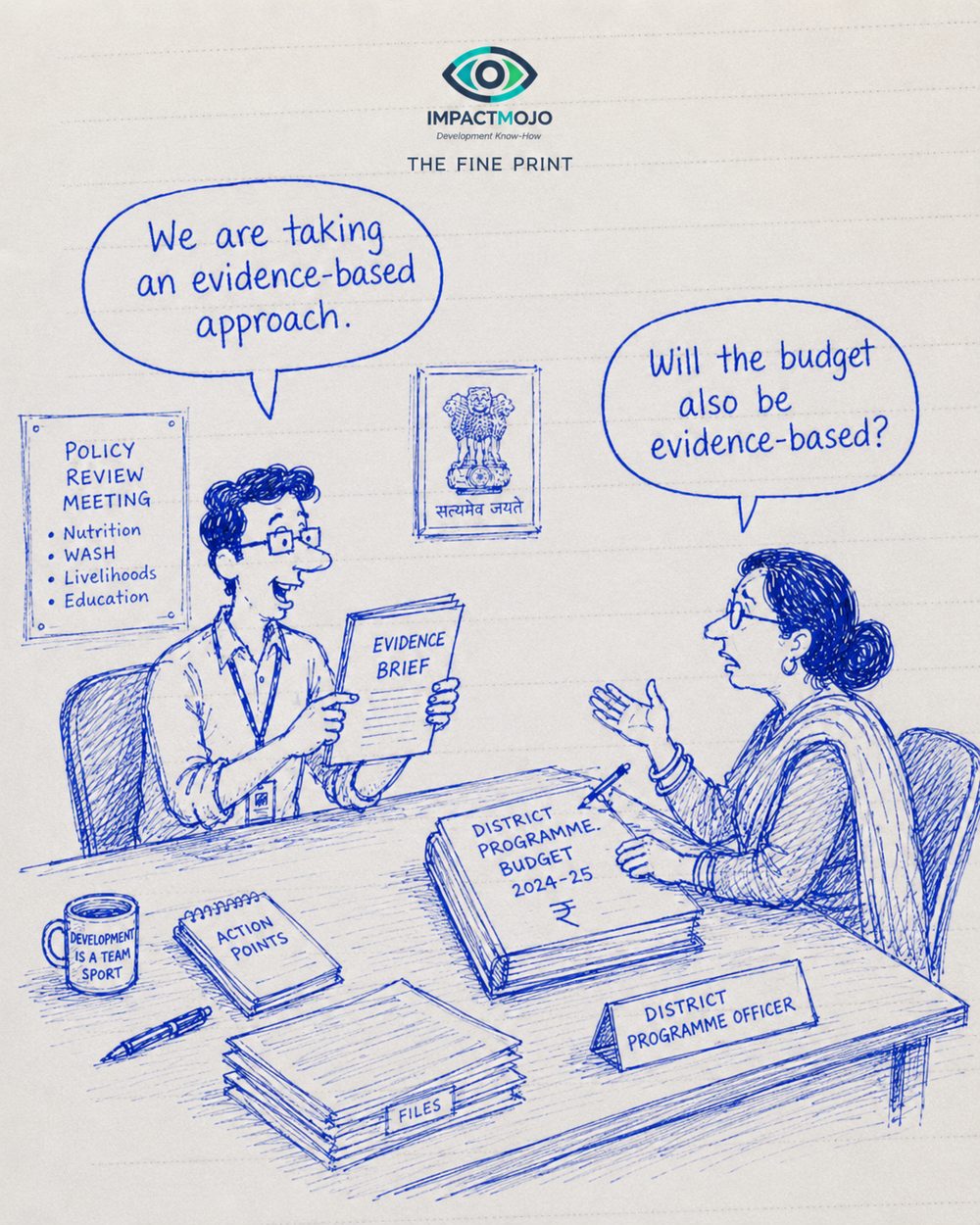
07 At a district policy review meeting an officer holding an 'Evidence Brief' says 'We are taking an evidence-based approach.' The District Programme Officer, beside the 'District Programme Budget 2024-25', replies 'Will the budget also be evidence-based?'
The pitch“We are taking an evidence-based approach.” The reply“Will the budget also be evidence-based?”

Evidence in the brief, not in the budget

The political scientist Paul Cairney draws the line that the District Programme Officer is testing: evidence-based policy lets the evidence shape the decision, whereas policy-based evidence decides first and recruits evidence to justify it.11 The tell is not the brief; it is the budget.

Reviews of evidence-based budgeting find that governments routinely keep funding the same line items by inertia and anecdote, regardless of what the evidence says works.12 An “evidence-based approach” that never moves money toward what the evidence supports is a presentation style, not a method. The fine print is the allocation.

Sources: 11, 12

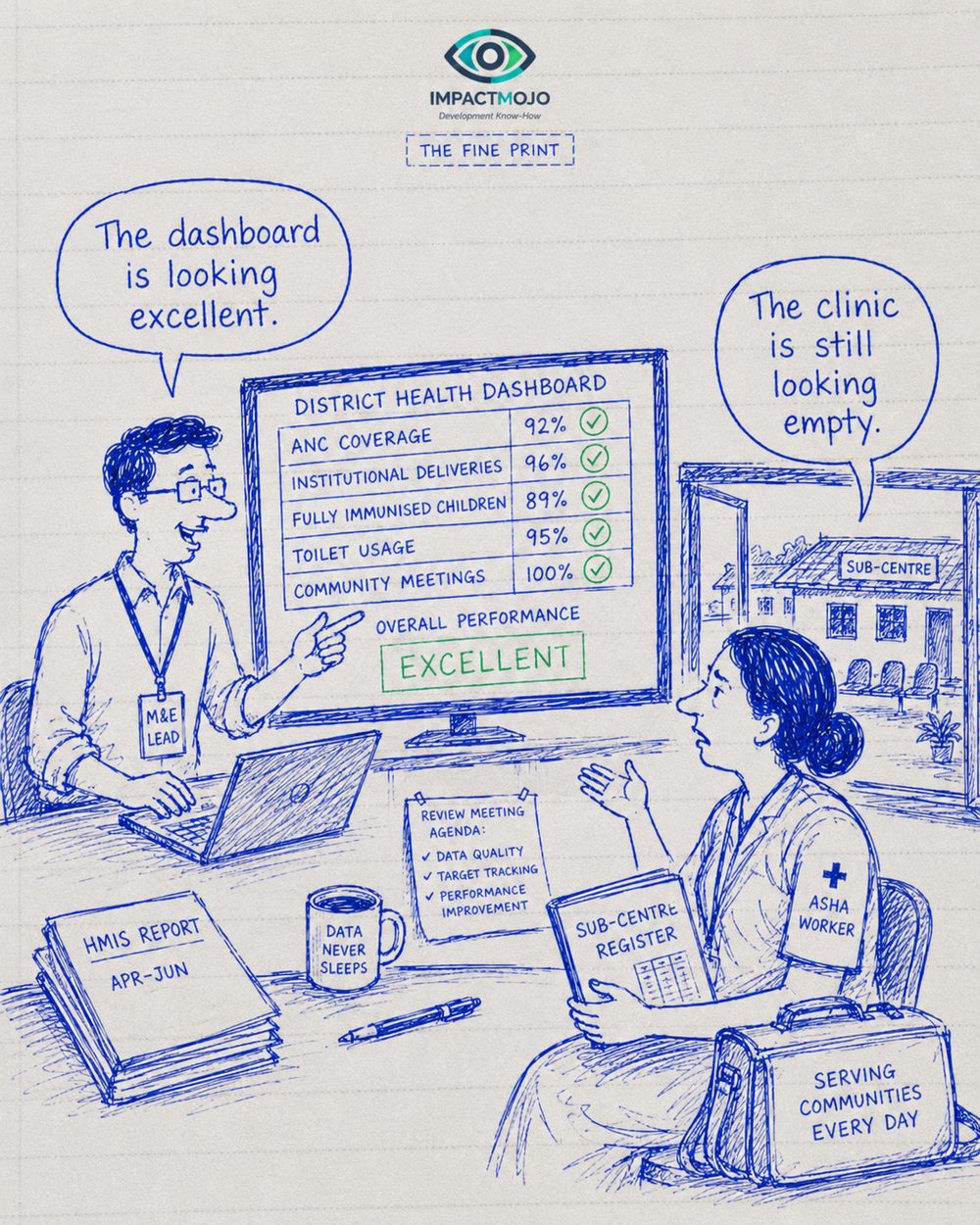
08 An M&E lead points at a 'District Health Dashboard' showing 92–100% green metrics and 'Overall Performance: Excellent', saying 'The dashboard is looking excellent.' An ASHA worker beside an empty sub-centre replies 'The clinic is still looking empty.'
The pitch“The dashboard is looking excellent.” The reply“The clinic is still looking empty.”

Green tiles, dry taps

This is Goodhart’s Law on a screen: when a measure becomes a target it stops being a good measure, because effort flows to the number rather than the thing it stood for.14 India’s Jal Jeevan Mission is the textbook case — tap-connection coverage near 98%, but a 2024 national assessment found only about three-quarters of households actually receiving a regular, safe, adequate supply.13 Coverage is green; service is patchy.

Where targets are tied to incentives, the data itself bends: a study of frontline maternal and newborn workers documented deliberate falsification, because the system rewarded the report over the reality.15 A “100% community meetings” tile and an empty sub-centre can both be true at once when the dashboard measures reporting, not care.

Sources: 13, 14, 15

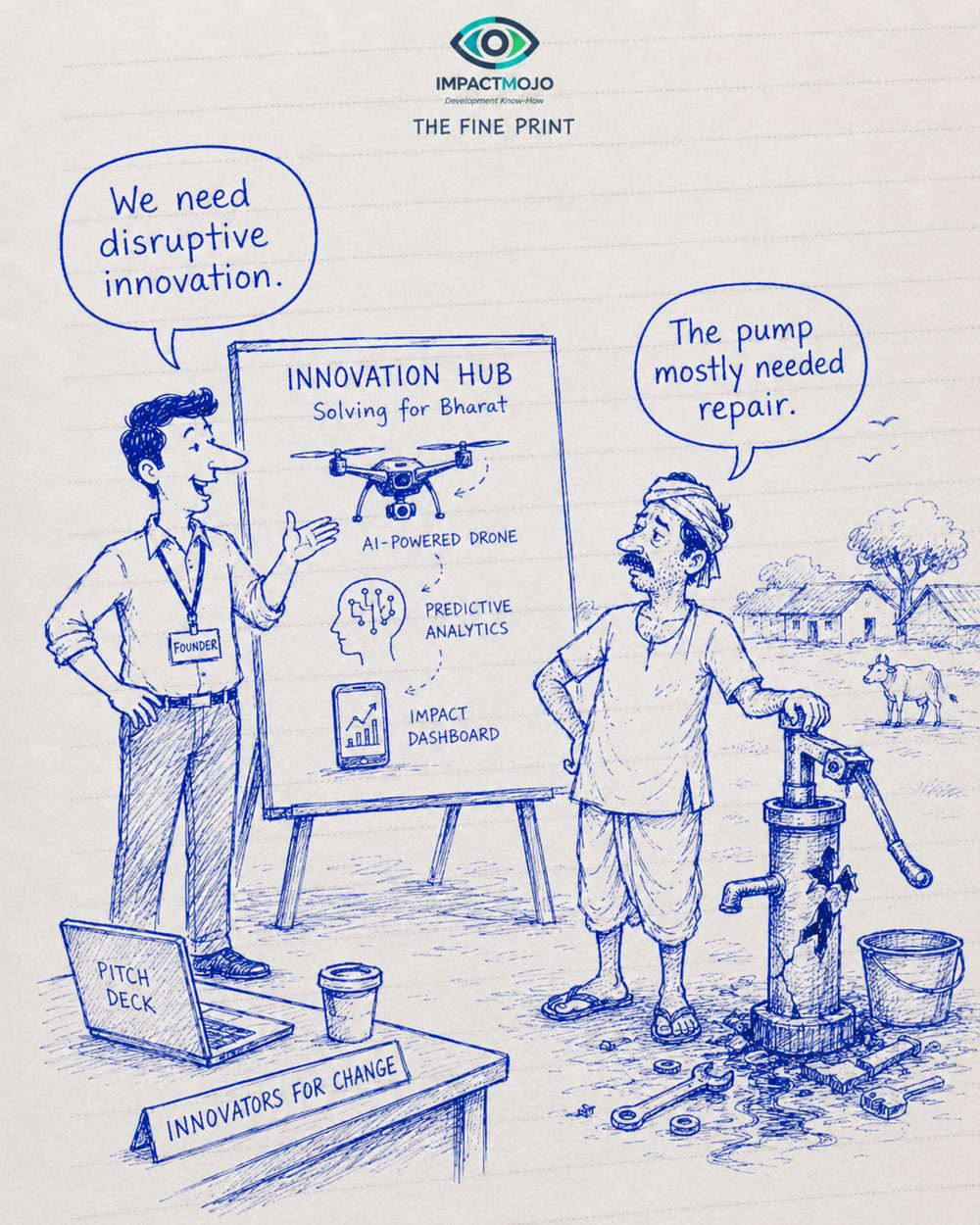
09 A founder at an 'Innovation Hub — Solving for Bharat' board (AI drone, predictive analytics, impact dashboard) says 'We need disruptive innovation.' A farmer at a broken handpump with a wrench replies 'The pump mostly needed repair.'
The pitch“We need disruptive innovation.” The reply“The pump mostly needed repair.”

The maintenance the pitch deck skips

Lee Vinsel and Andrew Russell’s Hail the Maintainers (2016) and The Innovation Delusion (2020) argue that “innovation-speak” systematically overvalues the new: the unglamorous work of maintaining and repairing existing infrastructure does far more for daily life than most novelty ever will.16

Rural water is the standing example — studies find up to a third of handpumps non-functional at any given time, a maintenance failure, not an innovation gap.17 A drone, predictive analytics and an impact dashboard do not lift water; a repaired handpump does. “Disruptive innovation” is often the headline over a deferred-maintenance problem.

Sources: 16, 17

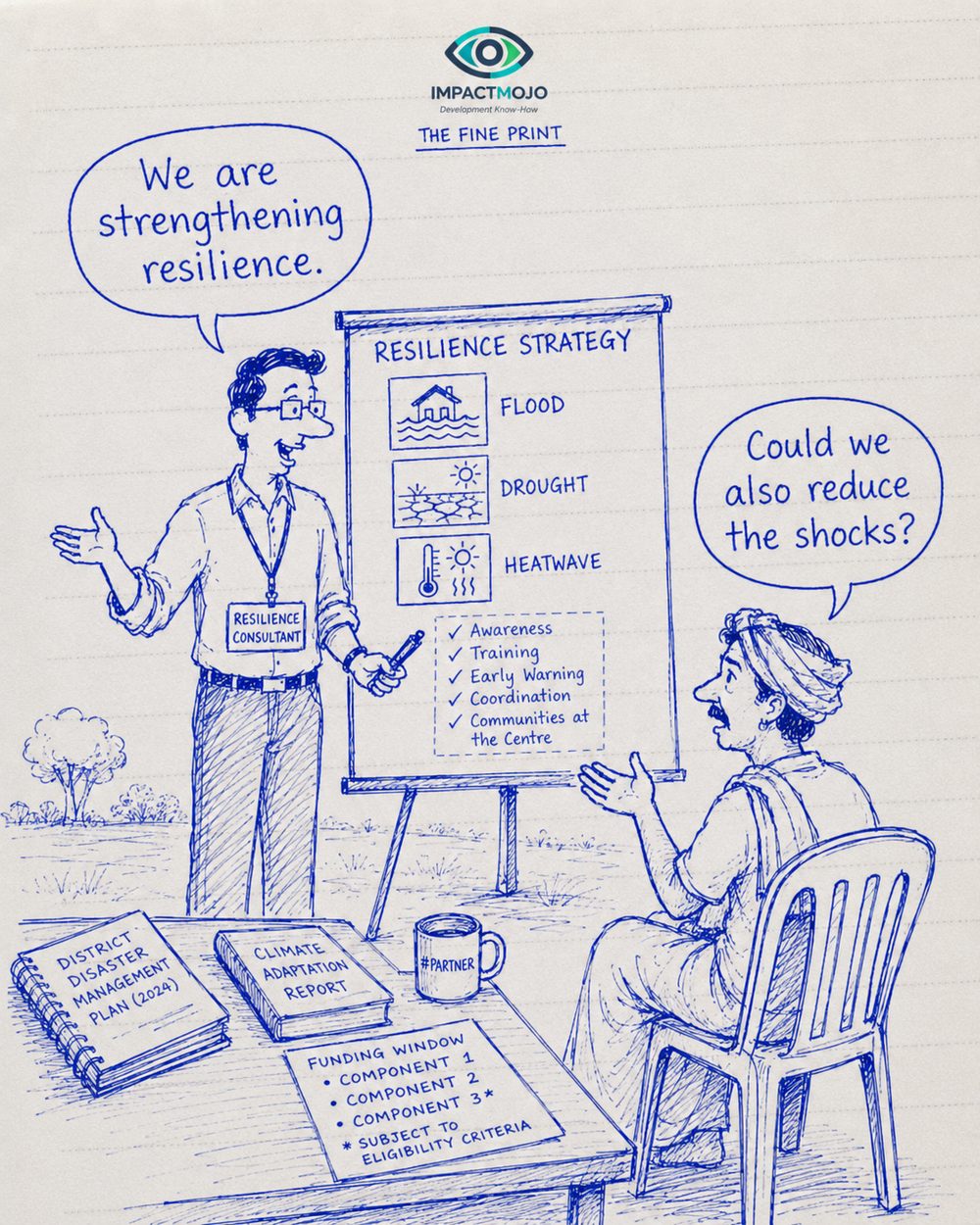
10 A resilience consultant at a 'Resilience Strategy' flipchart (flood, drought, heatwave) says 'We are strengthening resilience.' A farmer replies 'Could we also reduce the shocks?'
The pitch“We are strengthening resilience.” The reply“Could we also reduce the shocks?”

Coping is not the same as preventing

“Resilience” can quietly depoliticise a crisis: it asks the exposed to absorb shocks better, while leaving the drivers — emissions, land use, debt, inequality — in place. The foundational disasters text At Risk (Wisner, Blaikie, Cannon & Davis) traces hazards back through a “pressure and release” chain to root causes in power and political economy, not just the weather.18

That is why adaptation without mitigation, and resilience without loss-and-damage finance, places the burden on those least responsible for the shock.19 Strengthening resilience is necessary; treating it as a substitute for reducing the shocks is the fine print. The farmer is asking to move one rung upstream.

Sources: 18, 19

A note on the joke

None of these promises are lies. They are headlines printed larger than their conditions. The second speech bubble just reads the rest of the sentence — the ramp, the budget line, the salary, the allocation, the shock itself. The fastest way to retire the joke is to put the fine print in the same font size as the claim.

Notes & Sources

  1. Sherry R. Arnstein (1969). “A Ladder of Citizen Participation,” Journal of the American Institute of Planners 35(4): 216–224. — organizingengagement.org
  2. Participatory Budgeting Project, “What is PB?” (on Porto Alegre, 1989, and “real power over real money”). — participatorybudgeting.org
  3. Development Initiatives, “Funding to local and national actors” (Grand Bargain 25% localisation commitment vs. direct funding delivered). — devinit.github.io
  4. The Rights of Persons with Disabilities Act, 2016 (India) — accessibility of public buildings and the retrofit timeline. — indiacode.nic.in
  5. United Nations, Convention on the Rights of Persons with Disabilities (2006), Article 9 — Accessibility. India ratified in 2007. — un.org
  6. Roger A. Hart (1992). Children’s Participation: From Tokenism to Citizenship, UNICEF Innocenti Essay no. 4 (manipulation / decoration / tokenism). — unicef-irc.org
  7. World Health Organization, “Female health workers drive global health” (commentary). — who.int
  8. Women in Global Health, Subsidizing Global Health: Women’s Unpaid Work in Health Systems (2022). — womeningh.org
  9. World Health Organization, “Commercial determinants of health” (fact sheet). — who.int
  10. “Tracing the undercurrents: a scoping review of the lifestyle drift concept,” PMC (on interventions drifting from structural causes to individual behaviour). — ncbi.nlm.nih.gov
  11. Paul Cairney (2016). “How can you tell the difference between policy-based-evidence and evidence-based-policymaking?” — paulcairney.wordpress.com
  12. The Pew Charitable Trusts, “A Guide to Evidence-Based Budget Development” (2016). — pew.org
  13. India Water Portal, “From coverage to functionality: reviewing India’s national assessment of rural tap water services” (Jal Jeevan Mission, 2024). — indiawaterportal.org
  14. On Goodhart’s Law in health systems: “‘When a Measure Becomes a Target, It Ceases to Be a Good Measure’,” PMC. — pmc.ncbi.nlm.nih.gov
  15. “A qualitative study on intentional data falsification by frontline maternal and newborn healthcare workers,” BMJ Global Health / PMC (2022). — ncbi.nlm.nih.gov
  16. Lee Vinsel & Andrew L. Russell, “Hail the Maintainers” (Aeon, 2016) and The Innovation Delusion (Currency, 2020). — aeon.co
  17. Rural Water Supply Network — research on handpump functionality (up to one-third non-functional at any time). — rural-water-supply.net
  18. Ben Wisner, Piers Blaikie, Terry Cannon & Ian Davis, At Risk: Natural Hazards, People’s Vulnerability and Disasters (2nd ed., Routledge, 2004) — the “pressure and release” model of root causes. — routledge.com
  19. G. Jackson et al. (2023). “An emerging governmentality of climate change loss and damage,” Environment and Planning E. — journals.sagepub.com