
Skip to content
An ImpactMojo Special · Marginalia

The Theory of Change

Ten scenes from the logic-model industry, where the diagram meets the district it claims to explain.

Marginalia, because the reply is the note the field scribbles in the margin of the sector's script — and because the margin is exactly where those voices usually get filed. In each drawing, someone in a lanyard defends the planning tool — the theory of change, the logframe, the results framework, the arrow from input to impact; someone who does the actual work says what the arrows leave out. This is an affectionate roast, not a takedown. Good planning tools exist. The jokes are drawn; the footnotes are real.

The pitch — what the sector says The reply — what the field says back The evidence — why the reply is right

01 A consultant at a whiteboard filled with a large left-to-right arrow diagram reading 'INPUTS → OUTPUTS → OUTCOMES → IMPACT', saying 'First, let's build a theory of change.' A programme officer holding an already-thick, bound proposal replies, 'For a plan we already wrote?'
The pitch“First, let's build a theory of change.” The reply“For a plan we already wrote?”

The diagram drawn after the decision

A theory of change is meant to be a thinking tool — the honest map of how and why you believe change will happen. But when Craig Valters studied how one large international organisation actually used the approach, he found the tool pulling in three directions at once: to communicate, to learn, and to be held accountable — and those purposes sit “in some tension with each other.”1

The tension has a predictable resolution. Under deadline, the theory of change gets reverse-engineered to justify a plan that funding decisions already fixed — producing, in Valters' words, “top-down accounts of change which spoke more to donor interests than to the ground realities of people affected.”1 The reply in the cartoon is the quiet giveaway: if the diagram arrives after the proposal, it is decoration, not theory.

Sources: 1
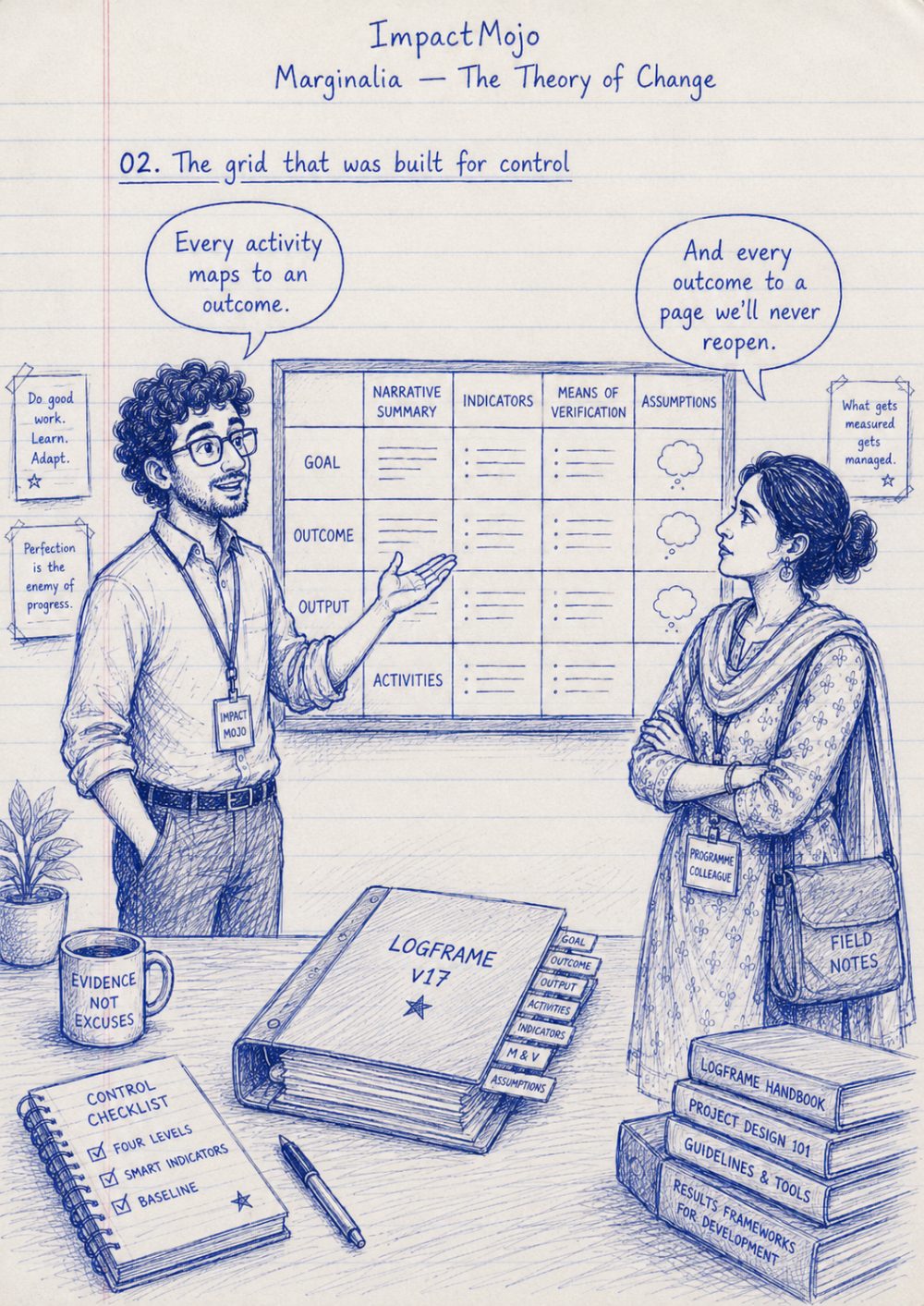
02 A manager pointing proudly at a huge grid on the wall headed 'LOGICAL FRAMEWORK' with rows of objectives, indicators, and means of verification, saying 'Every activity maps to an outcome.' A field officer with a dusty field bag replies, 'And every outcome to a page we'll never reopen.'
The pitch“Every activity maps to an outcome.” The reply“And every outcome to a page we'll never reopen.”

The grid that was built for control

The logical framework was not born in a village. It was designed for the US aid agency in 1969 by a firm of management consultants to help administrators plan and control projects from a distance — a tool of oversight before it was ever a tool of learning. That origin still shows.

Oliver Bakewell and Anne Garbutt, reviewing decades of practice, catalogue the “use and abuse” of the approach: applied rigidly, the logframe freezes a project's logic at the moment of least knowledge — the design phase — and then rewards teams for delivering against the frozen grid rather than for responding to what they learn.2 The matrix becomes a compliance document, filed and forgotten, exactly as the reply predicts.

Sources: 2

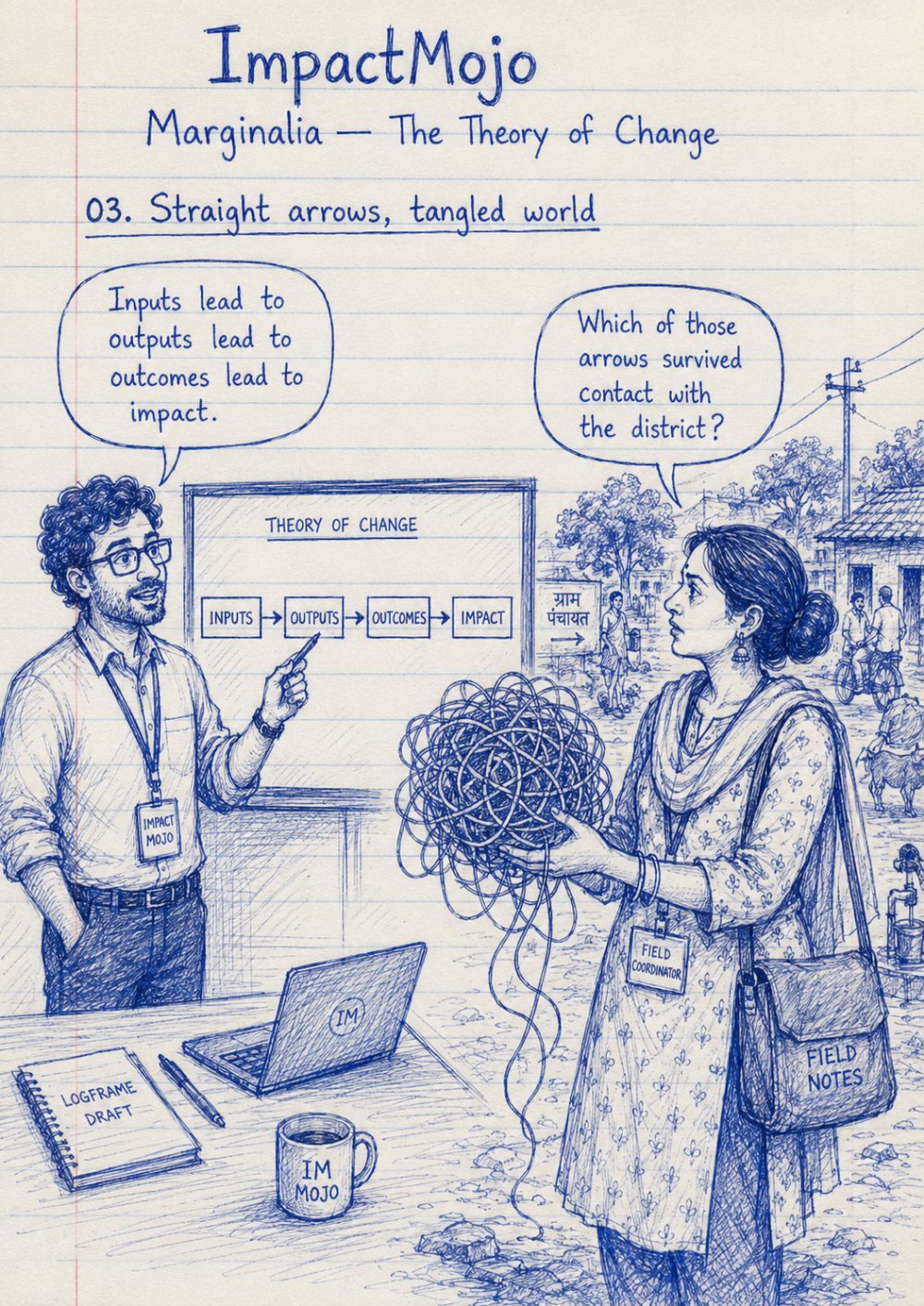
03 A presenter beside a neat, straight left-to-right chain of arrows on a slide. A field coordinator standing in a busy village holding a tangled ball of string that looks nothing like the neat arrows replies, 'Which of those arrows survived contact with the district?'
The pitch“Inputs lead to outputs lead to outcomes lead to impact.” The reply“Which of those arrows survived contact with the district?”

Straight arrows, tangled world

The results chain draws development as a line: a tidy sequence where each box causes the next. Ben Ramalingam's Aid on the Edge of Chaos argues that this linear machine-model is precisely wrong for the systems aid works in — economies, communities, ecologies — which are complex and adaptive, full of feedback loops, tipping points, and effects that emerge rather than follow.3

In a complex system, the same input produces different results in different places, and the neat arrow from activity to outcome is an assumption, not a law. That is why a design that works in one district stalls in the next. The reply isn't anti-planning; it asks the modeller to notice which of the drawn arrows is doing real causal work and which is just holding the diagram together.

Sources: 3

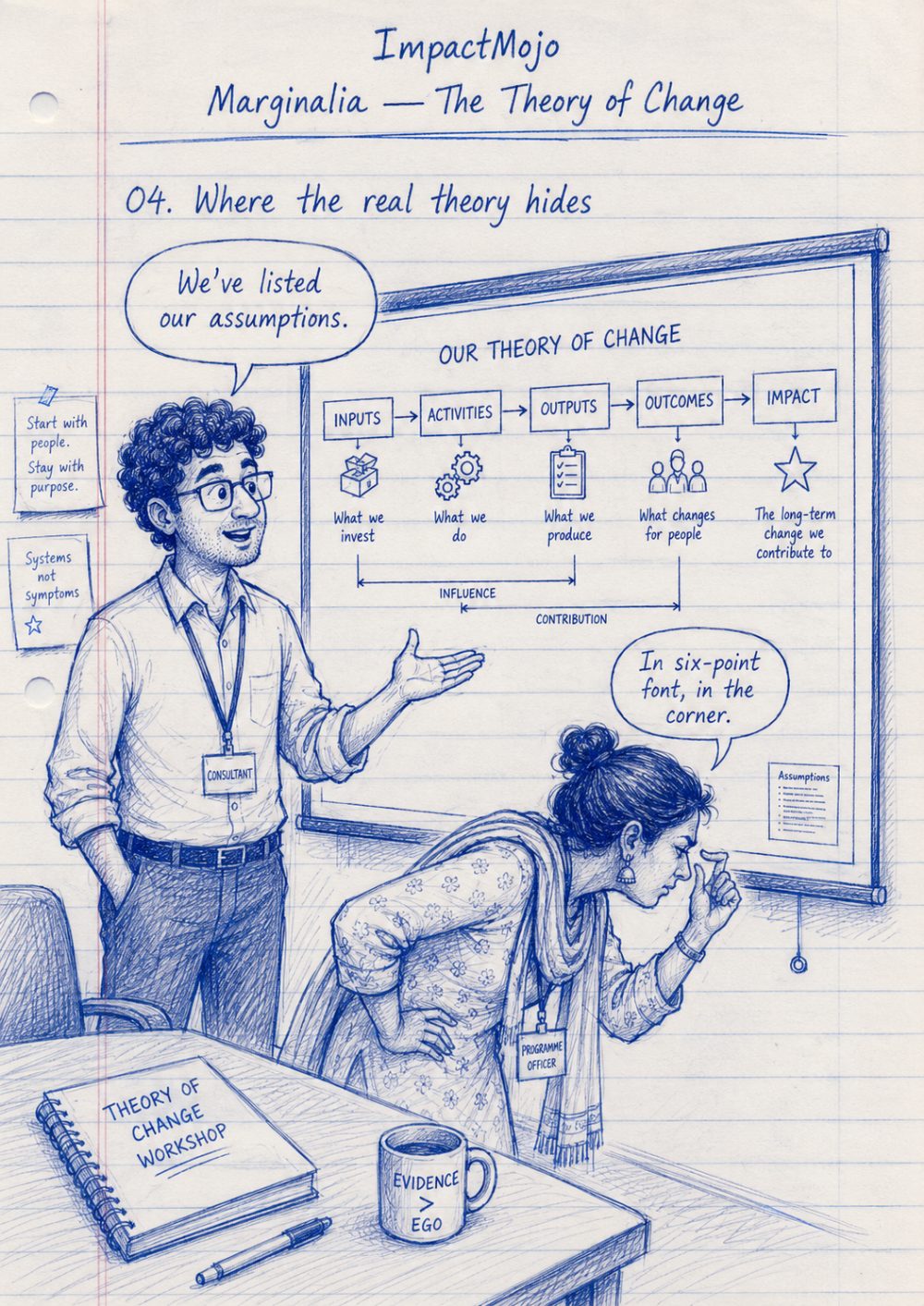
04 A slide dominated by a big, colourful results chain, with a tiny box in the bottom corner labelled 'Assumptions' in minuscule type. A presenter says 'We've listed our assumptions.' A woman squinting at the tiny box replies, 'In six-point font, in the corner.'
The pitch“We've listed our assumptions.” The reply“In six-point font, in the corner.”

Where the real theory hides

In any theory of change, the assumptions are the load-bearing wall — the beliefs about context, behaviour and politics that must hold for the arrows to connect. Isabel Vogel's review of theory-of-change practice for DFID found that this is exactly where the work is thinnest: the approach demands not just logical thinking but “deeper critical reflection,” and it is the interrogation of assumptions, more than the drawing of boxes, that separates a useful theory from a decorative one.4

Shrunk to a corner box, the assumptions stop being tested and start being hidden. The risky one — “the government will staff the clinic”, “the market price will hold” — is the one most likely to sink the programme, and the one most likely to be in the smallest font. The reply points at the corner because that is where the theory actually lives.

Sources: 4

05 A manager pointing triumphantly at a dashboard with a line arrow going up, saying 'The programme moved the indicator.' A field officer gesturing at the window — where you can see monsoon rain, an election rally poster, and a newly built road — replies, 'Along with the monsoon, the election, and the new road.'
The pitch“The programme moved the indicator.” The reply“Along with the monsoon, the election, and the new road.”

Attribution, contribution, and the honest verb

“The programme moved the indicator” is a claim of attribution — that this intervention, and not the dozen other things happening at once, caused the change. John Mayne built contribution analysis precisely because clean attribution is usually impossible outside a controlled trial: in the real world, an outcome has many parents, and the honest question is not “did we cause it?” but “did we plausibly contribute, and how?”5

Contribution analysis answers that by testing the theory of change against the other plausible explanations — the rival causes the reply lists — and seeing whether the results chain still holds once they're accounted for.5 The monsoon, the election and the road aren't heckling. They're the control group the dashboard forgot.

Sources: 5

06 An M&E officer carefully measuring a small potted seedling with a ruler, while a large full-grown tree stands unmeasured and ignored behind them. The officer says 'The outcome has to be measurable.' A colleague gesturing at the big tree replies, 'So we picked the outcome we could measure.'
The pitch“The outcome has to be measurable.” The reply“So we picked the outcome we could measure.”

The clarity paradox

Andrew Natsios, who ran the US aid agency, named the trap from the inside. There is, he argued, a central principle the compliance machinery ignores: “those development programs that are most precisely and easily measured are the least transformational, and those programs that are most transformational are the least measurable.”6 He called it the clarity paradox.

When a theory of change must show measurable outcomes to be funded, the measurable quietly displaces the meaningful: the seedling gets the ruler because the tree won't sit still for one. Institution-building, shifted norms, a community's confidence — the deep changes — resist the annual metric, and so drift out of the frame. The reply is the paradox stated in one breath: we didn't choose the outcome that mattered most; we chose the one the format could hold.

Sources: 6

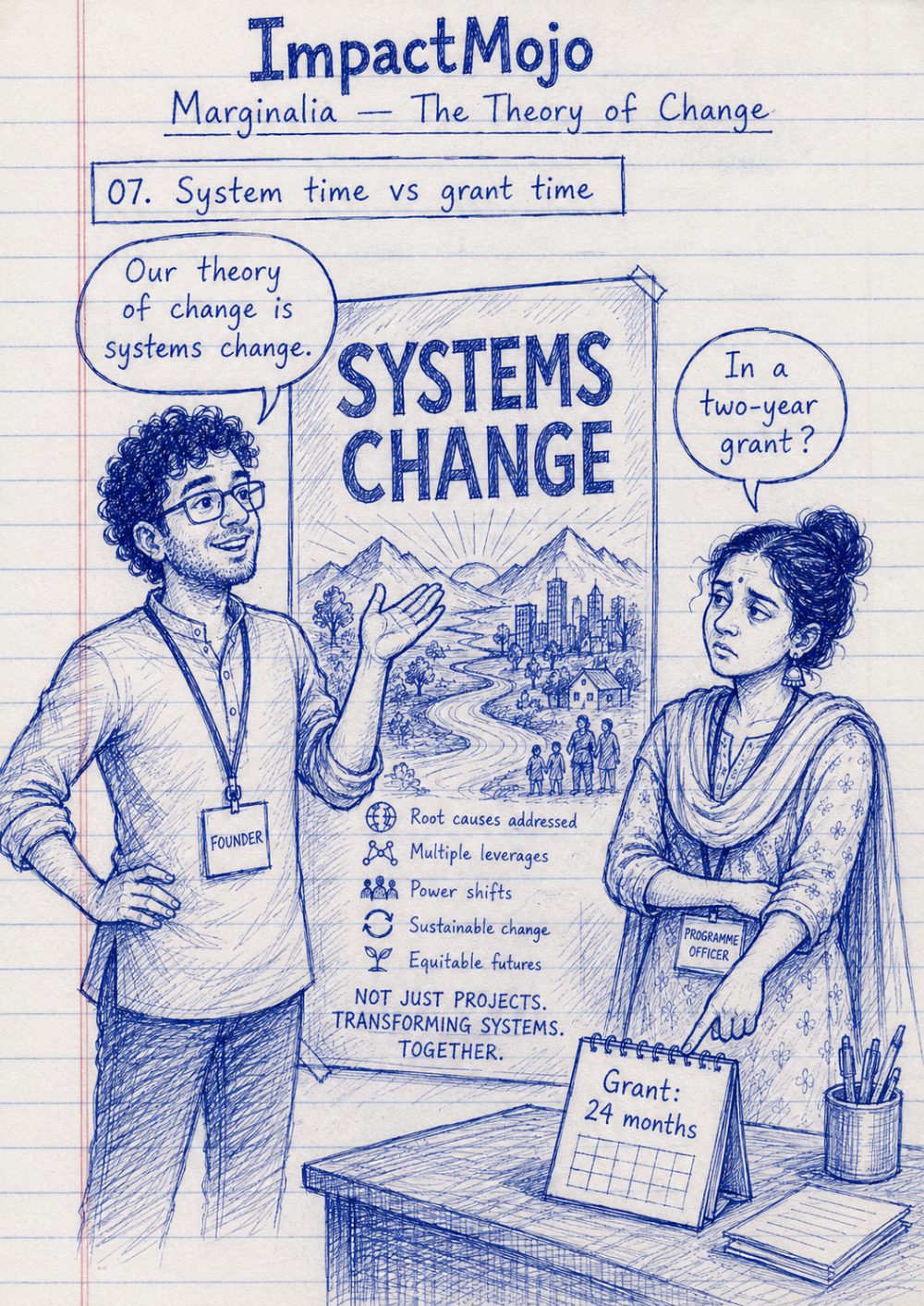
07 A founder standing before a grand poster reading 'SYSTEMS CHANGE' in big letters, beside a small desk calendar that says 'Grant: 24 months'. The founder says 'Our theory of change is systems change.' A weary colleague pointing at the calendar replies, 'In a two-year grant?'
The pitch“Our theory of change is systems change.” The reply“In a two-year grant?”

System time vs grant time

“Systems change” is the sector's most ambitious phrase, and often its least honest about time. Duncan Green's How Change Happens shows that change in complex systems is non-linear and slow: it moves through the gradual shifting of norms, institutions and power, punctuated by unpredictable “critical junctures” that no project can schedule.7 Systems bend on a horizon of years and decades, not funding cycles.

A theory of change that promises to shift a system inside a two-year grant is usually mis-stating either the ambition or the timeframe. Green's argument is not that the ambition is wrong — it's that reaching it demands patience, flexibility and the willingness to back long processes and local actors, rather than a log-framed sprint with a systems-change label stapled on top.7 The calendar in the cartoon is the whole critique.

Sources: 7

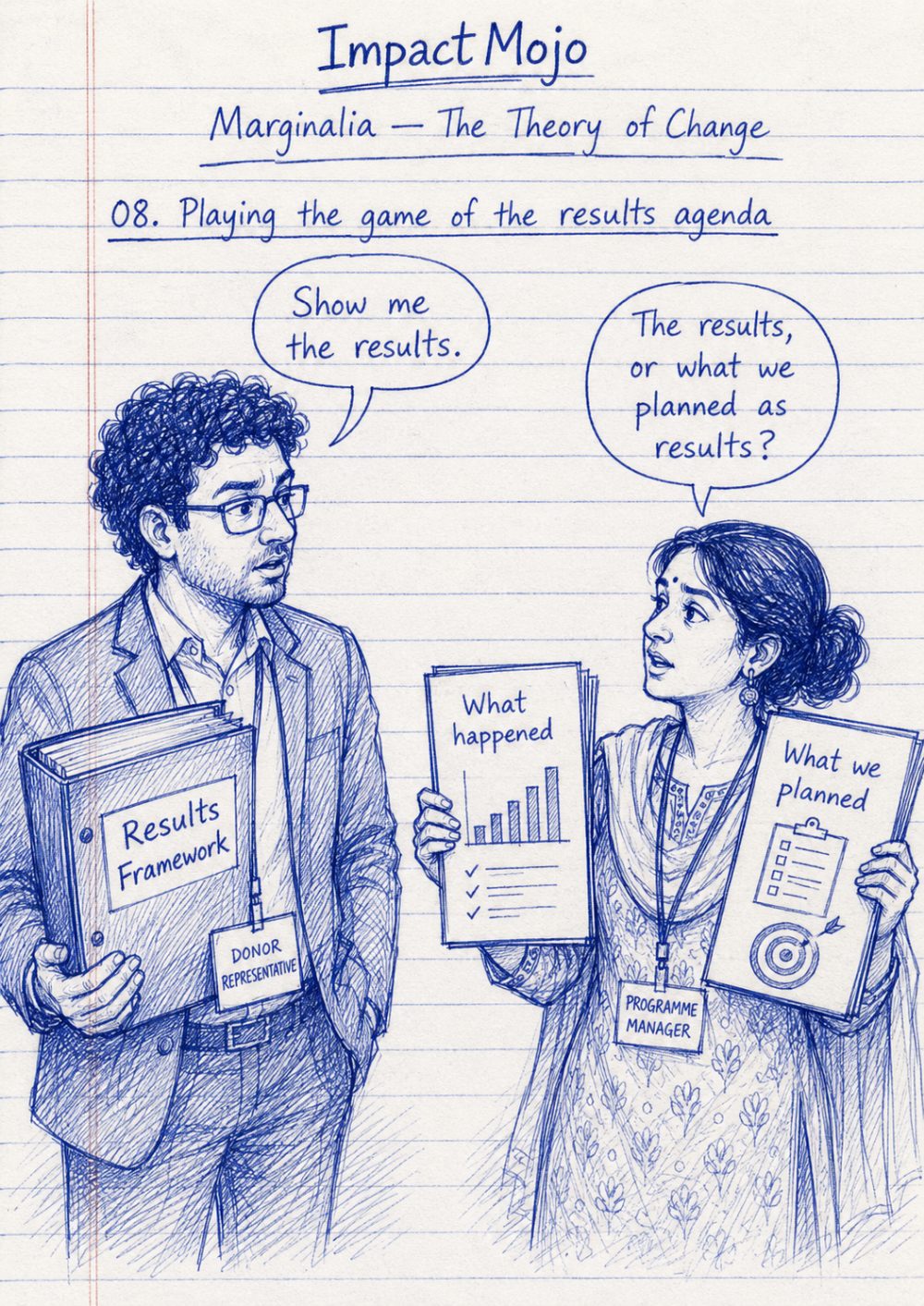
08 A donor representative holding a thick binder labelled 'Results Framework', saying 'Show me the results.' A programme manager holding up two folders — one marked 'What happened' and one marked 'What we planned' — replies, 'The results, or what we planned as results?'
The pitch“Show me the results.” The reply“The results, or what we planned as results?”

Playing the game of the results agenda

The volume edited by Rosalind Eyben, Irene Guijt, Chris Roche and Cathy Shutt — its subtitle, tellingly, Playing the Game to Change the Rules? — dissects what the “results agenda” does to development practice.8 When funding depends on demonstrating pre-specified results against value-for-money metrics, organisations learn to report the results the framework can recognise — which are the ones they promised in advance.

The effect is a slow narrowing: work is bent toward what is countable and attributable within the grant, and the messier, more honest account of what actually happened — including useful failure — becomes something to manage rather than to share.8 The reply's two folders are the two truths the results framework keeps confusing: the change that occurred, and the change that was forecast on page four.

Sources: 8

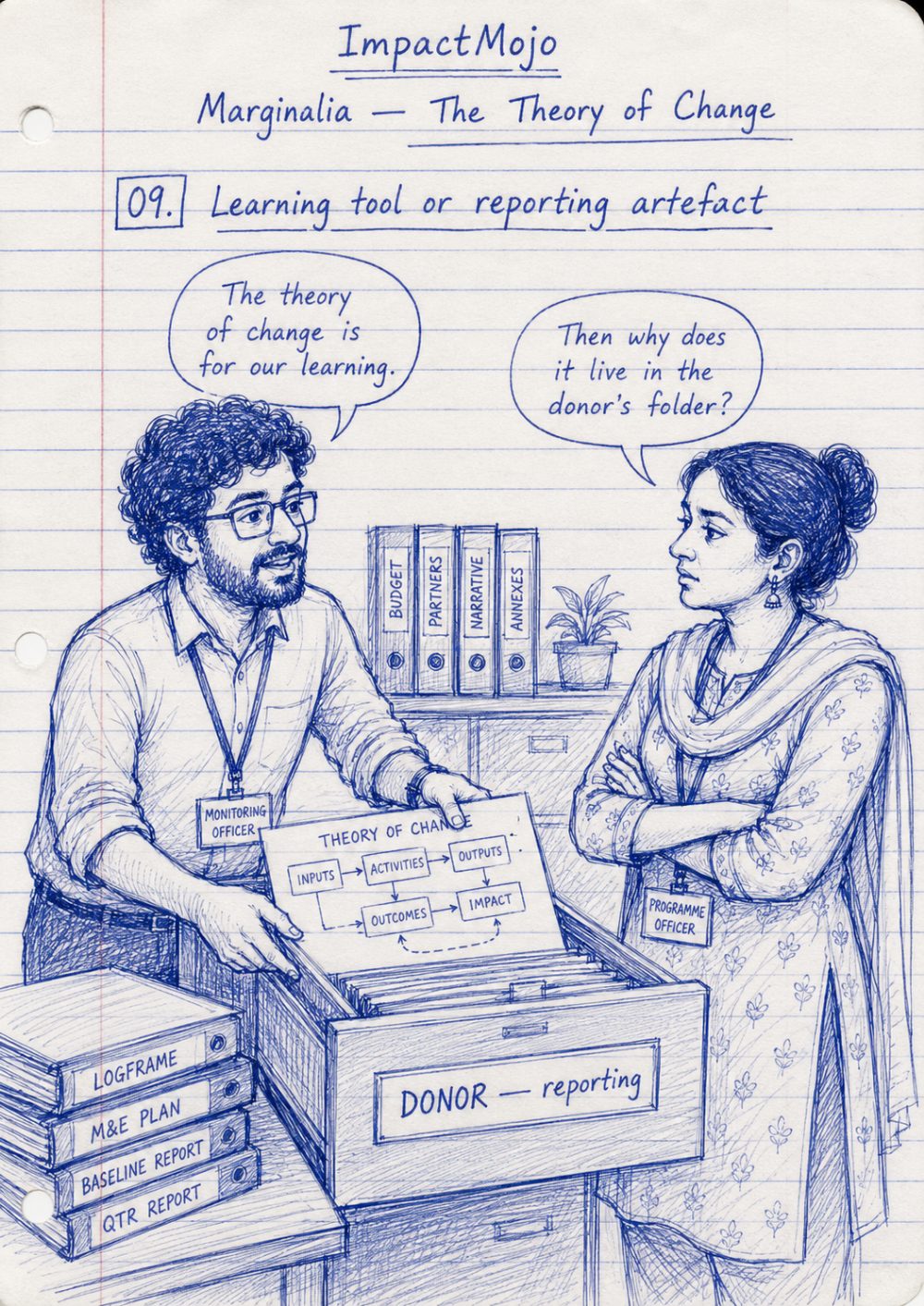
09 A monitoring officer sliding a printed theory-of-change diagram into a filing cabinet drawer labelled 'DONOR — reporting', saying 'The theory of change is for our learning.' A colleague watching replies, 'Then why does it live in the donor's folder?'
The pitch“The theory of change is for our learning.” The reply“Then why does it live in the donor's folder?”

Learning tool or reporting artefact

Cathy James's review for Comic Relief — literature plus interviews with people who actually use the approach — found the theory of change at its best is “a powerful learning lens” that sharpens a team's own thinking, monitoring and partnerships.9 At its worst, it is filled in once, to satisfy a funder, and never revisited: a reporting artefact wearing a learning tool's name.

The test is where the diagram lives and what it is for. A theory of change used for learning gets reopened, argued over, and revised when reality disagrees with it; one built for the donor gets printed, submitted and filed.91 The reply asks the only question that settles which kind you have — not what the tool is called, but whose drawer it ends up in.

Sources: 9, 1

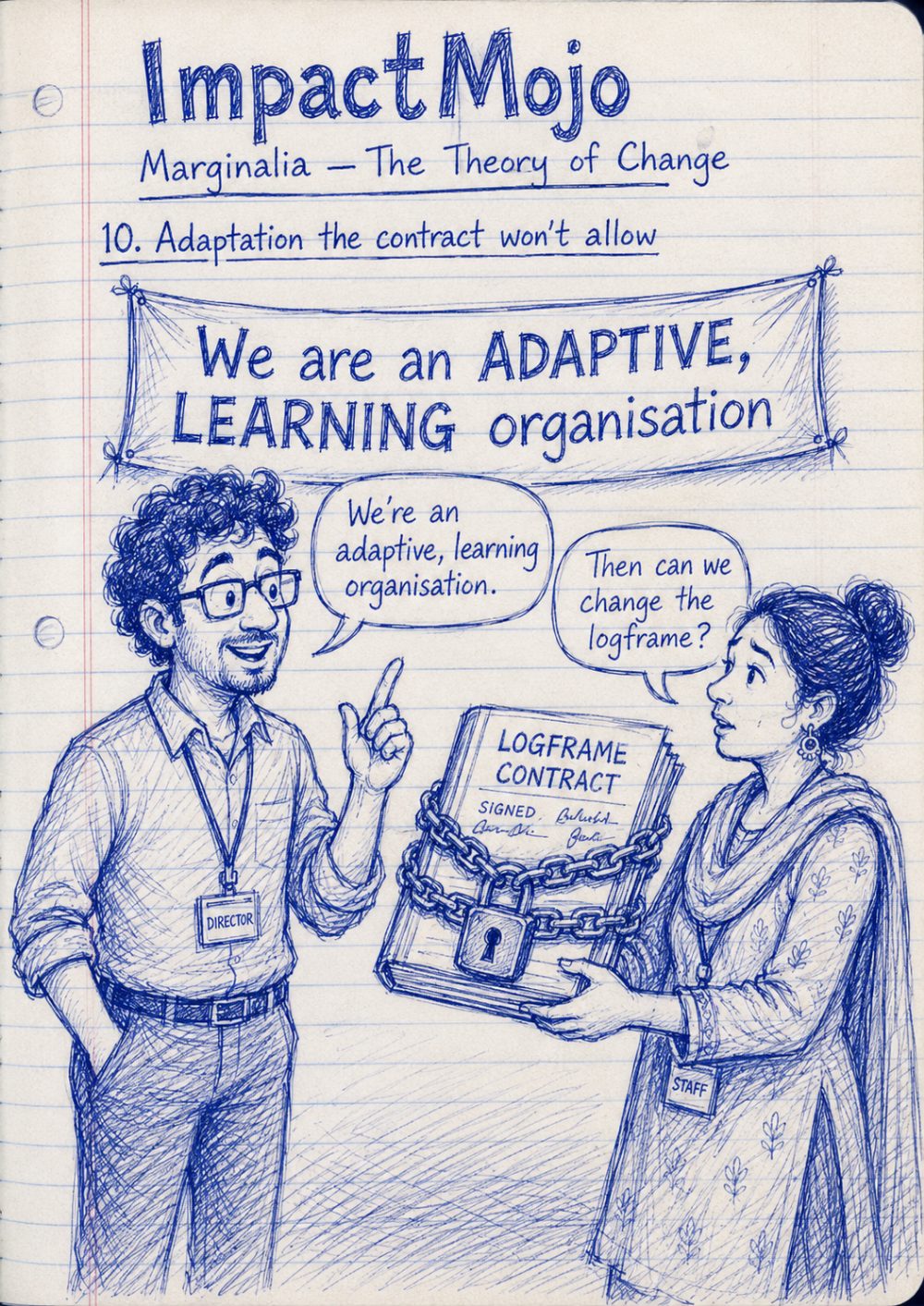
10 A director standing under a banner that reads 'We are an ADAPTIVE, LEARNING organisation', saying 'We're an adaptive, learning organisation.' A staff member holding the locked, signed logframe contract replies, 'Then can we change the logframe?'
The pitch“We're an adaptive, learning organisation.” The reply“Then can we change the logframe?”

Adaptation the contract won't allow

The reply is the acid test of every adaptive-management claim. The Doing Development Differently manifesto and the wider “problem-driven iterative adaptation” movement argue that real progress comes from working on locally-defined problems through fast cycles of trying, learning and adjusting — not from delivering a pre-drawn plan.10 Matt Andrews, Lant Pritchett and Michael Woolcock make the same case in Building State Capability: mimicking the plan produces the look of capability, not the thing itself.11

But adaptation you can't put in writing isn't adaptation. If the logframe is contractually fixed and the results were promised in advance, “we learned something” has nowhere to go. Approaches like outcome harvesting exist precisely to capture the changes a fixed framework can't anticipate12 — but they only help if the organisation is allowed to act on what they find. The question “can we change the logframe?” is where the learning rhetoric meets the signature page.

Sources: 10, 11, 12

A note on the joke

None of this is an argument against planning. A theory of change made honestly — arrows you'd defend, assumptions you'd test, a timeframe you believe — is one of the most useful things a team can do. The roast is aimed at the ritual version: the diagram drawn to be filed, the logframe that can't be reopened, the systems-change banner over a two-year grant. The tool is not the problem. Mistaking the tool for the thinking is.

Notes & Sources

  1. Craig Valters, Theories of Change in International Development: Communication, Learning, or Accountability? (JSRP Paper 17, Justice and Security Research Programme & The Asia Foundation, 2014). — gov.uk
  2. Oliver Bakewell & Anne Garbutt, The Use and Abuse of the Logical Framework Approach (INTRAC, for Sida, 2005). On the logframe's 1969 origins as a management-and-control tool for USAID. — intrac.org
  3. Ben Ramalingam, Aid on the Edge of Chaos: Rethinking International Cooperation in a Complex World (Oxford University Press, 2013). — aidontheedge.info
  4. Isabel Vogel, Review of the Use of 'Theory of Change' in International Development (commissioned by DFID, 2012). — gov.uk
  5. John Mayne, "Contribution Analysis: An approach to exploring cause and effect" (ILAC Brief 16, 2008); and "Contribution analysis: Coming of age?" Evaluation 18(3), 2012. — betterevaluation.org
  6. Andrew Natsios, The Clash of the Counter-Bureaucracy and Development (Center for Global Development, 2010). — cgdev.org
  7. Duncan Green, How Change Happens (Oxford University Press & Oxfam, 2016). — global.oup.com
  8. Rosalind Eyben, Irene Guijt, Chris Roche & Cathy Shutt (eds.), The Politics of Evidence and Results in International Development: Playing the Game to Change the Rules? (Practical Action Publishing, 2015). — practicalactionpublishing.com
  9. Cathy James, Theory of Change Review: A Report Commissioned by Comic Relief (2011). — theoryofchange.org (PDF)
  10. The Doing Development Differently Manifesto (2014), and the Problem-Driven Iterative Adaptation (PDIA) approach (Building State Capability programme, Harvard Kennedy School). — doingdevelopmentdifferently.com
  11. Matt Andrews, Lant Pritchett & Michael Woolcock, Building State Capability: Evidence, Analysis, Action (Oxford University Press, 2017). — global.oup.com
  12. Ricardo Wilson-Grau & Heather Britt, "Outcome Harvesting" (Ford Foundation, 2012) — an approach for identifying outcomes retrospectively where a fixed results framework can't anticipate them. — betterevaluation.org