When the checklist is not enough
Every research ethics course teaches the principles articulated in the 1979 Belmont Report: respect for persons, beneficence, and justice. Every institutional review board (IRB) requires informed consent forms, data protection protocols, and risk-benefit analyses. These frameworks are necessary, but in the South Asian research context, they are far from sufficient. The gap between procedural ethics and substantive ethics is vast, and it is in that gap where real harm can occur. A consent form can satisfy a review board and still leave a participant unsure what she agreed to.
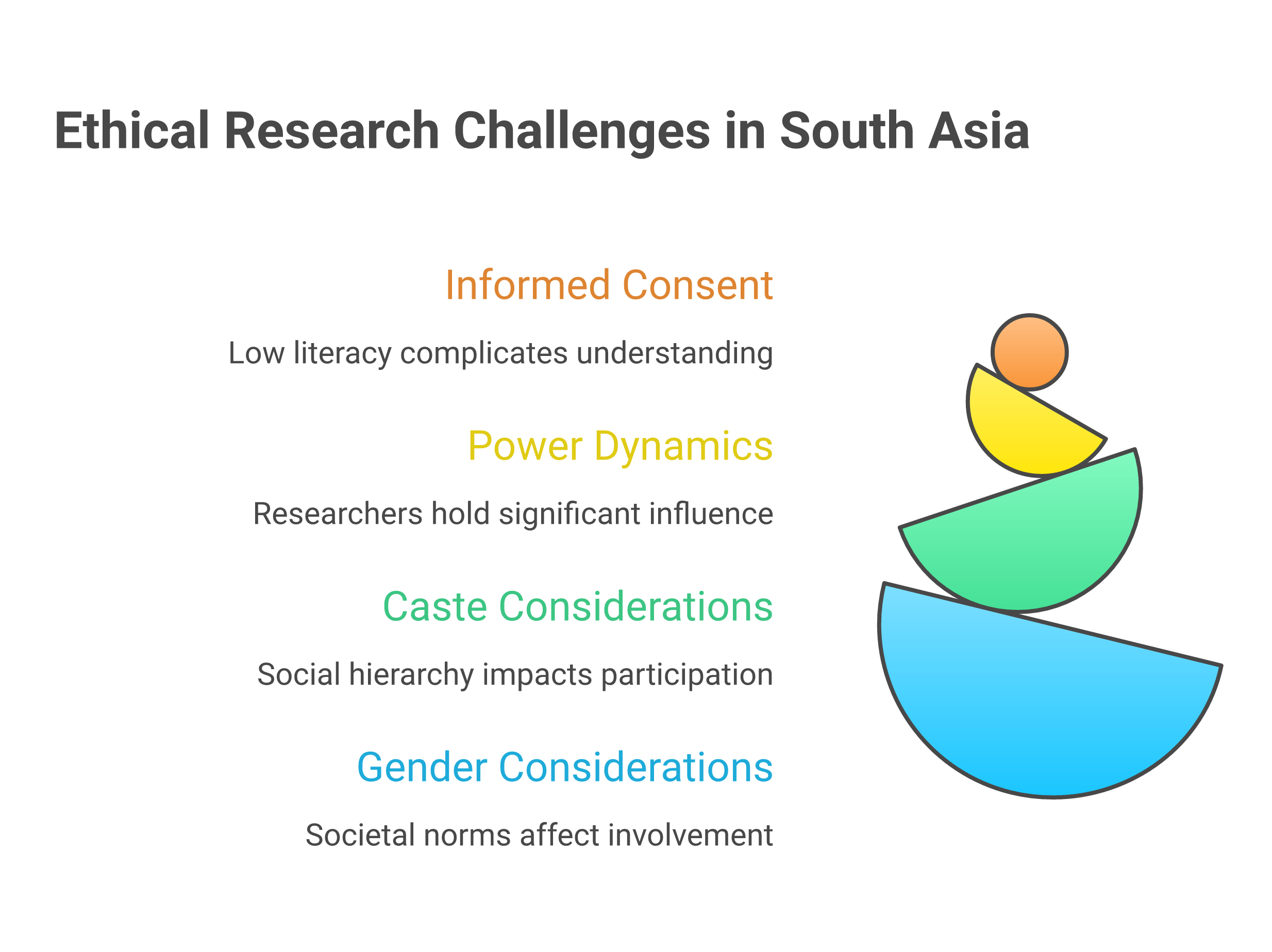
Consider the standard informed consent process. A researcher reads a two-page consent form to a Dalit woman in rural Uttar Pradesh. The form explains the study's purpose, her right to withdraw, and data confidentiality protocols. She nods and marks her thumbprint. Has consent really been obtained? The form was in Hindi, but her primary language is Bhojpuri. The concept of "research" is unfamiliar. The researcher arrived with the sarpanch, creating an implicit authority dynamic. Her husband is watching from across the room. The IRB box is ticked, but meaningful informed consent, the kind that reflects real understanding and voluntary choice, remains elusive.
Consent in low-literacy contexts
Low literacy affects a large share of respondents. India's 2011 Census put the effective literacy rate (people aged seven and above) at 74.04%, and at 65.46% among women. In the provisional totals, about 273 million people aged seven and above in India could not read and write. A consent form built around a written document cannot reach many of them. Reading the form aloud helps, but it does not show that the listener understood it, so the consent process itself needs redesigning. International guidance points the same way: the CIOMS International Ethical Guidelines for Health-related Research Involving Humans (2016) include separate guidelines on research in low-resource settings (Guideline 2), community engagement (Guideline 7) and research involving vulnerable persons (Guideline 15).
Innovative approaches being pioneered across the region include visual consent tools using pictorial explanations of study procedures, community-level consent processes where village assemblies discuss and deliberate on research participation before individual consent is sought, rolling consent where understanding is checked and re-confirmed at multiple points during data collection, and audio-recorded verbal consent that captures the consent conversation rather than just the signature.
Indian ethics frameworks increasingly treat consent as an ongoing process. India's national guidance for health research gives consent its own section. The Indian Council of Medical Research's National Ethical Guidelines for Biomedical and Health Research Involving Human Participants (2017) put the informed consent process in Section 5 and vulnerability in Section 6. Section 6 gives researchers an added responsibility when participants are economically, politically or socially deprived and so prone to exploitation, because their consent may be compromised by the expected benefits or by fear of what follows if they refuse. That is close to the situation described above. The guidelines are written for health research, and social-science teams can still read Section 6 as a model for their own protocols. The guidelines also allow community representatives to be involved where individual autonomy is compromised. This points toward a broader shift from procedural to substantive ethics that the social-science research community across the region can usefully adopt.
"Ethics is not a form to be signed. It is a relationship to be maintained (with every participant, in every interaction, throughout the life of the research.") Renu Addlakha, Centre for Women's Development Studies
Power dynamics: caste, gender and authority
Research in South Asia is never conducted on a level playing field. The intersecting hierarchies of caste, class, gender, religion, and education create power dynamics that shape every aspect of the research encounter: from who agrees to participate to what they feel safe saying.
When an upper-caste, English-educated researcher from Delhi interviews a Dalit agricultural labourer about her experiences with a government welfare programme, the power asymmetry is enormous. The participant may say what she thinks the researcher wants to hear. She may withhold information about corruption or exclusion for fear of retaliation. She may agree to participate not because she wants to but because refusing someone perceived as powerful feels too risky.
Gender dynamics compound these challenges. Women in many South Asian communities may not be accustomed to speaking with strangers, particularly male researchers. Joint interviews with husbands present may suppress what women say. Research on sensitive topics (domestic violence, reproductive health, dowry) requires female enumerators, private interview spaces, and referral pathways to support services.
Ethical practice in these settings starts with reflexivity: ongoing, critical examination of how the researcher's own identity and position shape the research encounter. It also needs diverse research teams that include members from the communities being studied. And it needs flexible protocols that can adapt to the specific power dynamics of each research site.
Beyond extraction: reciprocity and benefit-sharing
Perhaps the deepest ethical challenge in South Asian research is the extractive model that has dominated for decades. Researchers, often from elite urban institutions or international universities, descend on communities, collect data, publish papers, advance careers, and disappear. Communities receive nothing in return except, occasionally, a summary report written in language they cannot access.
This extractive model is ethically problematic, and it damages the research enterprise itself. Communities that have been repeatedly surveyed without visible benefit develop research fatigue: a well-documented state of apathy brought on by over-exposure to being researched, which recurs throughout the history of monitoring, evaluation, and learning. Fatigued respondents provide less thoughtful answers, refuse participation, or demand compensation that transforms the research relationship into a transaction. Field practitioners frequently describe over-researched communities asking, in effect: you came last year, and nothing changed, why should we answer your questions again? AHRECS notes that a sense of being mistreated by researchers, a lack of trust, or a failure to return any benefit to the community can make research fatigue worse.
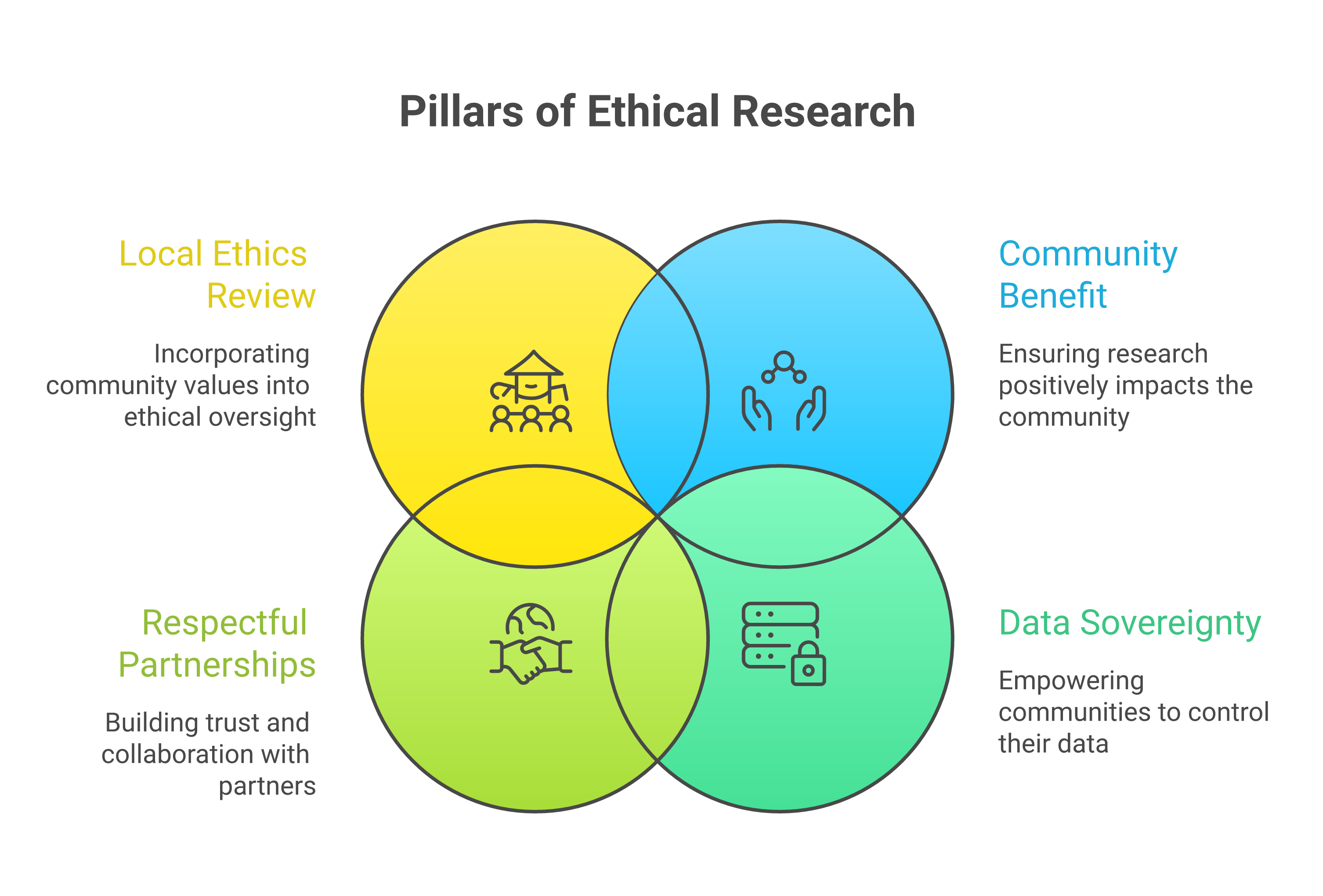
Moving beyond extraction requires structural changes. Participatory research designs that involve communities in defining research questions, collecting data, and interpreting findings give communities real ownership. Data sharing agreements that return processed data to communities and local organisations enable continued use beyond the original study. Capacity building that trains local researchers rather than using them merely as enumerators creates lasting benefit. And feedback loops that share findings with participants in accessible formats honour the relationship between researcher and community.
The ICSSR framework and beyond
India's Indian Council of Social Science Research (ICSSR) guidelines, alongside the ICMR's biomedical guidelines, provide useful starting frameworks for research ethics. ICSSR says in its call guidelines that research teams must follow ethical standards, including informed consent and confidentiality, and its 2025 calls also require the Project Director to submit an Undertaking on Research Integrity covering the originality of the proposal and adherence to ethical research practices. The ICMR's 2017 guidelines are more detailed on consent and vulnerability, but they cover biomedical and health research. Neither is written around the hierarchies of a particular village, so both need interpretation for the setting.
These frameworks are strongest on procedural requirements and institutional accountability. Where they could go further is in addressing the structural dimensions of research ethics: the political economy of research funding, the incentive structures that reward publication over community benefit, and the institutional cultures that treat ethics review as bureaucratic hurdle rather than substantive reflection. Data protection is becoming a legal as well as an ethical obligation: India's Digital Personal Data Protection Act, 2023 sets out consent and processing duties for organisations that handle personal data, and its Rules, notified on 13 November 2025, allow eighteen months for phased compliance, so the duties apply from 13 May 2027. From the same date section 17(2)(b) exempts processing for research, archiving or statistical purposes only where the data is not used to take any decision specific to a person and prescribed standards are met, so researchers should read the exemption's conditions before relying on it.
Researchers working across South Asia may answer to several ethical frameworks (ICSSR and ICMR in India, the Bangladesh Medical Research Council guidelines, and Nepal's National Ethical Guidelines for Health Research (2022)). Cross-border research requires harmonising standards, which typically means adhering to the most protective framework across all sites.
Towards an ethics of care
Ultimately, ethical research in South Asia demands moving beyond compliance to what scholars including Carol Gilligan, Nel Noddings and Joan Tronto developed as an ethics of care: an approach that centres moral life on relationships, attentiveness, and responsiveness to particular people, rather than on abstract rules alone. Applied to research, it becomes a commitment to maintaining respectful, responsive relationships with participants and communities throughout the research lifecycle. This means checking in on participants after data collection, saying plainly what the research can and cannot achieve, and recognising that every interaction with a marginalised community either reinforces or challenges existing power structures. Ethical research chooses to challenge them. For those designing surveys and instruments for these contexts, our Survey Design Studio covers question types, bias tests, ethics under India's DPDP Act and piloting, and our free Research Ethics 101 deck offers a structured grounding in the principles discussed here.