A region in transition
South Asia in 2026 is a region of extraordinary contrasts and rapid change, with fast-growing economies and large pockets of deprivation side by side. India's economy is among the fastest-growing major economies in the world, projected by the World Bank to expand around 6.6% in FY27, yet roughly 236 million people, about 16.4% of the population, remain in multidimensional poverty. Bangladesh's garment sector powers impressive GDP growth while climate displacement reshapes entire districts, and tropical cyclones alone cost it about $1 billion a year. Nepal's post-federalisation governance experiment, under the 2015 constitution, is entering its second decade with mixed results. Sri Lanka's recovery from its 2022 economic crisis remains fragile, with poverty still twice its 2019 level. Across the region, old development challenges persist while new ones (digital exclusion, climate migration, pandemic preparedness) demand fresh approaches.
For development professionals working in South Asia, understanding these macro trends is essential context for programme design, evaluation, and advocacy. The assumptions that guided development practice five years ago may no longer hold. Donor priorities are shifting, government structures are evolving, and communities are demanding different forms of engagement. This article maps the key trends shaping development in South Asia in 2026, taking four countries in turn and then the themes they share.
India: digital public infrastructure and foreign funding rules
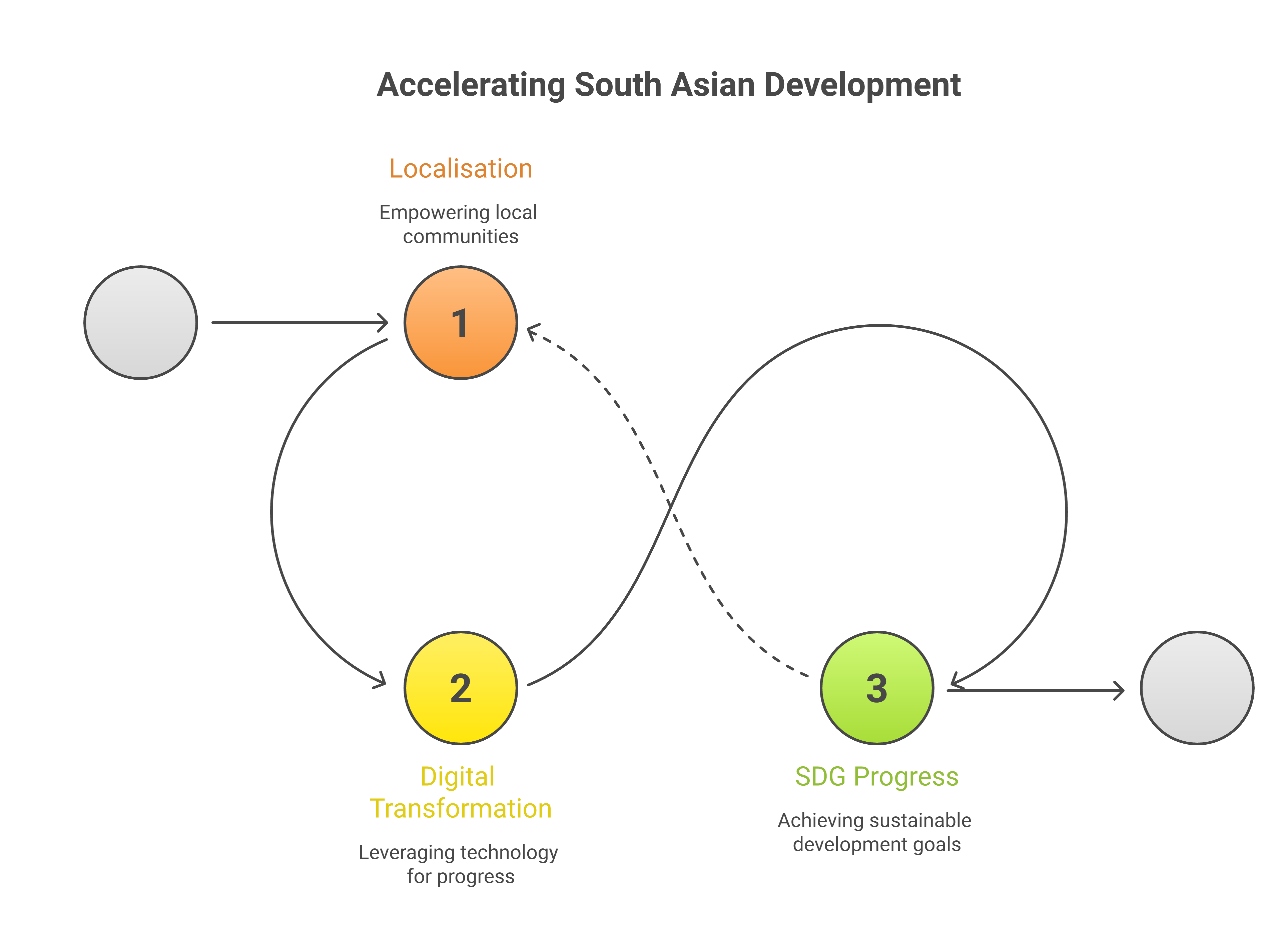
India's development trajectory in 2026 is shaped by two dominant forces: the rapid scaling of digital public infrastructure and the growing momentum behind localisation of development funding and decision-making.
The India Stack (Aadhaar identity, UPI payments, DigiLocker documents, and the Account Aggregator framework) is the digital layer through which many government services, financial products, and benefits now reach people. Direct Benefit Transfers (DBT) now cover over 300 central government schemes, reducing leakage and intermediary costs, and the DBT portal lists 320 schemes across 56 ministries. It credits DBT with estimated gains of ₹5,14,201.92 crore, which is the government's own estimate. Yet the digital dividend is unevenly distributed. Rural women, elderly populations, persons with disabilities, and tribal communities face persistent barriers to digital access and literacy. In the 2019-21 National Family Health Survey, 33.3% of women had ever used the internet, against 57.1% of men, and the figure for rural women was 24.6%. For development organisations, the challenge is dual: using digital infrastructure for programme delivery while ensuring it does not create new forms of exclusion. A programme that delivers through a phone or an app has to plan for the people who have neither.
Localisation, the push to shift decision-making power and resources from international organisations to national and local actors, has gained significant ground and is a stated aim of many donors. Indian CSOs increasingly lead programme design and implementation, with international NGOs playing supporting rather than directing roles. In India, the Foreign Contribution (Regulation) Amendment Act of 2020, passed by Parliament in September 2020, changed how foreign money moves: it bars an organisation from transferring foreign contribution to any other person, and it lowers the cap on administrative spending from 50% to 20% of the contribution. Organisations that relied on foreign funds, or passed them on to smaller partners, had to change how they work. The amendments continue to reshape the funding environment, pushing organisations toward domestic resource mobilisation. This has catalysed innovation in social enterprise models, CSR partnerships, and community-based financing, but has also created funding pressures for organisations working on rights-based and advocacy issues. In this setting, data-driven decision-making becomes essential for demonstrating impact to diverse funders.
Bangladesh: climate risk and national planning
Bangladesh's development story has long been one of defying expectations: achieving remarkable progress in poverty reduction, maternal health, and girls' education despite limited resources and extreme climate vulnerability. In 2026, climate adaptation has moved from the periphery to the centre of Bangladesh's development strategy. Bangladesh is among the countries most exposed to cyclones, floods and sea-level rise. The World Bank's 2022 Country Climate and Development Report warns that, without strong action, climate risks will undermine the country's development trajectory.
Tropical cyclones alone cost Bangladesh about $1 billion a year, or 0.7% of GDP. The same report estimates that climate impacts could produce as many as 13 million internal climate migrants by 2050. Salinity intrusion is rendering agricultural land unproductive, and the report expects sea-level rise to push it further inland. Climate migration is driving rapid, unplanned urbanisation of Dhaka and Chattogram. These are present realities shaping every aspect of development programming. Under severe flooding, it puts the fall in GDP at as much as 9%.
Bangladesh's response has been innovative. Community-based early warning systems, floating gardens, saline-tolerant crop varieties, and cyclone-resilient housing programmes demonstrate a pragmatic, locally driven approach to adaptation. Two national documents frame the response: the Bangladesh Climate Change Strategy and Action Plan, formulated in 2009, and the Bangladesh Delta Plan 2100, adopted in 2018. Programme designers working there will meet both, and the country has become a global voice for climate justice and loss-and-damage financing. For development professionals, Bangladesh offers both lessons and cautionary tales about integrating climate resilience into sectoral programming.
"Bangladesh has led the way in adaptation and disaster risk management. Over the past 50 years, it has reduced cyclone-related deaths 100-fold. Other countries can learn from this.": Martin Raiser, World Bank Vice President for South Asia, 2022
"Climate change is not a future threat for South Asia. It is a present reality reshaping livelihoods, migration patterns, and development priorities in real time. Every programme design that ignores climate is already outdated.": Bangladesh Climate Change Trust
Nepal: federalism and local government
Nepal's 2015 constitution established a federal system with 753 local governments across seven provinces. A decade into this experiment, the results are mixed but instructive. Local governments have gained significant authority over health, education, agriculture, and social protection: Schedule 8 of the constitution gives them 22 powers of their own, and the first local elections under the new structure were held in 2017. For anyone designing a programme, the municipality is now a counterpart in its own right. Some municipalities have demonstrated remarkable innovation, developing digital citizen charters, participatory budgeting processes, and community-led monitoring systems.
However, capacity constraints at the local level remain severe. Many municipalities lack the technical skills for evidence-based planning, financial management, and service delivery monitoring. The development sector has responded with a wave of capacity-building programmes, but these efforts are fragmented and sometimes contradictory. Open educational resources offer one path to more consistent, accessible capacity building: every municipality can get the same training material at no cost. Nepal's experience offers lessons for other countries pursuing decentralisation, particularly around the need for sustained, coordinated capacity building rather than one-off training events.
Sri Lanka: recovery after the 2022 crisis
Sri Lanka's 2022 economic crisis (triggered by foreign exchange shortages, debt distress, and policy failures) devastated livelihoods across the country. By 2026, recovery is underway but remains fragile. A four-year IMF programme of about US$3 billion, approved on 20 March 2023, aims to restore debt sustainability while limiting the impact on the poor, and IMF programme conditionalities have imposed fiscal austerity that constrains social spending. Poverty, which had declined steadily for decades and is measured here at the $3.65-a-day line, rose from 13.1% in 2021 to an estimated 25.9% in 2023 and was 24.5% in 2024, twice the 2019 level, which keeps roughly a quarter of the population below that line.
The crisis reshaped Sri Lanka's development context in lasting ways. International organisations that had been scaling down their presence returned. Domestic civil society, weakened by years of political pressure, found renewed purpose in crisis response and accountability work. Community-based organisations in rural areas proved more resilient than formal institutions, highlighting the importance of local social infrastructure and the need for building MEL culture that can withstand shocks. Sri Lanka's experience is a stark reminder that development gains are not permanent, that economic shocks can reverse decades of progress, and that social protection systems must be strong enough to withstand crisis. The poverty rate at that line roughly doubled between 2021 and 2023.
Cross-cutting themes
Several themes cut across national boundaries. The youth bulge (South Asia has the largest youth labour force in the world and is home to 340 million adolescents), about 30% of the world's total, which creates enormous potential but also enormous pressure on education and employment systems. In 2019 UNICEF estimated that 54% of South Asian youth were not on track to have the education and skills needed for employment in 2030. Mental health is finally emerging as a development priority, with programmes addressing both the mental health impacts of poverty and climate stress and the occupational wellbeing of frontline development workers. Poverty measures are not interchangeable. India's 16.4% is a multidimensional poverty rate from the 2025 Global MPI and Sri Lanka's 24.5% is an income poverty rate at $3.65 a day, so the two figures in this article cannot be read against each other. Data governance (questions of who owns, controls, and benefits from the data that digital programmes generate) remains largely unresolved, although India has had a legal anchor since the Digital Personal Data Protection Act of August 2023, which research teams should read alongside the principles of ethical research in the region.
For development practitioners working in this region, the imperative is clear: invest in understanding context, embrace adaptation as a core competency, and build the local capacity that makes sustainable development possible. South Asian development in 2026 rewards organisations that learn continuously, partner in good faith, and remain accountable to the communities they serve. For the economic foundations beneath these trends, our free course Understanding Development: An Economics Perspective is a good place to start.