Skip to content
An ImpactMojo Special · Marginalia

The Proposal Wrote the Programme

Ten exchanges where the funding document meets the village it was written about.

The Proposal Wrote the Programme is the sixth essay in the Marginalia series. Long before the first field visit, a programme is largely decided — in a proposal written to a deadline, aligned to a donor call, costed in a locked budget. In each drawing the lanyard reads out the design; the field asks the one question the design skipped — who set the priorities, when did demand arrive, what happens after March. An affectionate roast of our own profession, footnoted in earnest.

The claim — what the proposal says The reply — what the field asks The evidence — why the reply lands

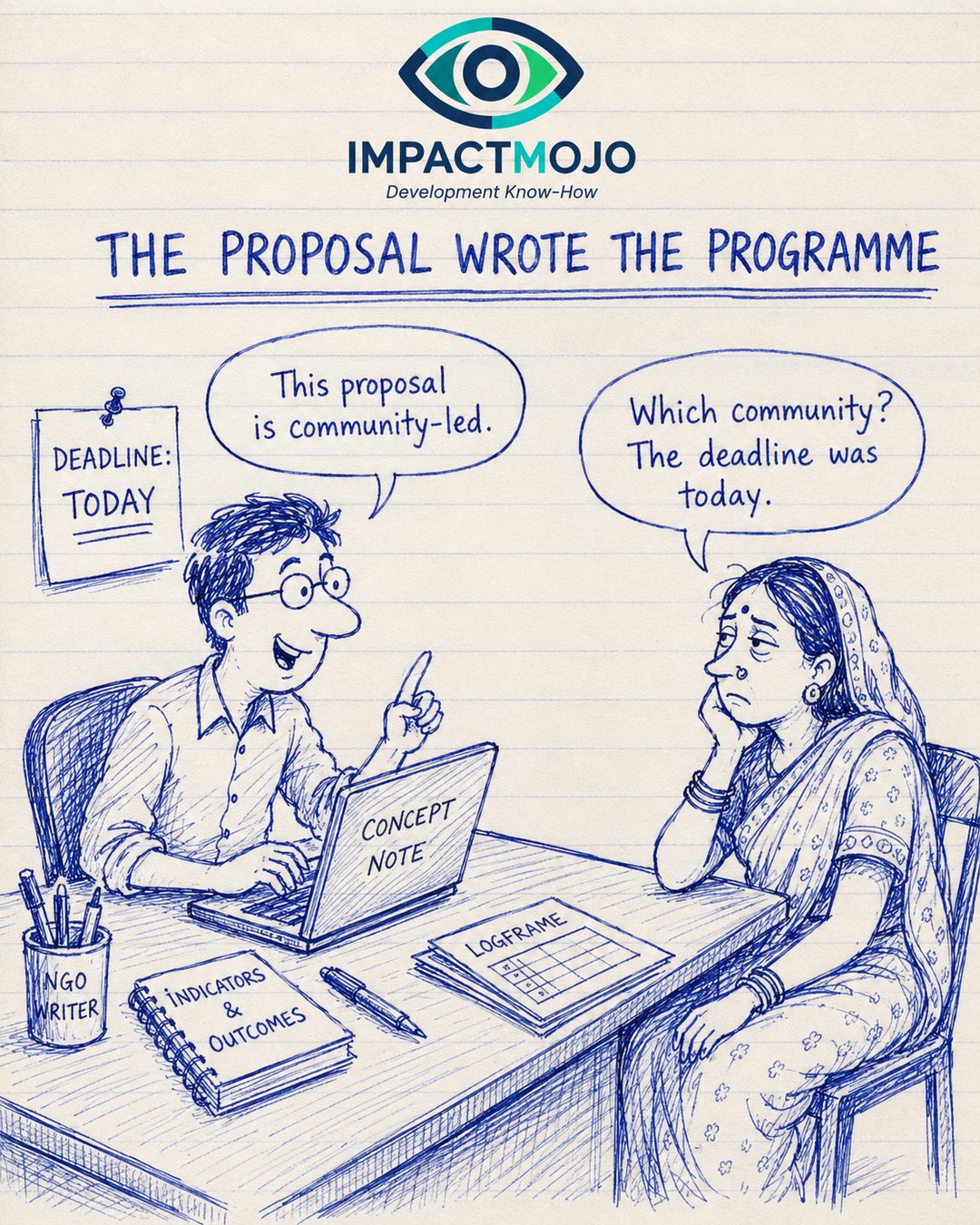
01 An NGO writer typing a 'Concept Note' at a laptop, with 'Indicators & Outcomes' notes and a 'DEADLINE: TODAY' sheet pinned to the wall, raises a finger and says 'This proposal is community-led.' A woman seated opposite, chin on her hand, replies 'Which community? The deadline was today.'
The claim“This proposal is community-led.” The reply“Which community? The deadline was today.”

A proposal written before the community arrived

When the document is finished to a submission deadline, the only voice that shaped it is the one holding the pen. David Mosse’s ethnography of aid found that project designs are produced first to mobilise funds and build coalitions among donors and managers; the participation of the people named in them is assembled — and narrated — afterwards, so the design reads as something the community asked for.1

Andrea Cornwall calls this the slipperiness of the word itself: “participation” travels comfortably from a public meeting to a tick-box precisely because it is never pinned to a moment in the cycle.2 If the community enters after the logframe is written and the budget is set, it is being consulted about a programme, not authoring one. “Community-led” is a claim about sequence; the deadline answers it.
Sources: 1, 2

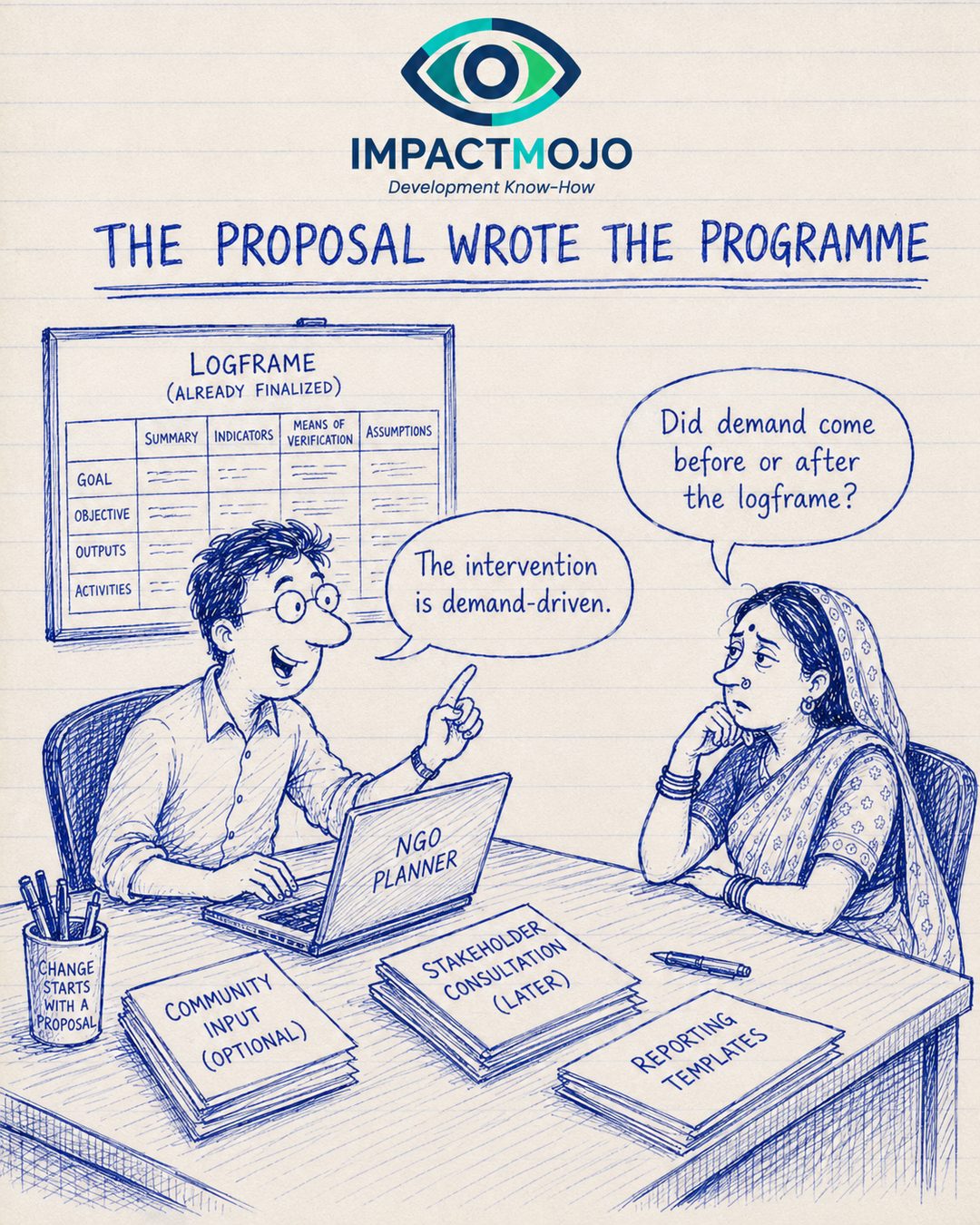
02 An NGO planner gestures toward a wall chart headed 'Logframe (already finalized)' with goal, objective, outputs and activities filled in. On the table sit folders marked 'Community Input (optional)', 'Stakeholder Consultation (later)' and 'Reporting Templates', and a mug reading 'Change starts with a proposal'. He says 'The intervention is demand-driven.' A woman opposite asks 'Did demand come before or after the logframe?'
The claim“The intervention is demand-driven.” The reply“Did demand come before or after the logframe?”

Supply, dressed as demand

The logical framework fixes goals, indicators and activities at design and then resists change, because every later report is scored against the cells agreed up front. Oliver Bakewell and Andy Garbutt, reviewing NGOs’ own experience for Sida, found the tool routinely locks a project in at the moment of least knowledge and recasts learning as deviation — the opposite of responding to demand as it is discovered.3

If the logframe is already finalised while community input is filed as “optional” and consultation is scheduled for “later,” demand cannot have driven the design; at most it will be invited to ratify it. A programme is demand-driven only if the demand is allowed to arrive before the matrix closes.

Sources: 3

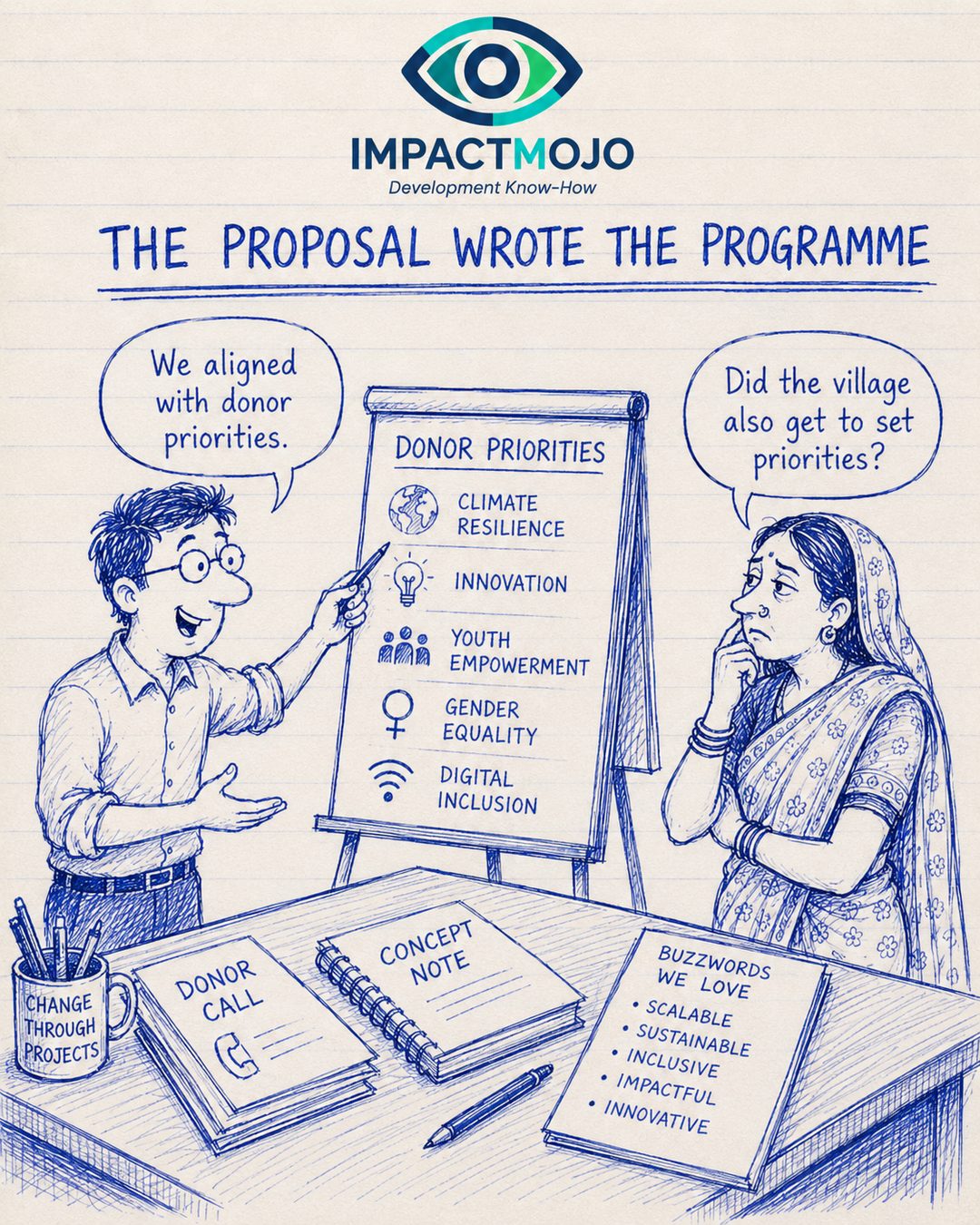
03 An NGO officer points at an easel headed 'Donor Priorities' listing Climate Resilience, Innovation, Youth Empowerment, Gender Equality and Digital Inclusion, beside a 'Donor Call' note, a 'Concept Note' and a list titled 'Buzzwords we love — scalable, sustainable, inclusive, impactful, innovative'. He says 'We aligned with donor priorities.' A woman, hand to her chin, asks 'Did the village also get to set priorities?'
The claim“We aligned with donor priorities.” The reply“Did the village also get to set priorities?”

Whose priorities the proposal carries

Aligning upward is rational under the incentives — funding flows to whichever themes the current call rewards. But the Paris Declaration made local ownership the first principle of aid effectiveness precisely because supply-led alignment had a long record of producing programmes that fit the donor’s strategy and missed the country’s.4 Two decades of reviews keep finding ownership honoured more in proposals than in practice.

Matt Andrews, Lant Pritchett and Michael Woolcock name the mechanism isomorphic mimicry: organisations adopt the forms a funder finds legitimate — the right keywords, the fashionable theme — to secure resources, while the functions the place actually needs go unbuilt.5 A board of donor priorities with no column for the village’s own is alignment in one direction only.

Sources: 4, 5

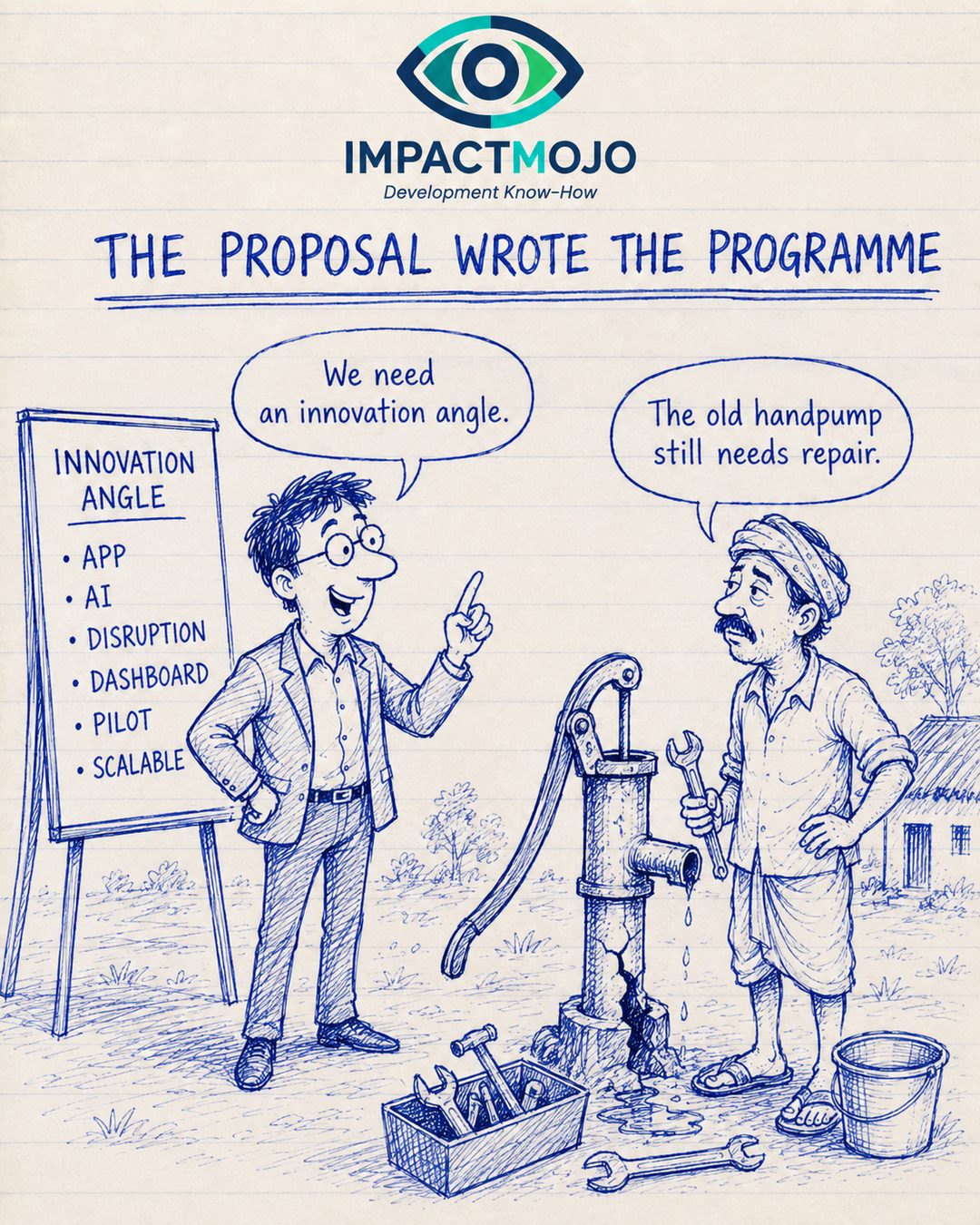
04 An NGO officer at an easel headed 'Innovation Angle' — App, AI, Disruption, Dashboard, Pilot, Scalable — raises a finger and says 'We need an innovation angle.' Across from him a villager holding a wrench beside a leaking handpump, a toolbox and a bucket at his feet, replies 'The old handpump still needs repair.'
The claim“We need an innovation angle.” The reply“The old handpump still needs repair.”

Novelty is fundable; maintenance is not

Donors reward the new pilot over the unglamorous upkeep of what already exists — a bias so familiar in global health it earned a name, “pilotitis”: a graveyard of demonstrations that are never sustained or scaled.6 The proposal needs an innovation angle because the call does; the village needs the pump it already has to keep working.

And the existing infrastructure is failing for want of exactly that attention. Studies of community handpumps in sub-Saharan Africa find roughly a third non-functional at any given time, overwhelmingly because no one funded the repair, the spare part or the mechanic — not because the technology was insufficiently disruptive.7 An app does not lift water; a working handpump does.

Sources: 6, 7

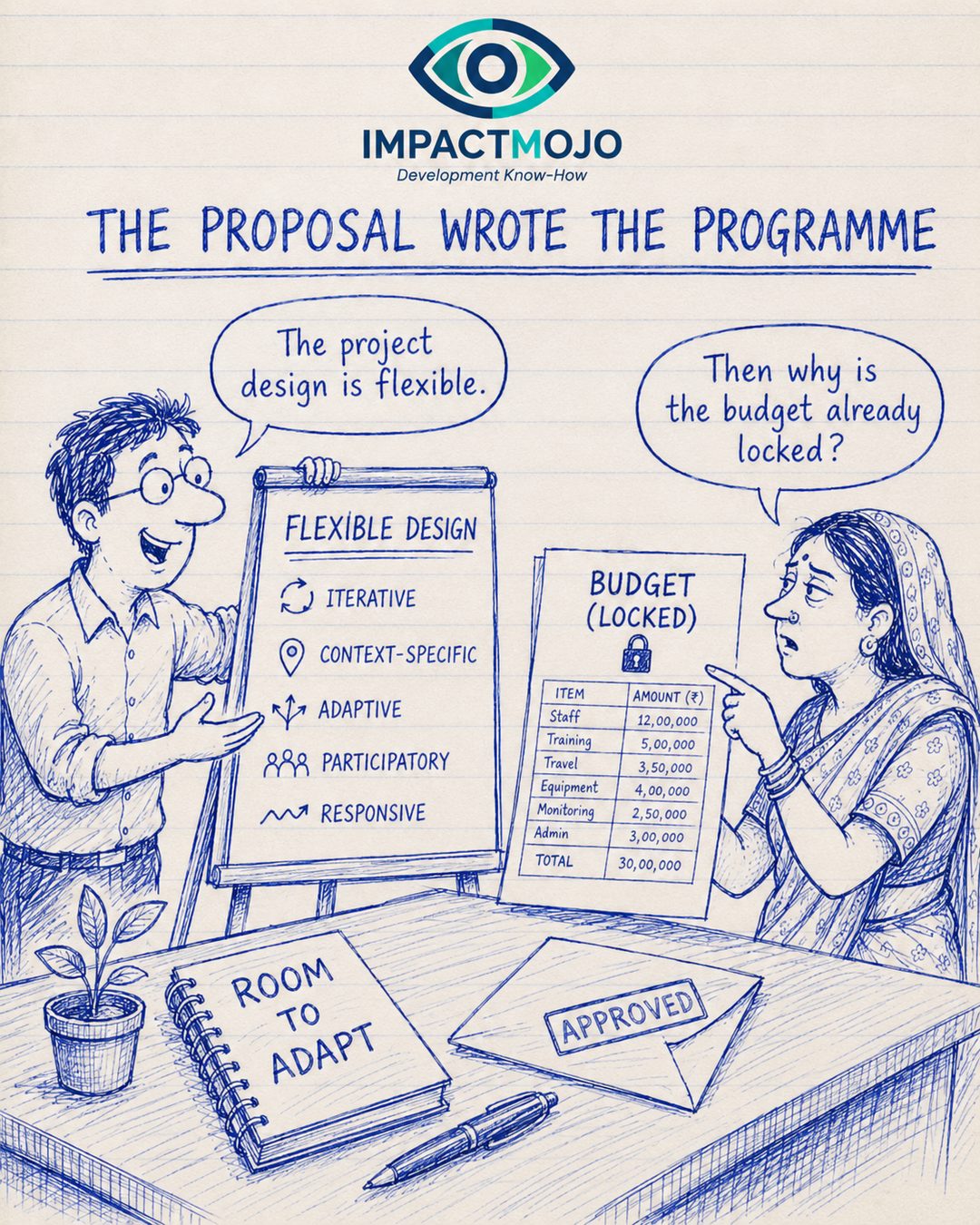
05 An NGO officer at an easel headed 'Flexible Design — Iterative, Context-specific, Adaptive, Participatory, Responsive', beside a notebook reading 'Room to adapt', says 'The project design is flexible.' A woman points at a second chart, 'Budget (Locked)', with every line item and a fixed total, and asks 'Then why is the budget already locked?'
The claim“The project design is flexible.” The reply“Then why is the budget already locked?”

Adaptive in the narrative, fixed in the budget line

A design is only as flexible as the money behind it. Dan Honig’s study of more than 14,000 development projects found that those given room for field agents to navigate by judgment outperformed those bound to predefined targets — but that funders’ own controls, the locked budget chief among them, systematically suppress that discretion.8 Flexibility written into the design and absent from the financing is a slogan.

This is why the Doing Development Differently community argues that genuine adaptation needs an authorising environment — budgets and rules that permit reallocation as learning happens — not just adaptive language in the proposal.9 When the line items are approved and frozen before the first field visit, “room to adapt” is a notebook title, not a permission.

Sources: 8, 9

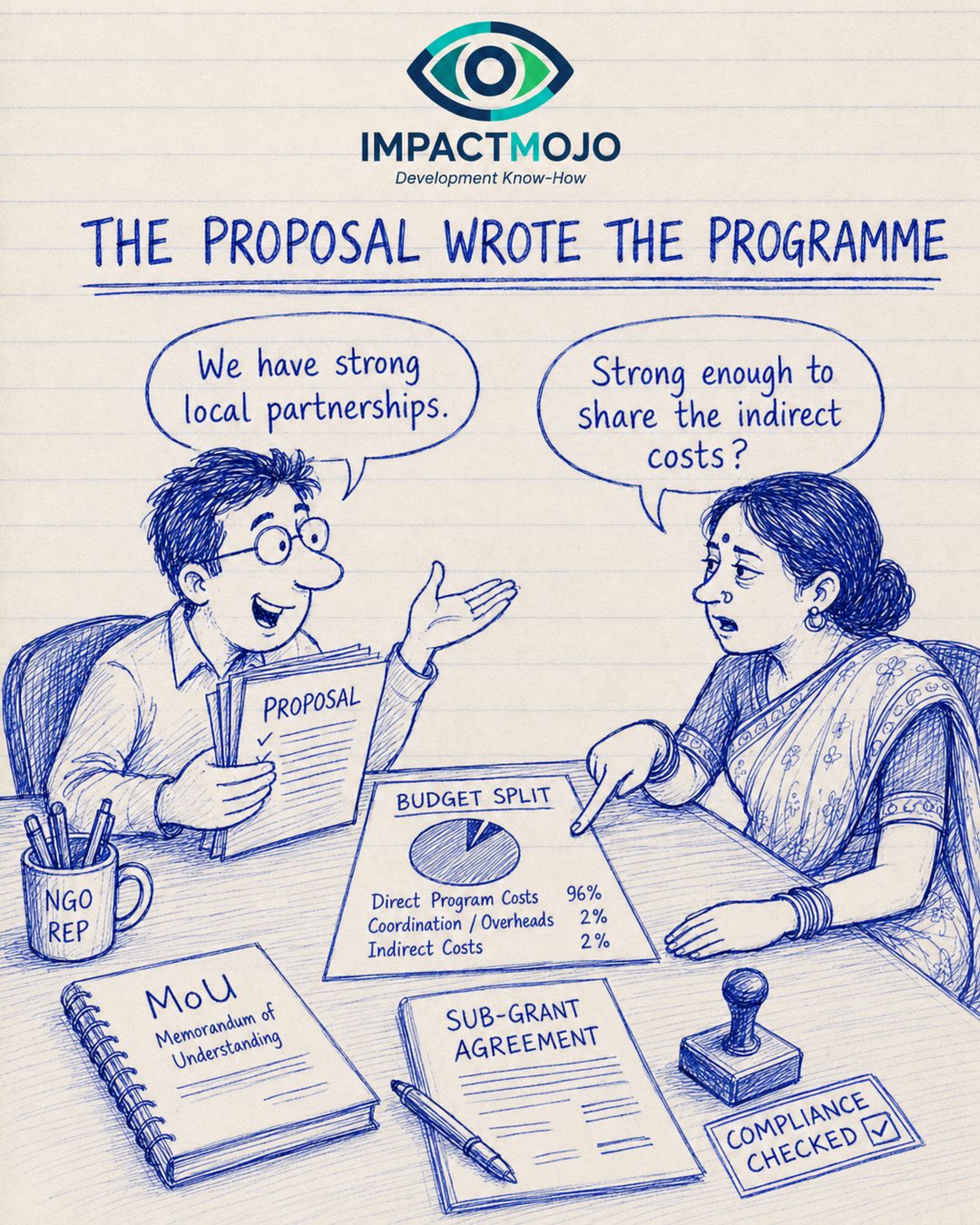
06 An 'NGO Rep' holding a 'Proposal' gestures across a table where a 'Budget Split' reads Direct Program Costs 96%, Coordination / Overheads 2%, Indirect Costs 2%, beside a 'Memorandum of Understanding', a 'Sub-Grant Agreement' and a 'Compliance Checked' stamp. He says 'We have strong local partnerships.' A woman, pointing at the split, asks 'Strong enough to share the indirect costs?'
The claim“We have strong local partnerships.” The reply“Strong enough to share the indirect costs?”

Partnership without the overhead

A sub-grant that passes on the activity but keeps the overhead turns a “partner” into a sub-contractor carrying the programme’s risk on none of its core costs. The Grand Bargain’s localisation commitment — that a quarter of humanitarian funding reach local and national actors “as directly as possible,” with fair overhead — was made because this is the norm, not the exception; years on, the target remains largely unmet.10

Denying overhead has a name on the funder side too: the nonprofit “starvation cycle,” in which unrealistically low indirect-cost rates leave organisations unable to build the very systems they are then judged for lacking.11 Passed down a sub-grant to a local NGO, the starvation is simply exported. Partnership that won’t share the 2% isn’t partnership; it’s delegation.

Sources: 10, 11

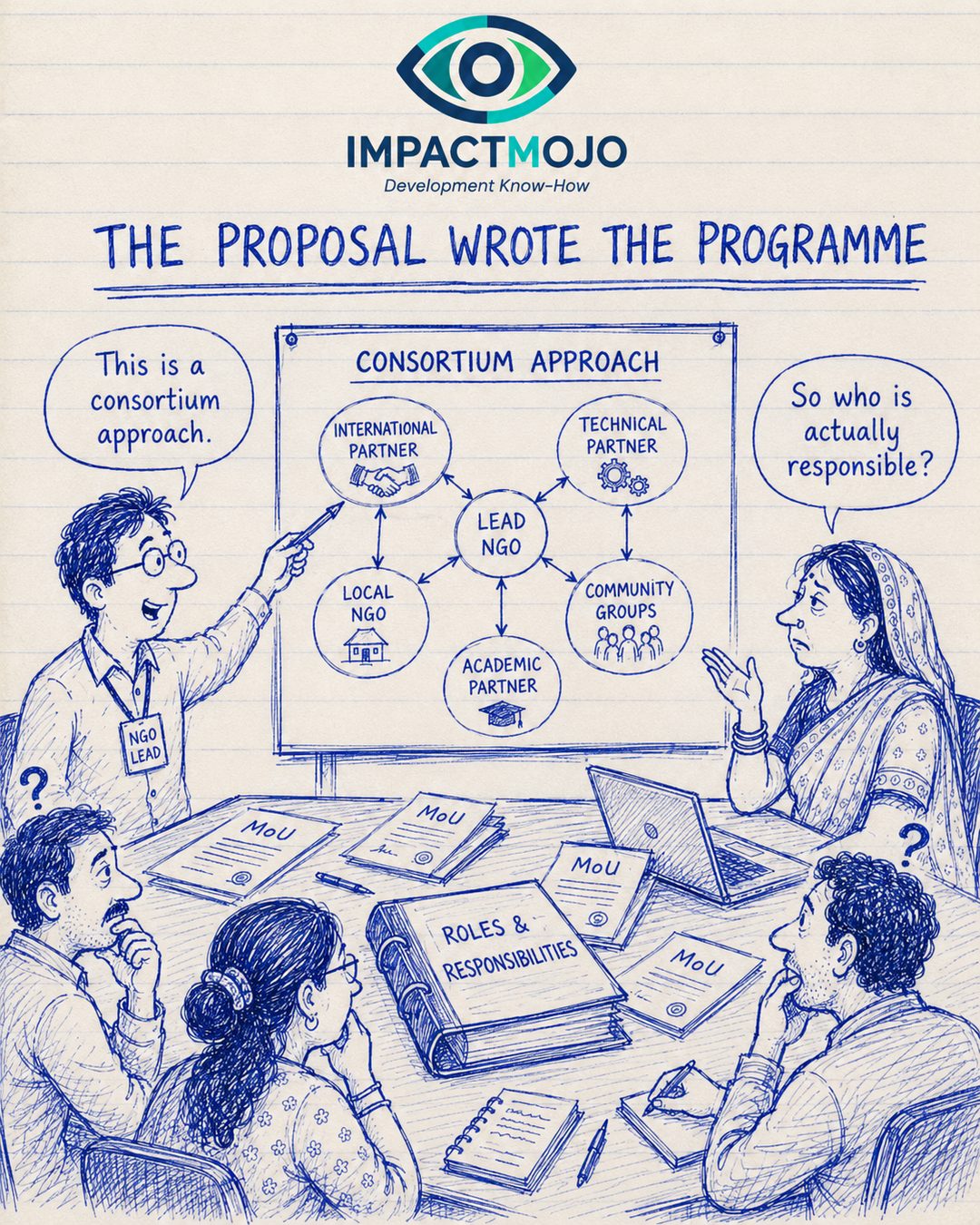
07 A man with an 'NGO Lead' badge points at a board headed 'Consortium Approach' linking an International Partner, Technical Partner, Lead NGO, Local NGO, Academic Partner and Community Groups, with a 'Roles & Responsibilities' binder and several 'MoU' documents on the table. He says 'This is a consortium approach.' A woman opposite — and two colleagues with question marks over their heads — ask 'So who is actually responsible?'
The claim“This is a consortium approach.” The reply“So who is actually responsible?”

Many partners, no single answer

A consortium spreads capacity — and, quietly, accountability. Dennis Thompson named the hazard the “problem of many hands”: when many actors each contribute to an outcome, it becomes hard to hold any one of them responsible for it, and responsibility evaporates into the diagram.12 An org chart with six boxes and a binder of roles can describe everything except who answers when the borewell runs dry.

And the answer, when it comes, tends to point upward. Alnoor Ebrahim showed that NGO accountability mechanisms overwhelmingly serve funders and external reporting, while accountability to the communities served stays weak and voluntary.13 In a consortium the chain only lengthens: more hands between the village and the body that could actually be held to account.

Sources: 12, 13

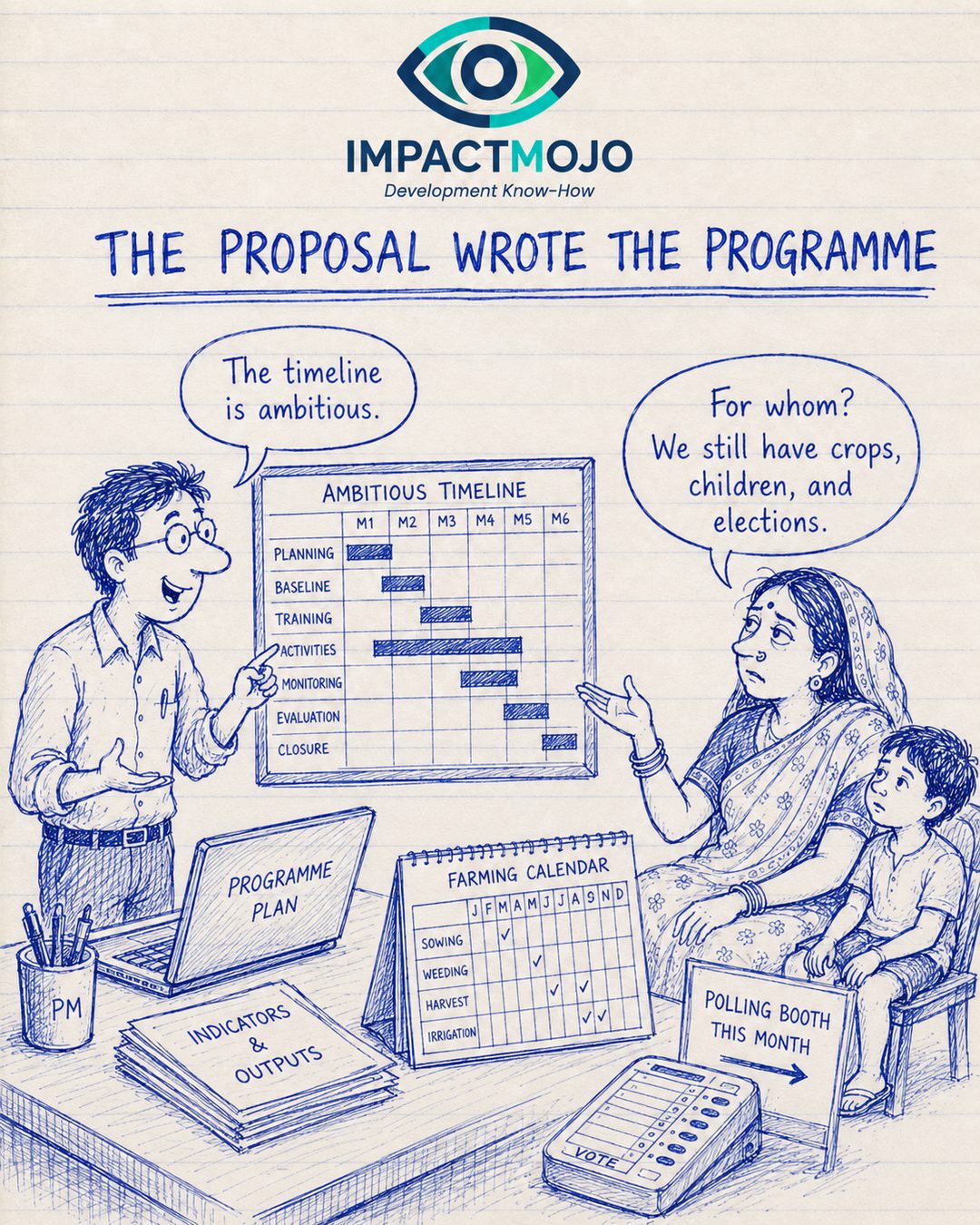
08 A programme manager stands by a Gantt chart headed 'Ambitious Timeline' running M1–M6 across planning, baseline, training, activities, monitoring, evaluation and closure. He says 'The timeline is ambitious.' A woman with a child on her lap, beside a 'Farming Calendar' marking sowing, weeding, harvest and irrigation, a 'Polling Booth This Month' sign and a voting machine, replies 'For whom? We still have crops, children, and elections.'
The claim“The timeline is ambitious.” The reply“For whom? We still have crops, children, and elections.”

The project calendar meets the village calendar

An “ambitious” timeline is ambitious for the office that has to disburse and report inside the funding window. It rarely consults the other calendars already running: the agricultural season that dictates when anyone can attend a training, the care work that fills a parent’s day, the election that commandeers the same officials and meeting halls. Robert Chambers and colleagues built a whole literature on this neglected seasonality — how poverty, labour and time are structured by a farming year that project schedules routinely ignore.14

When the programme’s months collide with sowing, harvest and the polls, attendance drops, and the gap is logged as the community’s low engagement rather than the timeline’s bad manners. Ambition measured only against the grant period is a schedule that fits the funder and fights the village.

Sources: 14

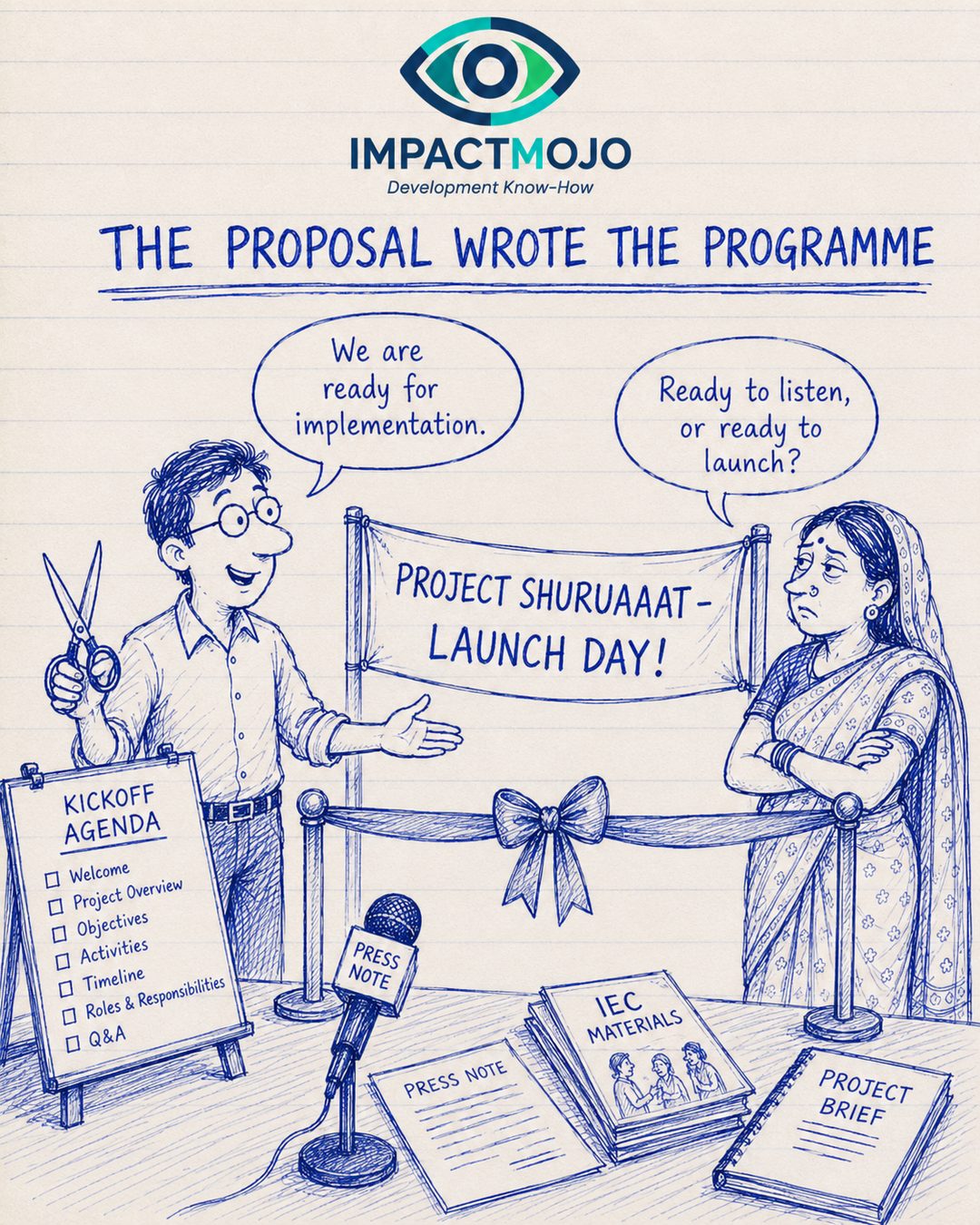
09 A man holding scissors beside a ribbon and a banner reading 'Project Shuruaat — Launch Day!' stands at a 'Kickoff Agenda' board, with a press-note microphone, 'IEC Materials' and a 'Project Brief' laid out. He says 'We are ready for implementation.' A woman with her arms crossed replies 'Ready to listen, or ready to launch?'
The claim“We are ready for implementation.” The reply“Ready to listen, or ready to launch?”

The launch as the first act

When the first event is a ribbon, a banner and a press note, the programme has optimised for visibility before it has heard anything. Sarah White’s classic typology separates this nominal participation — presence staged to confer legitimacy and display — from the transformative kind that actually shifts decisions.15 A launch day is participation as photograph: it proves an audience showed up, not that anyone asked them what they needed.

There is nothing wrong with marking a beginning. The question is which beginning. A programme “ready to launch” has prepared its agenda, its IEC materials and its brief; a programme “ready to listen” would have an inception phase before the banner, in which the design could still change. The order of those two readiness states is the whole essay.

Sources: 15

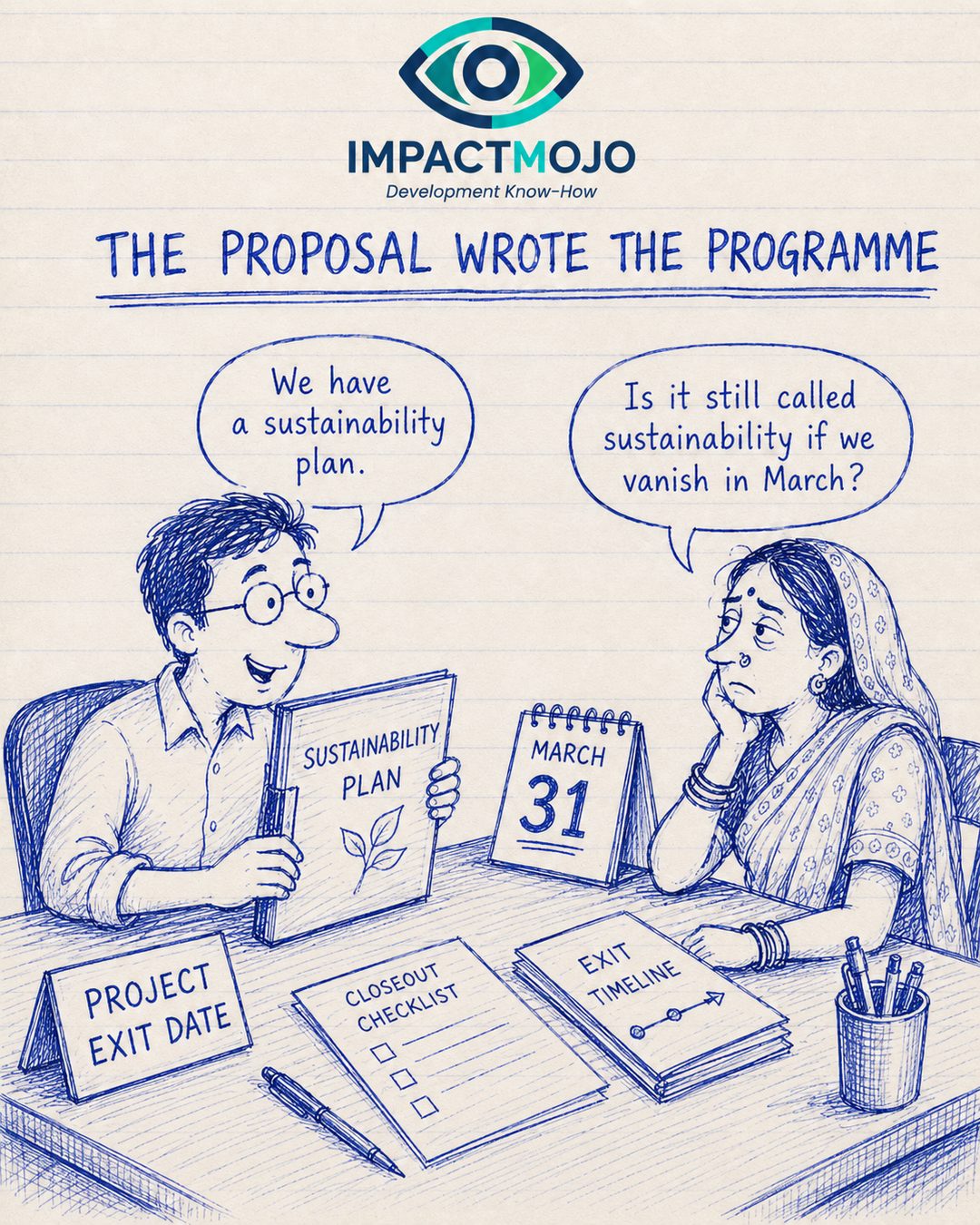
10 A man holds a folder labelled 'Sustainability Plan' next to a desk calendar showing 'March 31', with documents reading 'Project Exit Date', 'Closeout Checklist' and 'Exit Timeline'. He says 'We have a sustainability plan.' A woman, chin on hand, asks 'Is it still called sustainability if we vanish in March?'
The claim“We have a sustainability plan.” The reply“Is it still called sustainability if we vanish in March?”

Sustainability that ends on the funding date

Sustainability is a distinct OECD-DAC evaluation criterion because benefits so often look healthy at closeout and unravel within a year of exit; it asks whether anything continues after support ends, not whether a plan was filed.16 An exit dated to March 31 is governed by the grant calendar, not by whether the community is ready to carry the work — and those two dates rarely coincide.

The most detailed evidence we have agrees. Beatrice Rogers and Jennifer Coates’ four-country study for USAID found that activities survived exit only where motivation, resources, capacity and linkages were independently in place — and that handing over on the funder’s timetable, before those were built, predicted collapse.17 A sustainability plan that vanishes in March is a closeout checklist with an optimistic title.

Sources: 16, 17

A note on the joke

None of this means proposals are the problem. A sector accountable to distant funders has to write its intentions down, and a good proposal is how a scattered set of hopes becomes a fundable plan. The joke is the order of operations — when the document is finished before the village is asked, the proposal stops describing the programme and starts dictating it: the logframe that froze too early, the budget that locked before the first visit, the timeline that fits the grant and not the season, the exit dated to the money. Write the proposal after you’ve listened, leave it loose enough to change, and the order reverses — the programme writes the proposal, the way it was always meant to.

Notes & Sources

  1. David Mosse (2004). “Is Good Policy Unimplementable? Reflections on the Ethnography of Aid Policy and Practice,” Development and Change 35(4): 639–671 — design produced to mobilise funding; participation narrated afterwards. — doi.org
  2. Andrea Cornwall (2008). “Unpacking ‘Participation’: models, meanings and practices,” Community Development Journal 43(3): 269–283. — academic.oup.com
  3. Oliver Bakewell & Anne Garbutt (2005). The Use and Abuse of the Logical Framework Approach, INTRAC for Sida — on how the logframe freezes a project at the point of least knowledge. — full report (PDF)
  4. OECD (2005/2008). The Paris Declaration on Aid Effectiveness — ownership as the first principle of effective aid. — overview
  5. Matt Andrews, Lant Pritchett & Michael Woolcock (2017). Building State Capability: Evidence, Analysis, Action, Oxford University Press (isomorphic mimicry) — open access. — bsc.cid.harvard.edu
  6. Mark Tomlinson et al. (2013). “Scaling Up mHealth: Where Is the Evidence?” PLoS Medicine 10(2): e1001382 — on the proliferation of pilots that are never scaled (“pilotitis”). — journals.plos.org
  7. Tim Foster (2013). “Predictors of Sustainability for Community-Managed Handpumps in Sub-Saharan Africa,” Environmental Science & Technology 47(21): 12037–12046 — on the persistent share of non-functional handpumps. — doi.org
  8. Dan Honig (2018). Navigation by Judgment: Why and When Top-Down Management of Foreign Aid Doesn’t Work, Oxford University Press — analysis of 14,000+ projects on field discretion vs fixed controls. — global.oup.com
  9. “Doing Development Differently” Manifesto (2014), Harvard Center for International Development / ODI — adaptation requires an authorising environment, not just adaptive language. — buildingstatecapability.com
  10. IASC (2016). The Grand Bargain — the localisation commitment that 25% of humanitarian funding reach local and national actors “as directly as possible.” — interagencystandingcommittee.org
  11. Ann Goggins Gregory & Don Howard (2009). “The Nonprofit Starvation Cycle,” Stanford Social Innovation Review — on underfunded indirect costs. — ssir.org
  12. Dennis F. Thompson (1980). “Moral Responsibility of Public Officials: The Problem of Many Hands,” American Political Science Review 74(4): 905–916. — doi.org
  13. Alnoor Ebrahim (2003). “Accountability in Practice: Mechanisms for NGOs,” World Development 31(5): 813–829 (upward vs downward accountability). — sciencedirect.com
  14. Robert Chambers, Richard Longhurst & Arnold Pacey (eds.) (1981). Seasonal Dimensions to Rural Poverty, Frances Pinter — the founding study of seasonality and the project calendar. — ids.ac.uk
  15. Sarah C. White (1996). “Depoliticising development: the uses and abuses of participation,” Development in Practice 6(1): 6–15 — nominal vs transformative participation. — tandfonline.com
  16. OECD-DAC, Evaluation Criteria (2019 revision) — relevance, coherence, effectiveness, efficiency, impact and sustainability. — oecd.org
  17. Beatrice Lorge Rogers & Jennifer Coates (2015). Sustaining Development: A Synthesis of Results from a Four-Country Study of Sustainability and Exit Strategies, FANTA / USAID. — fantaproject.org